Your discipline probably does have a topic page. It is missing from Explore Topics because that page is a hand-picked shortlist written into the site by the UNI team, not a directory of everything. The great majority of topics on UNI are not on it. The page you are looking for sits at uni.xyz/topic/ followed by the topic name, and it works whether or not the shortlist links to it.
What Explore Topics actually is
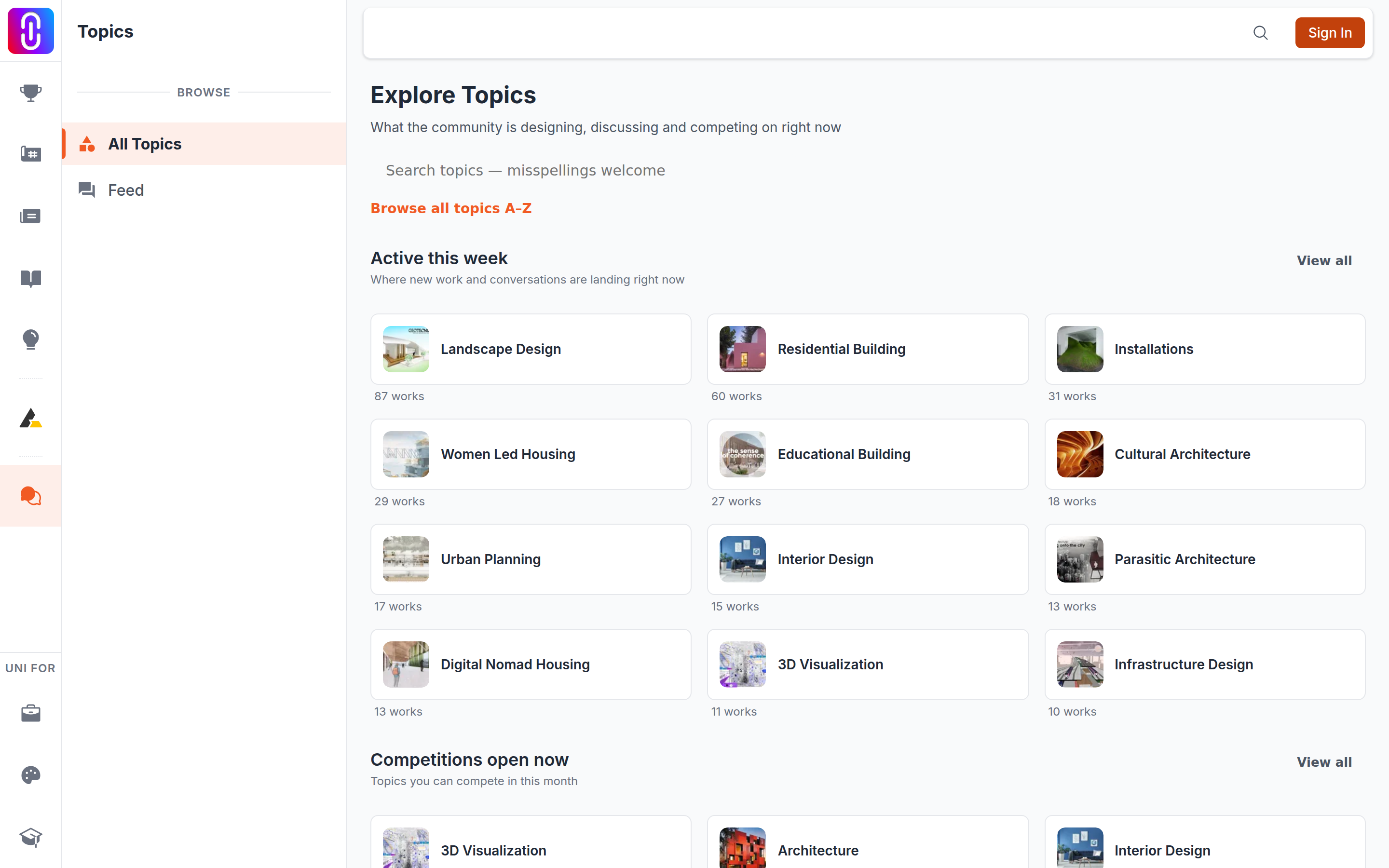
Open uni.xyz/topic/ and you land on Explore Topics. It holds eight groups, always in this order:
- Design Disciplines
- Advanced Design & Computation
- Building Typologies
- Sustainability & Environment
- Materials & Construction
- Software & Tools
- Visual Arts & Representation
- Specialized Fields
Each group holds a fixed handful of topics, and three things follow from that. They are what make the page read as incomplete.
- The list is written by hand. Topics are added to it by the UNI team. A topic does not appear on it because it is busy, because it is new, or because you followed it.
- Nothing on the page is sorted. The groups appear in the order above and the topics inside each group appear in the order they were written. Not alphabetical, not by how much work sits behind them.
- There is no search box on the page. The sidebar beside it carries All Topics and Discussions, and nothing else.
A topic left off the shortlist is not hidden, closed or deleted. It has the same page, the same tabs and the same work behind it as any topic that is on it.
Three ways to reach a topic that is not listed
- Click the discipline on a piece of work. Every project, journal and publication shows the disciplines set on it, and each one is a link straight to that topic. This is the most reliable route, because the link is built from a topic that certainly exists rather than from a name you guessed.
- Type the address. A topic's address is its name in lower case with hyphens in place of spaces:
uni.xyz/topic/rammed-earth,uni.xyz/topic/adaptive-reuse,uni.xyz/topic/3d-printing. If the name is right, the page opens. - Try the search bar at the top of the site. It can return a Topics section, but only a small number of topics are carried in it. Treat a hit as a shortcut, and treat a miss as telling you nothing: it is not a way to check whether a topic exists.
If the address does not open
Two different situations look identical from the outside.
- The topic exists but the address is not what you guessed. Punctuation and word order have to match. "3D printing" is
3d-printing, and "Landscape Architecture" islandscape-architecture. Reaching the topic from a piece of work that carries it settles this in one click. - There is no topic for that word. Topics are created by the UNI team one at a time. Tagging your work with a word never creates one, however many people use it. Why your tag does not have a topic page covers what to do instead.
One more thing to expect when you get there: every card on Explore Topics points at the topic's About tab, and About is blank for almost every topic. That is normal, and the work is on the other tabs. See A topic page opens on About.