

Envent
Design challenge to reuse E-waste
OVERVIEW
 Fig: 1 - Smartphones and their various functions
CELLPHONE IMPACT
Modern technology has empowered us as individuals and as a society, to a point we are almost superhuman. A regular person can do more today with his cellphone than entire teams of scientists and experts could, just a few decades back. Cellphones and the internet are nothing short of a superpower to us - and the best part - is they keep getting better and better.
Mobile phone technology is growing by leaps and bounds, in an exponential curve so steep that what could not have been possible a couple of years back turns into a feature we just cannot live without today. Our cellphones have become beyond smart - perhaps even intuitive - from sensing when we wake up to how many steps we have walked on a particular day to our favorite hangout spots in the city, they seem to know it all.
But have you wondered what happens to our old cell phones when we discard them for a newer and better model?
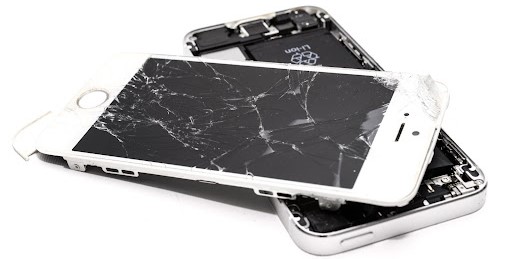 Fig: 2 - Smartphones ending up into waste because of fast outdated - A concept
E-WASTE OVERPOPULATION
Cellphones and other electronic devices when discarded form a waste that is very specific in its composition. It is called e-waste. It is estimated that 50 million tonnes of e-waste is produced each year on an average, and it is set to only increase indefinitely by about 8% a year. Heavy metals in e-waste can cause harm to not only humans but also to animals and plants, thereby polluting the entire ecosystem.
The consumption of electronics and in turn the generation of e-waste has been on the rise. While this can be attributed to many factors, the underlying undeniable reality is the large population that has access to them in urban areas. E-waste pollution is still only one problem that plagues our urban spaces that have become gravity points for population growth. There are many more issues that come up with the increasing population.
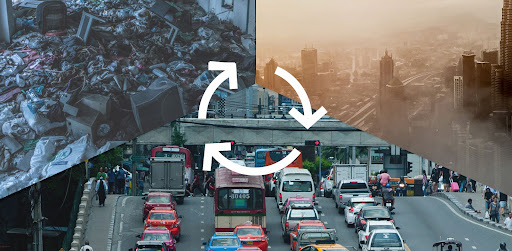 Img 3: Parallel problems in the city - A concept
E-WASTE RECYCLING
The rapid rise in population has had our urban spaces struggling to keep with newer and more complex problems that are typical with this rise. E-waste is a major issue that is tangible and quantifiable, but there are many other problems such as safety, congestion, access and transport that are far more intangible problems in a city. These also cost the economy of the city besides the well-being of its citizens.
While solving each problem in a city individually might seem far-fetched and not viable economically, Can we designers, think of systems that cross through these different problems and solve them in a productive way? Perhaps systems, where the outcomes of one problem can be solutions for another - such as can e-waste, provide us with the necessary configurations to not only reduce the discarded electronics but to provide solutions to other urban issues as well?
Nearly all the parts of a cell phone can be recycled. These e parts can not only be used in making newer cell phones but can they be used as information infrastructure to solve the numerous urban problems - in cities all over the world?
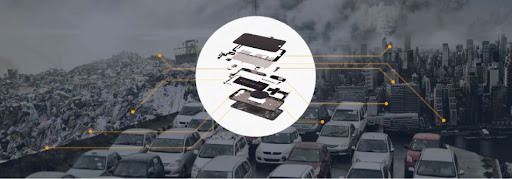 Img 4: Can these sensors be the crux of smart devices that solve urban issues? - A representation
BRIEF OF THE COMPETITION
The problems in our cities grow along with the development and growth in the population and in the activities that happen in them. Can these issues, most common of which are security, congestion, and pollution be solved with minimal, but smart infrastructural intervention? Such as the parts of a discarded cell phone that can be used to collect data and use it to make cities better, safer, and more readable.
Most discarded cell phones are still in perfect working condition and contain a plethora of components- motion, light, sound, camera, magnetic field, e-gyroscope, and a lot more. Can these sensors be used collectively or individually, in an innovative way, to tackle real-world urban problems in our present-day cities?
To identify the issue of e-waste and propose a solution in the form of an outdoor urban/street furniture (bus stand/dustbin/bench/traffic light or a hybrid or anything)
The solution should use systems based on the sensors of a discarded cell phone, and technology in a cell-phone to detect/solve/ease it in an innovative way.
OBJECTIVES
- Relevance: Select one urban issue that is applicable to cities at a global level.
- Suitability: Connecting the right component to the right issue.
- Optimize: Using the components to their complete potential.
- Sustainability: The solution should aim to create lesser e-waste at the end of its lifecycle.
The objectives can be a point of beginning to conceive this design. Participants can assume their own contexts and users before initiating their design process.
Participants may assume data wherever they find suitable to solve this challenge. The challenge will not dwell into technical details but look more at a single issue solved at a massive level through a single intervention.

