
FarmUrban
Challenge to design for farming and living
Overview
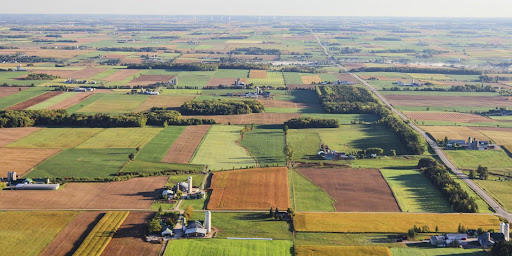 Fig: 1 -Co-existence with farming and healthy lifestyles (Credits- Sveta-Fedarava)
PREMISE
For 2.5 million years we have fed ourselves by hunting animals and gathering plants. The transition to the most important event; the agricultural revolution began slowly and in restricted groups around 9500-8500 BC.
To amplify the existing products for growing people, we domesticated both the plant and animal species. Even today with all the advanced technologies, 90 per cent of our calories come from the original or evolved versions of plants and animals that our ancestors domesticated. Today, as much as years back Earth's population is dependent on food for farming.
The only thing that has changed drastically is the sharp increase in the size of the population across the world. To meet this increased modern farming, technological developments and synthesized fertilizers have increased crop yields. But for these fast demands, unsustainable farming practices have caused widespread ecological and environmental damage.
 Fig: 2 –Trends where binge eating and watching is causing unhealthy lifestyles 9Credits-Stockphoto)
CO-DEPENDENCE
In-between eating direct farm produce to buying natural products through multiple channels, our relationship with food has drastically changed. Farming, an important aspect of our daily lives, is now an activity of ignorance and exploitation. Our city models are being crafted around fast life and convenience.
This has decreased the transparency of production, distribution and consumption. From open markets for exclusive products to supermarkets and malls that provide attractive products under discounts, the way we consume food is modifying at a fast rate. While more sustainable and technologically advanced businesses in farming are coming up, they are limited to a few who can afford time and money on it.
More than half of the population is experiencing either food surplus or food shortage. Such unhealthy and unbalanced patterns of buying and eating is adding to the pressure on the environment and existing farming activities.
How can we change the scenario? Can we bring sustainable farming in a way that affects more than just a few groups in the community?
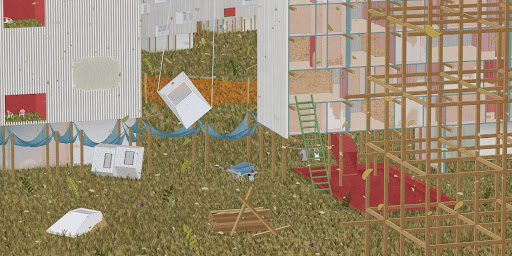 Fig: 3 – All that solid melts into the air-Living units and farming- A concept (Credits-Ninad/Transfarm)
BRIEF OF THE COMPETITION
Agriculture flourished around fertile soil and easy access to food. This in turn influenced the development of households, communities and gradually entire cities around it. The typologies of communities/cities that valued agriculture have changed and we are starting to forget where our food comes from.
Our dependency on food will always remain, but the nature of dependency will vary on our choices today. Can we take this opportunity to make a more healthy choice? Modern farming technologies have changed the scenario of farming, but in a way that is inaccessible and unsustainable. There is an urgent need for efficient agriculture for an ecological balance of the entire planet.
How can we make these farming technologies more accessible and sustainable? Bringing back the conditions that started farming and in turn communities around it is impossible, but can we develop living around modern farming?
The design challenge here is to develop units that comprise living around farm units.
The aim is to bring farming as a primary activity to the city in the form of modules where people can live, participate, indulge and involve themselves in understanding how the food they eat is made.
OBJECTIVES
The farm units we are looking for takes on a different approach to the use of the land: instead of exploiting resources to the maximum, it aims at repairing the damages caused by us.
- Balance: Design to establish a synchronised living
- Mindset: Changing the perception of agriculture by education and self-experience.
- Functions: What would the functions and type of your spaces for your farm units and living as well as other activities around it look like?
- Modular: The module should be flexible for it to be replicated as required.
The objectives can be a point of beginning to conceive this design. The user group for the conception should be able to house 100-120 families (a family of 2-4). Other facilities may be designed following the user group in the same structure or different zones.
Participants can free to form their programmatic outline according to the user group. The competition challenges you to reinvent the typology of farming and living which has been with us since the beginning of times. This may comprise enclosed structures for living, plants and animals, spaces for storage, and working of farming technologies and machines.
PROGRAMMATIC OUTLINE
- Infrastructure for farming 20%
Food supply, production, water storage, infrastructure, water systems, stores
- Farms and living 65%
Garden, home units, workshops, community farms, community space, social facilities
- Services 15%
Administration, Storage spaces, surveillance room, electrical room etc
SITE
The site chosen for this design exercise is hypothetical and can be associated with a peri-urban region around any city of the world. The design context is independent of the site context and a detailed study is not required; you may assume a certain place in the world of your choice with a Site Area of 5000sqm.




