
HEAL+
Regenerative housing for Kerala
OVERVIEW
The Premise
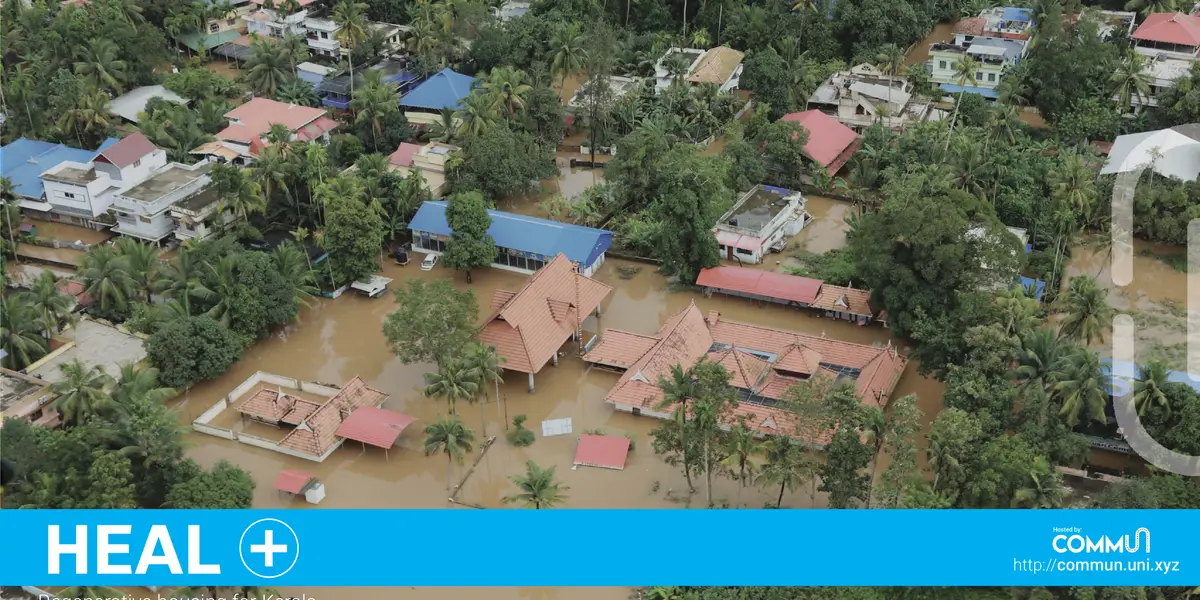
Urbanization, the key to the future – a good or a bad one at that? In August 2018, Kerala & some parts of Kodagu, India faced one of the worst Floods of the century, with 300+ deaths and infrastructure damages over Rs. 8,000 crores (1.1 Billion USD). Every time disaster hits, we as humans do everything in our power to suppress it, provide aid and rehabilitate. But even the most advanced prevention systems and methods fail. The only way out is to fold how humans grow and work together + towards living with the forces of nature collectively.
During flood?
There are different levels of damages in a flood situation - ranging from limited water logging to total wipe-out. This leads to transportation hamper, slow degradations of infrastructure, and a lot more. Many people have to build their lives over again, with all their belongings lost. The damage can be of physical assets at the same time irreparable life losses which make things even tougher.
These conditions are not very surprising to note, but the sequence and multiplied chaos they cause is what makes floods a very lethal threat in their entirety. Beyond the physical catastrophe, the mental part of a flood victim works in a dilemma whether to hold on or let go which causes the most trauma. How long do I stay? When will things go right? When will help come in? Or will the help come? And there are much much more.
After the flood?
A series of events follow after the flood where people try to rebuild their lives after claiming aid from insurance agencies, savings, and government aid that is given to affected areas based on losses of property and lives. The already struck down transport network has costs of resources surged which makes the rebuilding slow and even more costly. With already a weak support/resource/ strength they are burdened not only with survival but challenges that are beyond generic living.
As they start rebuilding their lives the priorities are still running different ways where every person is running again for himself/herself. Can this change?
What is our reality?
India has a huge territory with the world’s second-largest population to nourish. These two divided factors make the top-down approach in dealing with disaster relief and planning issues very complex. With a huge coastline with rivers running across the subcontinent, the scope of the problem is wider than just a state. Larger cities with concentrated populations have structured urban management policies, and are easier to cater to. With around 70% of the population still in villages and in peri-urban areas, this makes the marginalized communities too scattered to be helped. A larger action plan after the disaster is not enough, but it requires a two-way action. We have to make solutions that can scale.
The Questions
With floods being an inevitable problem with drastic climate change and rising sea levels,
- Can we build habitats that accept water surge as a reality?
- Can we design buildings that help people to get back on their feet much faster than before?
- As everybody is rebuilding in the same battle can they do it together?
- If India is too big to be planned ‘outside in’, can we create habitats that are planned ‘inside out’?
- If a flood rises to a wipeout situation can there be places of refuge built or made accessible beforehand?
- Can habitats be prepared for the next disaster already irrespective of time while rebuilding?
Response to crisis
In a situation of crisis like this, the whole country came together to support Kerala by sending aid and relief - in an unprecedented amount. But what stood out was the contribution made by people who came down to help the affected areas. From fishermen to the local population, every contribution coupled with the Government’s swift efforts enabled Kerala to hold back against the storming waters. It’s evident that we work together in a situation of crisis, which is the most beautiful gesture humanity exhibits.
But what happens after the crisis? When we get back into our struggles of getting lives back together, why can’t we make an effort for safeguarding our neighbors as it will safeguard us in return as well?
The Design Challenge
Brief: A ‘community regenerative housing’ proposition that is scalable, heals when damaged, and regenerates faster than before when broken down.
The design problem is to build a unit micro-neighborhood for 100 families, with a case of use established in Aluva.
Housing development in most of the peri-urban and rural Kerala is organic and spread out which cannot change. The state government cannot bring forces to secure each of these households, with its limited funds/strength. The challenge is to gather 100 households that work together to make a habitat that stands/works together in a situation of a flood.
The problem is expected to be answered at a point in time in a post-flood scenario, where people are rebuilding their partially damaged/wiped-out /degraded homes. The idea is not to spend all the private resources of a person on a planned cooperative housing redesigned from scratch, but on pre-conceived shared systems that help to sustain the direct (residents) and indirect population (marginalized communities, livestock, etc.) of this unit neighborhood which contains households/owned plots already.
The shared systems can help battle floods, or store essential items, or build places of refuge, or have a function designated to these colonies, etc. for 100 households at a time by the people. The next step would be how a top-down entity (government) help these unit neighborhoods and make them thrive at a large level integrating them into an action plan in the next hazard scenario
Program Guidelines
As the existing houses are not in a uniform state, we limit the ideation to concept-level ideas only. The structure of ideation here will be the factor of commonality.
The program is targeted towards the concept of a family housing of 5 people per family. The major economic strata are defined as people who cannot afford to hire technical experts Eg: Architects/Engineers (in post-flood scenarios and mostly planning to construct everything on their own). Aspects like costing and finances will not be a part of this submission, but the key here is incrementally growing to a robust habitat or a place that quickly adapts to sustain its people.
The submission has to be made in 3 major outlines in ‘Short & Long term’:
-
Action Plan - Overall plan of the affected region in the post-flood scenario.
-
Master Plan - Multi-unit neighborhood plan working.
-
Dwelling unit Concept - House/Street level concept.
You may use the site plan(in the additional materials folder) to begin the design with the context plan in the larger volume. Existing houses are placed as an organic housing settlement would be. A few partially damaged houses are also kept in place to explore ideas to use these houses as well. The direction of idea building is up to participants from dwelling unit level to an action plan or vice versa, or any new method, but the information has to be structured/or has to begin in above 3 levels only.
Short-term is the next 1-year action, long-term can change as your concept evolves. The idea should compound the security/safety of the whole unit by each passing year.
Similar Competitions
Discover competitions you might be interested in


