
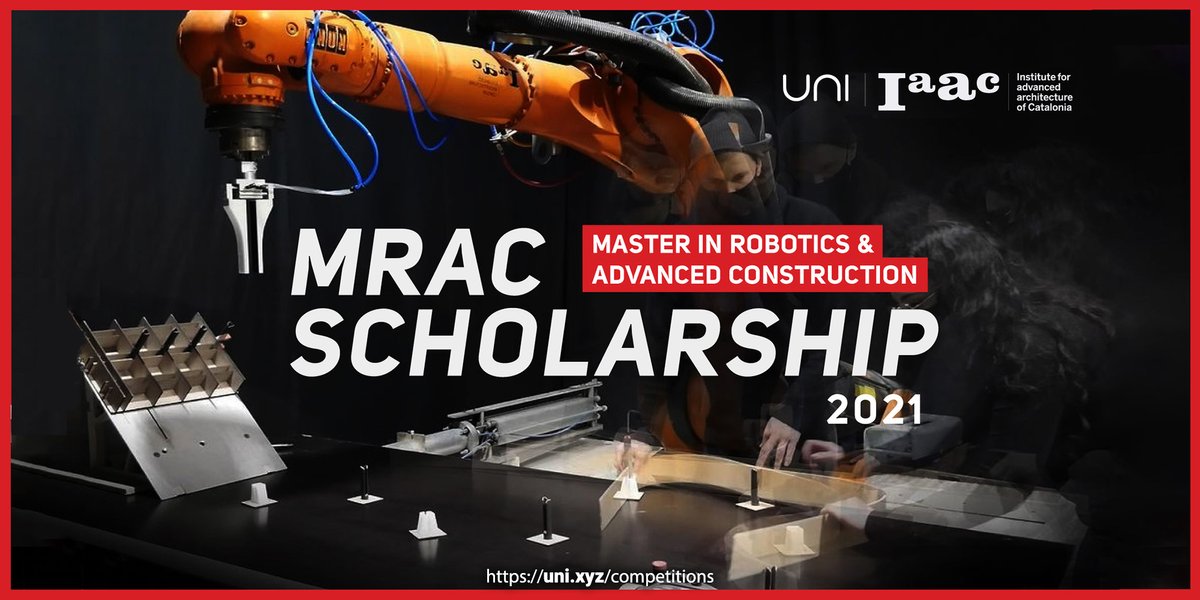
IAAC MRAC Scholarship Challenge 2021
Architecture Scholarship Challenge
MRAC Program
INTRODUCTION
The Master in Robotics and Advanced Construction (MRAC) seeks to train a new generation of interdisciplinary professionals who are capable of facing our growing need for a more sustainable and optimized construction eco-system. The Master is focused on the emerging design and market opportunities arising from novel robotic and advanced manufacturing systems.
Through a mixture of seminars, workshops, and studio projects, the master program challenges the traditional processes in the Construction Sector. It investigates how advances in robotics and digital fabrication tools change the way we build and develop processes and design tools for such new production methods.
The MRAC offers an international and multidisciplinary environment where engineers, designers, architects, craftsmen, academics and industry partners have the opportunity to rethink the construction industry. The master will take place in the Institute for Advanced Architecture of Catalonia, a creative space fully equipped with the most recent manufacturing technologies, in Barcelona, an international hub for innovation in a traditionally rich industrial region.
CONTEXT & AGENDA
The construction sector is currently faced with a need for change. A new approach towards how our environment is built must be taken. Growing cities are challenging the sector to find better ways to build more and at a lower cost. Furthermore, the limited resources that we have on this planet push us towards a more sustainable way of building, inhabiting, and reusing our constructions. On top of this, an aberration from mass-produced cities indicates a need for a more holistic design, integrating the various needs and desires of the inhabitants.
In addition to this, the construction sector has not yet taken advantage of the digital revolution that is happening in other manufacturing sectors, such as in the automobile and aerospatial engineering industries. While studies predict that Automation, Robotics, and AI will possibly increase productivity by 60% in the construction sector, they also open new opportunities for design and for increased building performance.
In this context, IAAC proposes a new interdisciplinary program where prospective students can expect to learn about the state of the art in Robotics and Advanced Manufacturing technologies, as well as theory and practical tools of computational design and artificial intelligence. Master candidates will become fluent in the use of these technologies through continuous hands-on experiments, methodology, and a series of workshops and pilot projects with research and industry partners.
ACADEMIC STRUCTURE
The Master Programme in Robotics and Advanced Construction is an innovative educational format that offers interdisciplinary skills and understanding through a series of class seminars that are put into practice through hands-on workshops. IAAC gives students the opportunity to create individual studio agendas and develop Pilot Thesis Projects based on the knowledge acquired during the seminars and workshops split into 3 Modules. In this way, IAAC puts together an experimental learning environment for the training of professionals with both theoretical and practical responses to the increasing complexity of the construction sector.
The master offers a flexible structure to allow both full-time or part-time dedication to the master. Full-time students can complete the program in 1 academic year (October to July) while part-time students can complete it in 2 academic years. Monthly encounters with professionals and researchers are condensed into one week of seminar lectures and hands-on workshops per month and are combined with online classes and video conference reviews to offer the possibility for students to study from abroad with part-time jobs.
Full-time students will have the possibility to develop their own studio and thesis project during the 3 remaining weeks of each month, while part-time students can extend their study over 2 years to complete the studio and thesis project and acquire the master's degree.
Students will be part of a highly international group, including faculty members, researchers, and lecturers from all over the world, this environment will encourage them to develop collective decision-making processes and materialize their project ideas.
The Master in Robotics and Advanced Construction offers students the possibility of pursuing the program in 4 different modalities:
– MRAC 01 – 9 month full time, 75 ECTS
– MRAC 01 PT – 18 month part-time, 75 ECTS
– MRAC 01 + OTF – 15month full time, 120 ECTS
– MRAC 02 – 18 month full time, 120 ECTS
The MRAC program comprises the following elements:
T. – THEORY SEMINARS
S. – SOFTWARE SEMINARS
H. – HARDWARE SEMINARS
W. – WORKSHOPS
R. – RESEARCH AND DESIGN STUDIOS
V. – VISITS
MRAC 01 First year
Term 1 – Materialising with Machines
Human to Robot, From Digital to Physical - 24 ECTS full time or 15 ECTS part-time
Advances in File to Factory workflow allow for precise and complex constructions. In this new paradigm, the architecture will be mass-customized, constructive logic will be encoded, new materials will be introduced and materiality will be programmed.
During this first term, students will explore the possibilities being already offered by digital fabrication and computational design to gain control over the entire process of materialization from digital to physical, from the human intention to the robot execution. A special focus will be given on the challenges and opportunities raised by Robotic and Additive Manufacturing for construction.
Topics
- S.1 – Software 1 : Algorithmic Design
- H.1 – Hardware 1 : Robotic Actuators
- T.1 – Theory 1 : Materialising with Machines
- R.1 – Research Studio 1 : Robotic Craft
- W1.1 – Workshop 1.1 : Additive Manufacturing
- W1.2 – Workshop 1.2 : Subtractive Manufacturing
Term 2 – Scanning and Learning machines
Robot to Human, From Physical to Digital - 21 ECTS full time or 15 ECTS part-time (studio is excluded in the part-time students)
Advances in data collection (sensors, drones, …) and analysis (optimization algorithm, AI, …) allows for better integration of the construction-specific challenges such as site monitoring and adaptability, heterogeneous materials, inventory management, assembly tolerances, changing climate conditions, and team coordination.
During the second semester, students will integrate increasing amounts of data in their workflow, using robotic sensing and digital simulation to get new information about the construction process. Physical computing and analytics will help drive new decision-making processes including iterative logic, computational optimization, and artificial intelligence.
Topics
- S.2 – Software 2 : Robotic Control
- H.2 – Hardware 2 : Robotic Sensors
- T.2 – Theory 2 : Scanning and Learning Machines
- R.2 – Research Studio 2 : Robotic Sensing
- W2.1 – Workshop 2.1 : 3d Scanning in Construction
- W2.2 – Workshop 2.2 : Adaptive Fabrication
Term 3 – Human-Machine collaboration
Robot with Human, Mixed Realities – 18 ECTS + 12 ECTS Master Project full time or 15 ECTS part time (studio is excluded in the part time students)
Advances in Human-Machine Interactions and mixed realities allows for seamless collaboration between humans and robots in factory and construction sites, taking advantages of the best of both virtual and real world.
During the third semester, students will extend their skills and perspectives towards new devices and strategies that combine existing manual constructive methods with the digital and robotic ones. This new digital craftsmanship in factories and construction sites will be the scenario students will use to explore the potential of collaborative robots and Augmented Reality for the construction sector.
Topics
- S.3 – Software 3 : Machine Learning
- H.3 – Hardware 3 : Robotic Interaction
- T : Theory 3 : Human – Machine collaboration
- R.3 – Research Studio 3 : Final Project
- W3.1 – Workshop 3.1 : Collaborative Robotics
- W3.2 – Workshop 3.2 : Swarm Robotics
MRAC 01 Part-time modality
IAAC offers students the possibility of pursuing this Master’s degree through both full-time and part-time modalities. While the full-time modality consists of a 9 months program along the course of one academic year, the part-time modality consists of a 9 + 9 months program along the course of two academic years.
The MRAC part-time format has been designed for all those interested students and professionals with part-time jobs from Spain or abroad, to attend the courses. The format combines online teaching content and remote reviews with intensive weeks to allow students to manage their work/study balance easily, with a required presence of only one week per month in Barcelona, and one day per week required availability for remote reviews. In detail the two-year format unfolds as follows:
• During the first academic year of the MRAC 01 part-time modality, Seminars will be arranged in remote for the students not to miss any classes and reviews, while physical attendance will be required in IAAC 1 week every month for the following content: one kick off intensive seminar week, happening the first week of each term; two intensive hands-on workshops lasting one week each, happening at the beginning and closing of each term.
• During the second academic year of the MRAC 01 part-time modality, students will focus on their research project to be developed in the MRAC Studio of each term, with online classes and reviews. Every month, the students will come to IAAC for one week to produce their prototypes and to take part in scheduled visits at renewed industry and research centers.
MRAC 01 + OTF
MRAC 01 First year + OTF: 3D printing Architecture
The Master in Robotics and Advanced Construction first year can be combined with the complementary program OTF : 3D printing Architecture. This allow students to apply the knowledge learnt into this unique applied research program center into the revolutionising technology of additive manufacturing for the construction of sustainable architecture. For more information, please see the dedicated page about the OTF program: https://iaac.net/otf
MRAC 02
MRAC 02 Second-year – Research Thesis
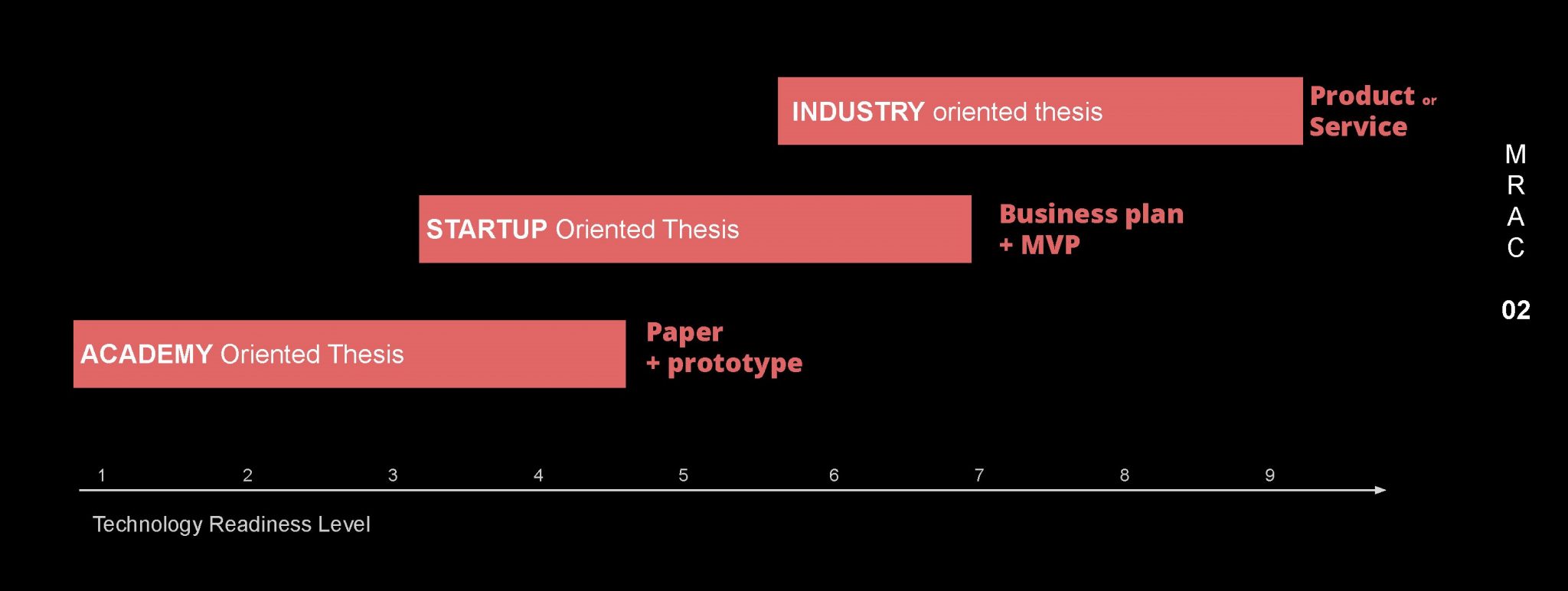
Targeted towards students’ future careers in Academia, Start-up, or Industry, the second year of the Master in Robotics and Advanced Construction offers the occasion to develop a thesis project with the support of IAAC infrastructure, experts, and network, with the goal to maximize its impact on our society.
Students can choose to work either individually or in a group and can propose their own topic and the collaborative company or choose from the one proposed by IAAC and its strong partners. The development of the project will be supported by advanced seminars in Technology, Theory, and Business to bring the proposal state of the art research that can really impact the construction industry. To this end, students will collaborate with one specific industry/academia or incubator to develop their project, with a series of internship immersion in the collaborative company as well as review and support directly on the thesis project.
In parallel to the development of the Thesis Project Studio, the second year of the Master in Robotics and Advanced Construction offers a series of seminars enhancing both the theoretical, practical, and digital skills of the students. Students will also have the occasion to join cross-disciplinary workshops to build large prototypes and installations.
Topics:
• R.4 – Research Thesis
• Academy track
• Startup track
• Industry track
• RS.1 – Research Support 1: Economics of Sustainability & Impact/LCA
• RS.2 – Research Support 2: Advanced Technology – specific to the project
• T.4.1 – Theory 1: Research Methods
• T.4.2 – Theory 2: Business Innovation
• T.4.3 – Theory 3: Market for Industry Research
• W.5 – Workshop 5: Cross-Disciplinary Project
• W.5 – Workshop 6: Cross-Disciplinary Prototype
• I > Internship at collaborative Industry / Academia / Incubator
Learn More about MRAC Program - https://to.uni.xyz/mrac-pdf
Similar Competitions
Discover competitions you might be interested in



Design challenge to reuse E-waste


Illustrate the lost glory of Angkor Wat - Render Challenge

Photograph architecture without architects


Challenge to reimagine the Iron Throne
