Overhaul 2020
Designing service stations of tomorrow
Overview
Premise
In 2015, over a billion people migrated: 244 million went abroad and 763 million moved within their home country. In search of a new opportunity, for a better quality of life, to escape violence or an ongoing disaster.
As the century drew to close, a broad-based rehabilitation of the central city as the place to work, live and study has dominated the landscape. This has led to an increase in population and a change in demographics. Among them are young adults. Almost 30 percent of the young adults aged 18-34 in the United States are either foreign-born or of foreign parentage. While Canada saw an 18.5% increase in 2018, international students studying in Amsterdam saw an increase of 8%.
In pursuit of better opportunities and fulfillment, more people are choosing to travel abroad. This trend is envisioned to grow as the change gets reflected in the urban fabric of the city.
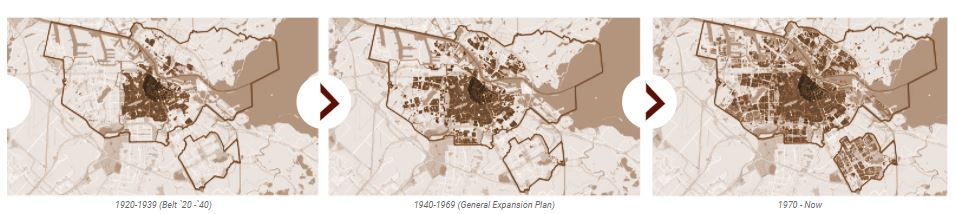
Img 2: Built density of Amsterdam growing over the years Source
Evolution
The influx of migrants and refugees has seen the borders of many cities expanding in the last few decades. As of 2017, Amsterdam’s population is anticipated to increase by 23% up to just over a million in 2040, mostly due to migration.
Over the past century, one of the biggest urban development challenge for the city has been densification. 19th-century buildings are being demolished to accommodate the growing housing crisis. Along with construction on green wedges and land expansion outside the administrative borders has led to the present city fabric.
Though the city council has proposed housing solutions to integrate the permanent residents. It’s the temporary residents like international students, planning to study in the city who are at loss.
Img 3: 8% increase in population of international students in Amsterdam. Source

Issue
While students are pursuing their education abroad, they encounter numerous issues in social settings. Adjusting to a new way of living can become overwhelming, as it often differs from what one has identified with all their lives. With university and work being the only place to socialize, it becomes difficult to build a network.
They account for 11.5% of the total student body at Amsterdam University, twice the number 10 years ago. (Source) Due to reported straining of city housing and course availability for Dutch Students, University of Amsterdam now aims to reduce its influx.
The student housing crisis has also led to a high demand for inhabitable rooms and fraudsters taking advantage of the unaware. Many students were forced to live in tents while some had to leave the opportunity to study in the country. Students, who don’t have the avenue to network and find a trustworthy source for an accommodation became vulnerable.
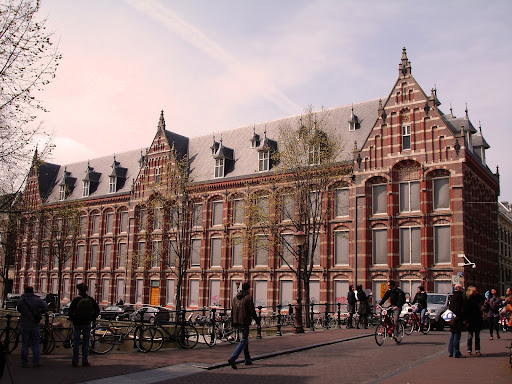
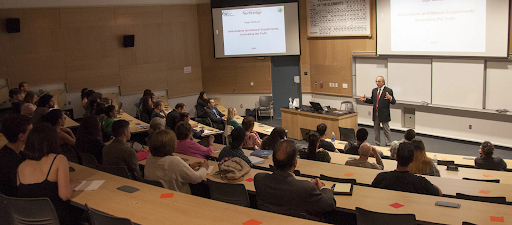
Img 4: Students leaving after a day end at University of Amsterdam. Source

Brief of the competition
The world’s 12th best city in terms of 'quality of life', Amsterdam is known for its cultural inclusivity. Despite government policies formulated for inclusion of migrants, the internationalization of education has been a point of debate for years. 2018 report by OECD reported that about 51% of the population agrees that foreigners who live in the city are not well integrated.
Intercommunal interactions must occur for people to adjust. These adjustments are complex, ambiguous and carry a temporal sense of identity. A space, a stepping stone that facilitates the process of inclusion into city fabric. An avenue that helps students feel belonged to society and help in preserving one’s identity.
Brief is to design a community center for 100 international students (age 19-35). The creation of the space aims to enable international students to find gateways into familiar circles of the city and find an overlap with the locals.
Objectives
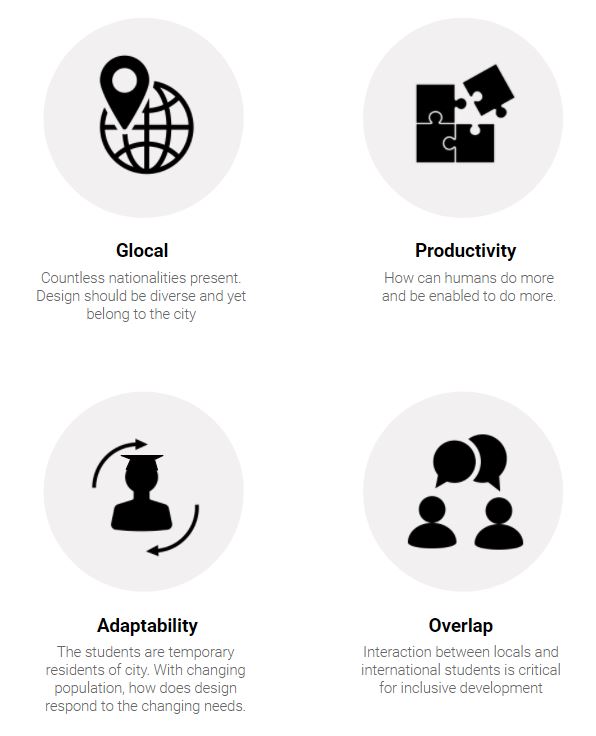
The following objectives can be a point of beginning to conceive this design. Participants can assume their own contexts and users before initiating their design process.
The community space will be a stepping stone, that facilitates smooth inclusion of international students into local fabric. Besides resourcing their needs in a foreign land, it will be a space of interaction between locals and students. An avenue to celebrate their culture, and make it familiar to the people of Amsterdam. Also a platform for students to be self sufficient by earning credit or money.
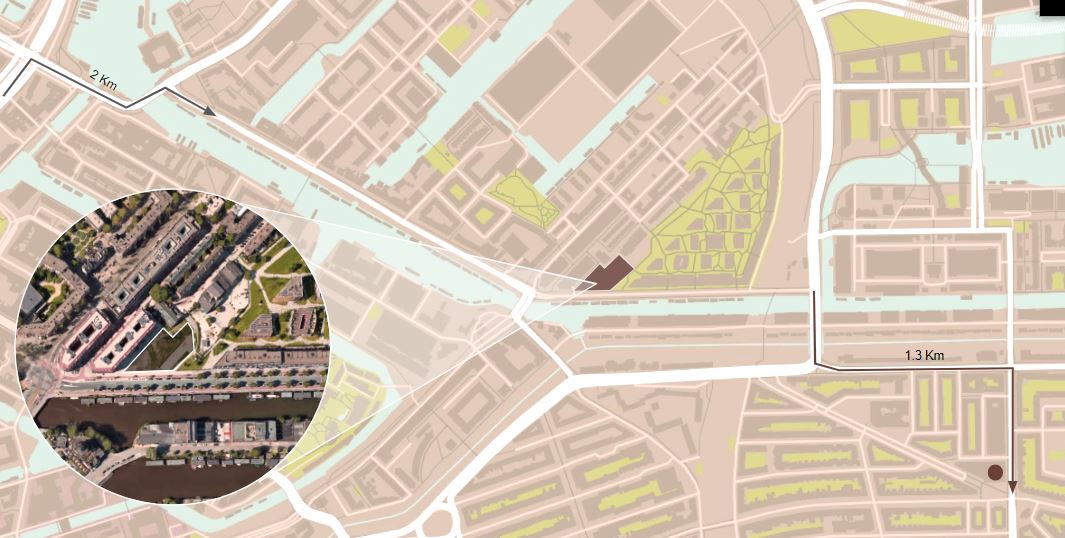
Img 5: Left -Site Plan. Right - Location of site in larger context
Czaar Peterbuurt, Amsterdam
Once an industrial suburb, Czaar Peterbuurt has blossomed into a hub of food, drink and shopping since 2014. The area directly borders the city center. The site is adjacent to mix used development, with restaurants and grocery story outlining the ground floor while accomodation and offices sit atop. Residential plot and child care center completes the contextual fabric. Site is 2km away from Amsterdam School of Arts, 1.8km away from Academy of Architecture (same direction) and 1.3km away from community college - Volksuniversiteit Amsterdam. Sports Complex at a walking distance of 300mprovides requirment of physical activity.
- Site Area - 2500 sqm
- Coordinates - 52°22'03.9"N 4°55'39.2"E
- Maximum Ground coverage - 100%
- Maximum Height - 24m
- Setback - 2m
- Build Up Area - 4600 sqm
Programmatic Outline
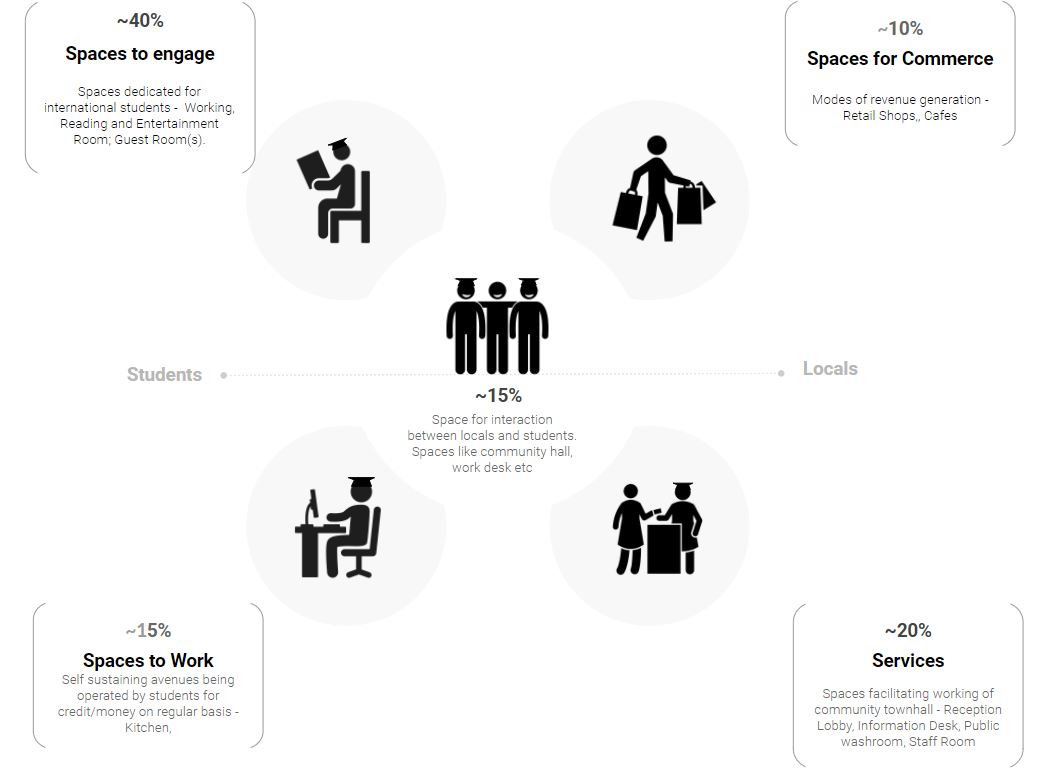
Participants can alter the area programme according to the design concept and intent. Participants don’t have to necessary detail out individual spaces.