
Rebuilding Mordor
Challenge to imagine architecture inspired by fiction
Overview
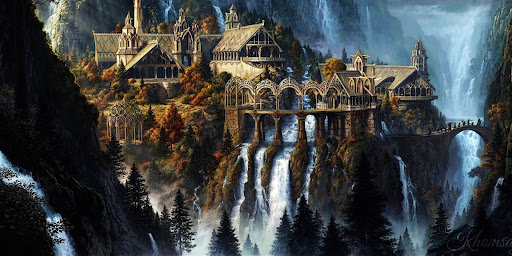 Fig: 1 - Stories like Lord of the Rings portray architecture at its best (Credits- Rivendell by Mahdi Khomsaz)
ARCHITECTURE AND FICTION
Art and architecture have had a long-standing and significant relationship. Overtly art emerges as a form of expression whereas the goal of architecture is to create cohesive and functional spaces for human settlement.
However, under the surface, both art and architecture influence each other and create for its audience potent experiences steeped in the engagement of the senses. Within this nexus exists the world of fiction. Fiction and its sub-themes such as fantasy and science fiction have often dealt with magnificent worlds that thrive in the realm of imagination. These worlds pose intriguing contexts that are often far different from those of our own world that have in time become exceedingly familiar.
In turn, they allow us peacemakers to play and challenge our skills by imagining fantastical possibilities in artificial contexts with novel and contrived challenges.
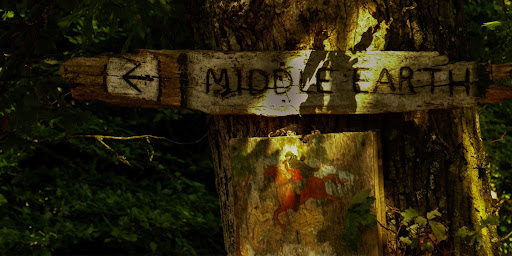 Fig: 2 -Lord of the Rings is based in middle-earth, consisting of beautiful and barren landscapes ruled by various powers including Mordor (Credits-Nick Fewings)
LORD OF THE RINGS
Mordor translates to the Black Land or the dark land in Tolkien’s contrived language of Middle Earth. The arid wasteland was Sauron's seat of power in the southeast of Middle Earth. It was flanked on three sides by mountain ranges with the deep valley Of Udûn on the northwest corner acting as one of the few entrances and thereby the site of Sauron's Black Gate.
Mordor’s bleak geography was ideal for defence against enemies with unscalable mountains, the broken jagged land of Gorgoroth and Núrn, and the unfriendly dry plains suffocated by the fumes of Mount Doom.
In the Third Age the lands became home to the Nazgul, Ringwraiths and Orcs, all members of Sauron’s army against Middle earth. The land ruled by the dark power presents intriguing extreme geography that was unwelcoming and unsuitable to live among the peaceful people of Middle Earth.
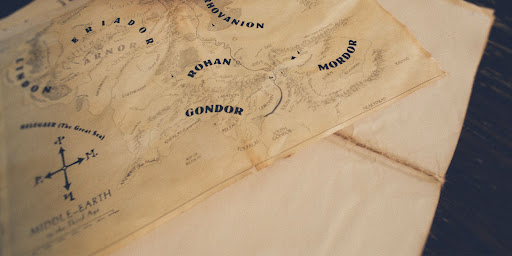 Fig: 3 - Can we imagine the grandeur of the LOTR universe in its very own barren and cruel lands of Mordor? (Credits-Liam Troung)
REIMAGINING THE LANDS OF MORDOR
Fictional worlds, especially ones as elaborately detailed as Tolkien’s Middle Earth, offer imaginative and exciting opportunities in novel geographical settings. While these worlds may not exist in our plane of existence they offer us opportunities to push our skills to adapt to extreme conditions.
Brief: For this challenge, the fictitious context chosen to tickle the imagination, is the deserted black lands of Mordor. You must imagine and visualise a future city in Mordor in the years after peace was restored.
The city should be designed in a way that it responds to Mordor’s extreme climatic conditions and harsh terrain but still be comfortable and inviting to new peaceful habitants of Mordor. The design may be inspired by the existing architecture of middle earth or envision an entirely new typology for the lands.
OBJECTIVES
- Learn: Understand the history and prevailing conditions of Mordor.
- Respond: Consider the interventions one may employ to respond to Mordor’s extreme conditions
- Ideate: Ideate a habitable future for those who move to Mordor.
- Represent: Create a visual representation of a possible city in Mordor.
SITE
The Site for this project is Mordor as mentioned. The dark plains of Mordor are flanked on three sides by Tall mountains and are characterised by the arid, broken lands of Gorgoroth. To the south of Mordor lies the lands called Núrn, a was slightly more fertile land watered enough to hold the inland Sea of Núrnen. Nurn was slightly more fertile because the ash blown from Mount Doom left its soil nutrient-rich, thus allowing dry-land farming.
To the west of Mordor lies the land of Gondor with Ithilien, the city of Osgiliath and the great river Anduin, while directly East of it was Rhûn, and to the southeast, Khand.
You might choose any part of the land of Mordor as your site, but your design must respond to the micro conditions of the area you choose.
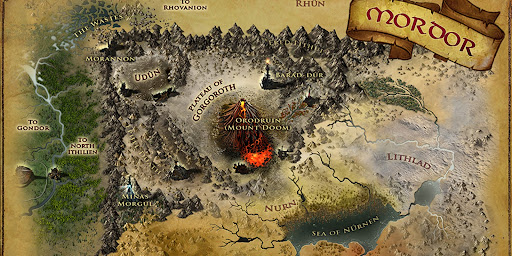 Fig: 4 - Map of Mordor (Credits-LOTRO Wiki)

DELIVERABLES
You have to deliver a graphic/visual outcome representing the given theme, based on the following outlines. Only one final graphic design needs to be submitted. The image should be of size [2800px x 3200px] in portrait or landscape digital format (JPEG only).
The graphic may be entirely hand-drawn and rendered, digitally created, or a combination of both. The usage of photographs, stylized/credited or otherwise, directly is strictly not allowed.
The use of lassoed graphics lifted from an existing image is limited to half of the total graphic. (The guidelines are indicative, and are placed only to reduce plagiarized artworks – any infringement detected or reported will be notified, and may be removed from competition if found guilty)
The list of deliverables are:
1. Title
2. Subtitle
3. Visuals x 3
4. A few process images
5. Additional cover image of 2000px x 1000px
6. A statement in about 100 words supporting the artwork - You can attach this as an additional image below your artwork.
