
Container City - Modules by the Sea
Contained Living? Not quite.

From the 1960s onwards, containerization has been the defining design change in the push towards an increasingly globalized economy. Almost every object we use nowadays has at one point or another travelled inside of a standardized shipping container, and there is a strong case to say that we now live in a world as interconnected as there ever was because of these objects. However, this ease in connectivity has made the shipping container a relatively silent actor in the process of globalization, becoming so effective that in a way it is taken for granted, becoming invisible. Yet, the undeniable materiality of the container is an essential aspect of containerisation – even if it only becomes more visible when it causes issues to the global logistics system, such as is the case with the grounding of the Ever Given in the Suez Canal.
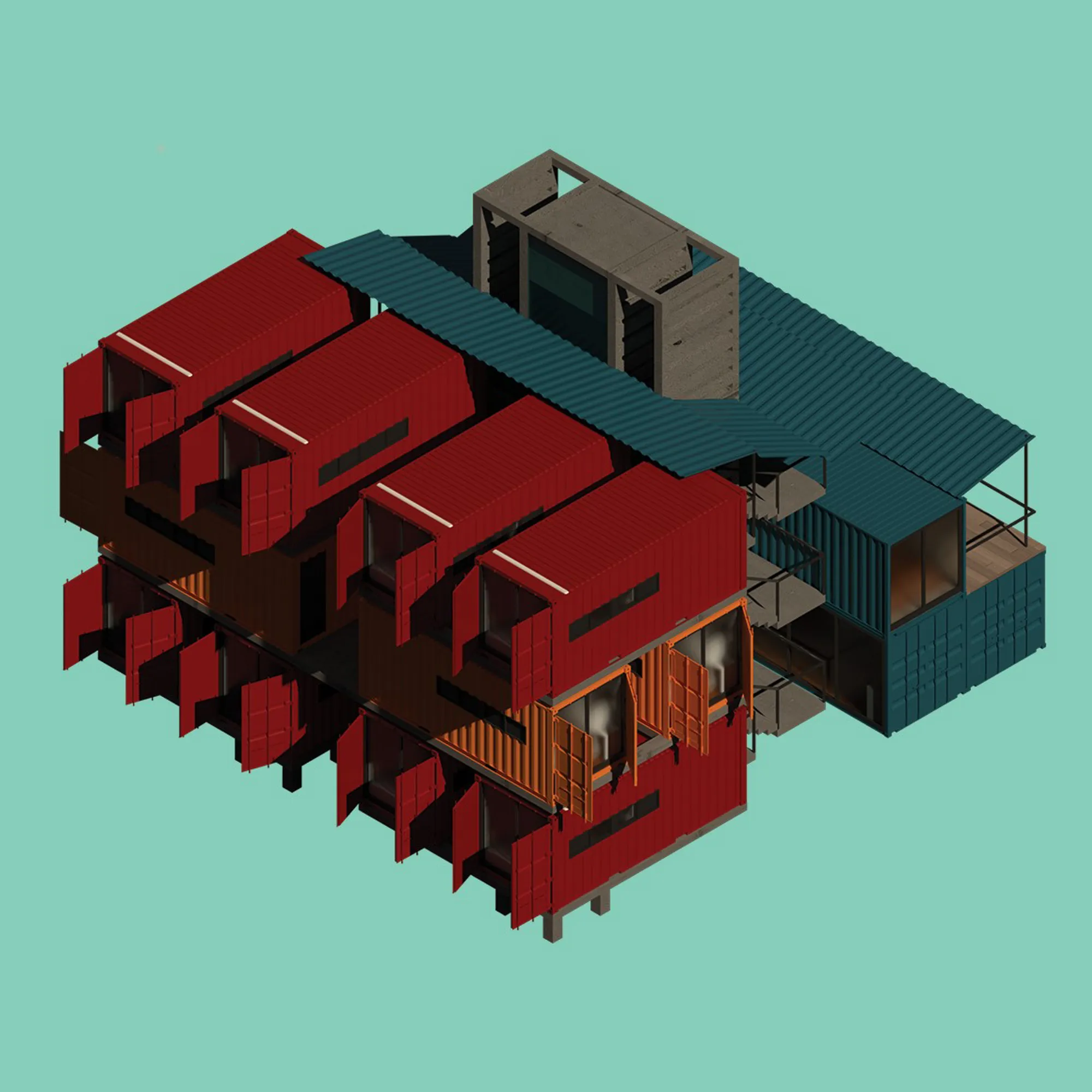
Materiality became an important aspect when creating the concept for our ‘Container City’ entry. However, two different approaches were taken when considering this aspect. On the one hand, using Craig Martin’s seminal work Shipping Container and other Design History studies on containerization, the seemingly accidental human scale of the container was highlighted. This object is not only streamlined for efficient intermodal transfer, but it also presents dimensions very suited to the creation of a comfortable living environment. On the other hand, concepts on modular architecture, particularly from the Japanese Metabolism movement, gave inspiration to a modular take on shipping container architecture, considering its potential for both built order and organic dynamism.
The key concepts for our site, then, were centred around creating a space that fit a human scale and that represented a more dynamic, mobile view of the shipping container. The spaces created would give options to the student users, between communal and private areas for study and leisure. Mobility and accessibility were key components in our concept, with different room typologies being designed to suit different needs and lifts being installed to provide access to the different parts of the site. The container’s intrinsic connection to water was also an aspect we wanted to explore, and thus our imaginary site was from the beginning located on the seaside, with part of its design flowing onto the water itself.
To do this, we set out to create a multi-levelled complex, a playful take on container stacks. On one side of the site, next to the water, stand three different levels, with a total of twelve 20-foot containers. This is the residential side, with potential for both a single and double room typology, giving the site a capacity between 12 and 24 students. Across from this area stand the communal spaces, created out of three 40-foot containers and divided in two levels: one for cooking, eating and lounging, and one with study rooms and a communal balcony. The two sides are connected by a concrete structure, with access coming from stairwells and a central elevator shaft. With this site, we were able to create interesting and comfortable spaces in a visually appealing way, all the while maintaining a relatively small site footprint due to the stacking ability of the shipping container – both structurally and visually.
In transforming the containers into rooms, metal removed for windows and doors was used to create shading for these, and the main doors of the containers were maintained to create an adjustable shading device. The sections removed from the communal areas were similarly reused to create a cover for the connecting sections of the design. For the structure of these connecting sections, as well as that which supports the containers, concrete was chosen for its durability, and accompanying materials were chosen in order to create a living environment that did not feel temporary.
This attempt at a dynamic permanence was a key point when conceiving our design. After initial attempts that felt too temporary, we believed that it was essential to create a space where students would feel as if a part of something, rather than thinking of the site as just a temporary place to stay. The idea that we could create a student and alumni community centred around their experience in our container site was a major goal for its future, keeping in line with the human dimension of the shipping container. In fact, the creation of a community through containerized architecture would also go a long way to reverse the negative impact of containerization in traditional port cities and their communities.
To conclude, we believe the site we have conceived to be one of connection, dynamism and comfort, creating both an ideal student housing environment, and highlighting the key aspects of the container’s relationship with humankind. The efficient use of space, coupled with the reuse of materials and the efforts taken to maximise accessibility combine with the relative ease in changing the layout of the structure to create a site that feels permanent but allows for its recreation in different sites, providing a strong template for the container cities of the future.



Popular Articles
Popular articles from the community


Conexión: Biophilic Design Reimagines High-Rise Living in Hong Kong
Conexión reimagines high-rise living in Hong Kong through biophilic design, green facades, shared spaces, daylight, water and nature within.

Lunar Spiral: Space Architecture Shaped by the Mathematics of the Universe
Lunar Spiral reimagines space architecture through Fibonacci geometry, lunar regolith, levitating habitats, and self-sustaining Moon living.

Riyadh For All: Intergenerational Urban Design for Active Aging in Rabat
Riyadh For All reimagines urban design in Rabat with intergenerational co-living, adaptive courtyards, and Moroccan cultural exchange today.

The Earth Pod: 3D Printed Homes for Resilient Refugee Communities
The Earth Pod reimagines refugee housing through 3D printed homes made from clay, combining resilience, self-sufficiency, and rapid shelter.


Similar Reads
You might also enjoy these articles

Day and Night Park: A Time-Based Urban Newsstand in Beijing
A temporary urban newsstand in Beijing blending travel, light, and reading through poetic colors, compact form, and community-focused design.

Modernist Patio Renovation in El Masnou, Barcelona by Oliver Segura Arquitectura + Cebrià Arquitectura
Modernist patio renovation blending tradition and innovation with a movable pool, leveled floors, and Catalan materials in El Masnou.

Alto Residencial Coop: Cooperative Housing Development in Santiago de Compostela by Carbajo Barrios Arquitectos
A linear cooperative housing complex blending white volumes and perforated metal façades, enhancing community living, natural light, privacy, and urban integration.

Vil Genis School by BPA ARCHITECTURE – Massy, France
Vil Genis School in Massy, France, features sustainable design, south-facing classrooms, community integration, accessible spaces, and modern educational architecture.

Comments (0)
Please login or sign up to add comments
No comments yet. Be the first to comment!