
FLEXIBLE MODULARITY
DIANA WOO + HARUKA ENOKIDO

CONCEPT
More than ever, there has been a need to provide residents with affordable and comfortable housing. San Francisco has especially felt the effects of the housing crisis with spikes in homelessness and housing costs all across the Bay Area. This project achieves the fine balance of density and comfortability through flexibility. With aspects of flexibility on all scales, the project maximizes any given space while minimizing its effects on comfortability
ORGANIZATION ACROSS MULTIPLE LEVELS
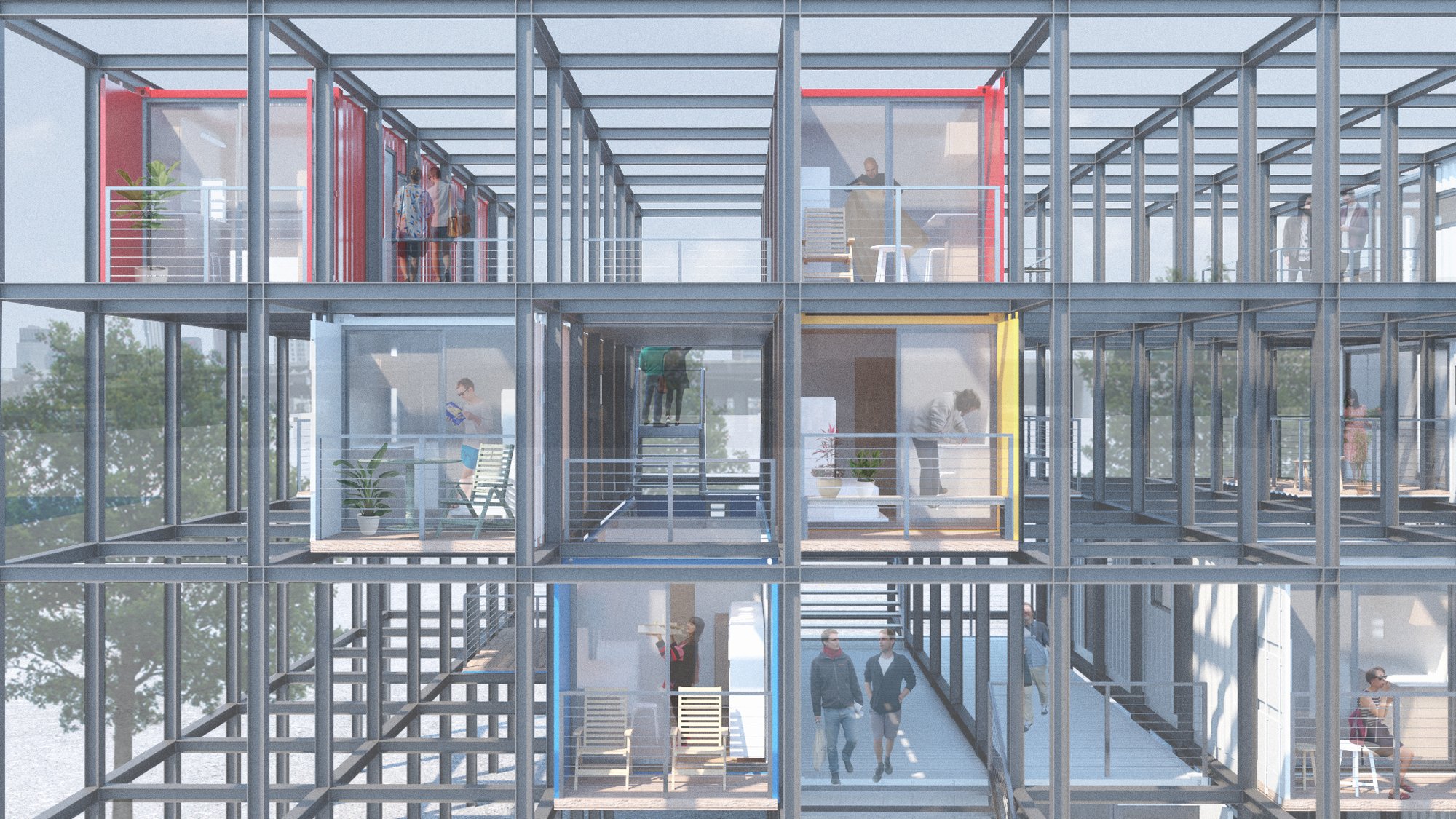
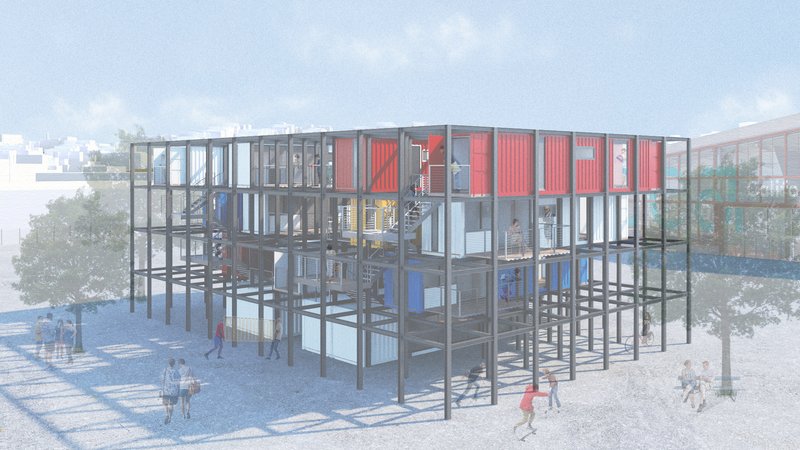
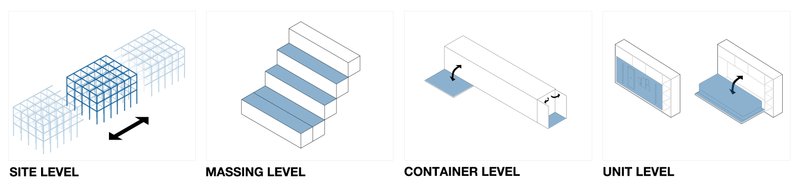
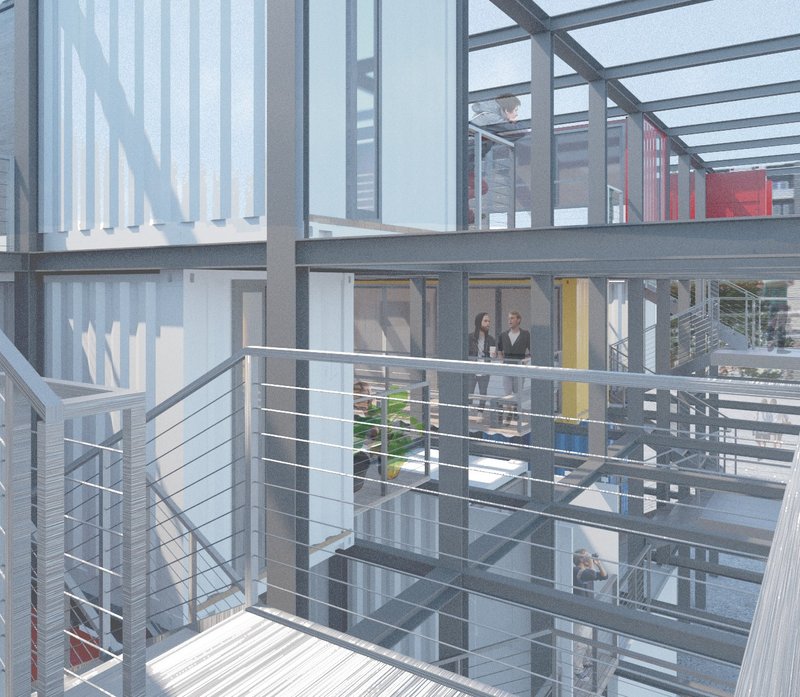
The project focuses on efficient use of space through means of flexibility on all scales from the site level all the way to its furniture. On the site scale, we feature a grid structure. While seemingly rigid and restricting, the grid provides the foundation for flexibility. It is not only flexible to expand or shrink depending on its site, but also provides the structural flexibility needed for the massing scheme. The organization of the units is designed to maximize the surface area of the containers and provide adequate sunlight and ventilation to each container. By organizing the containers in a stepped manner, the top of each container provides the main source of circulation for the units and allows sunlight to enter each unit. The modular stepped form can be multiplied across a much wider grid to accommodate larger sites while still maintaining minimal additional material. The units themselves also maximize the material of its original form. The original doors and siding that would have been removed to provide windows, were folded out to provide an outdoor deck for each and every unit. The folding out of existing material provided the added advantage of maximizing material and space. This folding operation is brought into the unit as well to provide a similar effect. The Murphy bed in each unit provides the flexibility of use between work and sleep while also providing plenty of storage.
LEADING UP TO THE FINAL FORM
Our first round of iterations focused on creating pockets of outdoor space for all units. While interesting in its form, it lacked the modularity that would provide ease of replicability. Through exploring the possibilities of the grid structure, we were given the structural freedom to experiment with different massing schemes. Through understanding the need to minimize costs and construction, we arrived at the stepped massing scheme that showed efficiency and higher quality of living on multiple scales.

FOCUS OF PROGRAM
In a time where many felt isolated by the pandemic, the programs featured in this project focus on bringing a sense of community within the new norm. The ground floor greets residents and students of the campus to gather in the four ground floor containers that house an indoor/outdoor gallery space, workspace, and cafe. The blurred line between indoor/outdoor spaces is created through the folded operation used in the unit layouts. The ground floor serves as a communal gathering space and the intersection between campus and housing. There is an increased level of privacy from the second floor to the fourth floor consisting of 11 containers of student housing. Each container houses two students with a private studio space, private deck, and shared bathroom for a total of 22 units. The project focuses on creating studios with shared bathrooms to maximize the number of units while still maintaining a balance of shared and individual space.
OBJECTIVES - SOLUTIONS
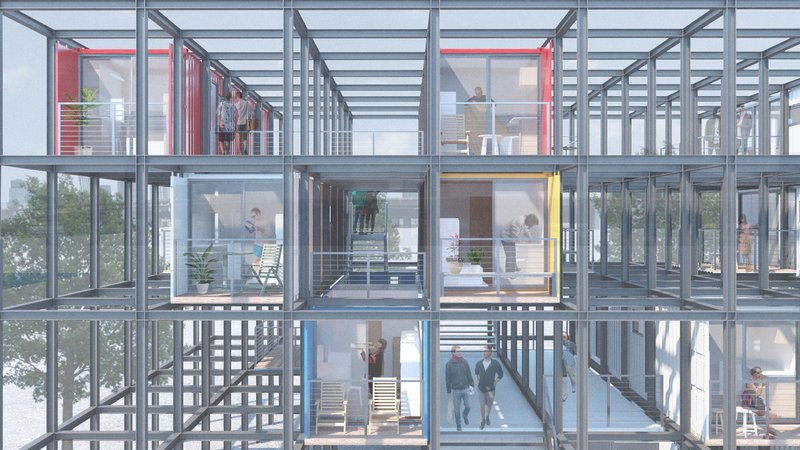
Quality of Living: The structural integrity of the grid frees the containers from the constraints of its structural weaknesses. By inserting the containers into the grid, the containers are properly supported while providing each unit with a spatial buffer that provides the necessary light, ventilation, and privacy needed to create a sense of spaciousness and comfort.
Spaces: Each unit benefits from their own private deck that provides an opportunity for indoor/outdoor living. The decks are created from folding out the facade of the original container. The smaller deck features the original container doors to provide an added sense of privacy while the larger deck features a spacious outdoor space open to the interior of the building.
Container Utility: The modularity of the containers themselves provides ease of replicability and construction. With only two variations of unit layout and a modular massing scheme, the project maximizes the potential of efficient construction through modular design on multiple scales. Maximizing the surface area of the containers themselves for decks and circulation spaces also reduces the issue of generating excess waste.
Replicability: The design is innately replicable both on the larger massing scale and on the container scale. The grid allows for adaptability to both small and large sites while the modular massing scheme can be added and subtracted depending on the site's unique demands. On a smaller scale, there are only two unit typologies, providing ease in replicability across multiple containers.
EXPANSION PLAN
As housing demands increase, the grid may expand to accommodate more modules of container units. The grid may also expand to accommodate covered parking spaces for student housing and the campus. The grid is a flexible foundation that can expand to accommodate the changing needs of the campus and its students. Whether it be adding more container spaces, adding more units, or adding more parking spaces, the possibilities are endless in adapting to the unique needs of different sites and times.


Popular Articles
Popular articles from the community


Solar Steam: A Climate-Responsive Architecture That Redefines the Monument
A climate-responsive memorial architecture that transforms heat, decay, and time into a living system reflecting humanity’s ecological impact.
Louis Malle Cinema: A Limestone Cultural Landmark Revitalizing Community Life in Prayssac
Limestone cinema extension with public forecourt, blending heritage and modern design to create flexible cultural spaces and strengthen community interaction.
On the Brooks House by Monsoon Collective – A Contemporary Kerala Home Rooted in Tradition
Kerala home blending tradition and modernity with water-inspired design, brick architecture, courtyard planning, and sustainable rainwater harvesting strategies.
Treehouse Apartment: A Warm Timber Interior Blending Craft, Play, and Contemporary Living
Warm timber apartment with integrated treehouse, combining natural materials, craftsmanship, and playful design to create a flexible, family-oriented living environment.

Similar Reads
You might also enjoy these articles


The Ken Roberts Memorial Delineation Competition (Krob)
As the most senior architectural drawing competition currently in operation anywhere in the world, it draws hundreds of entries each year, awarding the very best submissions in a series of medium-based categories.
A Contemporary Take on Iranian Residential Architecture
A modern interior design in Mashhad that reinterprets brick, light, and spatial flow to create a warm, contemporary residential architecture.
Franche-Comté Advanced School of Engineering by Dominique Coulon & associés, Besançon
A flexible engineering school immersed in woodland, combining concrete minimalism, adaptable spaces, and natural light to support evolving educational environments.


Waterfront Redevelopment and Urban Revitalization in Mumbai: Forging a New Dawn for Darukhana
A transformative waterfront redevelopment project reimagining Darukhana’s shipbreaking heritage into an inclusive urban future.
Explore Low Cost Design Competitions
Discover active competitions in this discipline




The Global Benchmark for Architecture Dissertation Awards


Challenge to design mud housing for contemporary communities
Comments (0)
Please login or sign up to add comments
No comments yet. Be the first to comment!