
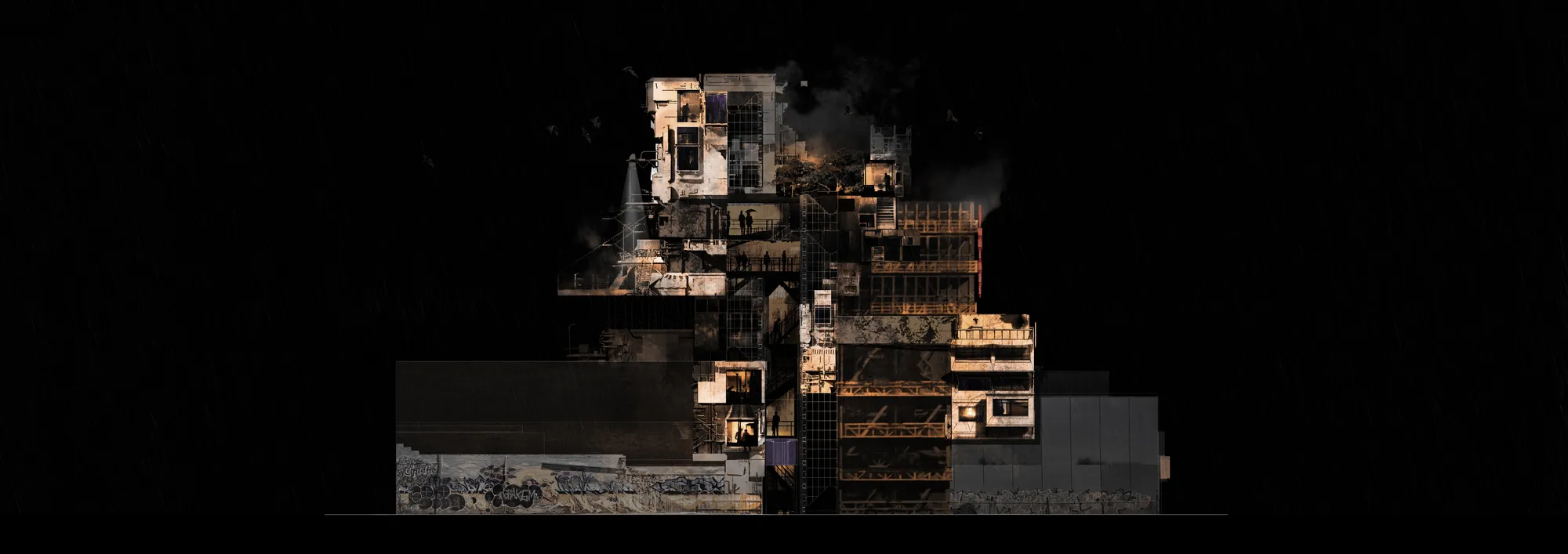
Graphis Homefutura - Little Footscray
Home Futura; the Trajectory of Home


“The naturalisation of architecture is about addressing nature in a different way, no longer as an opposition between the natural and man-made, but in a new sort of hybrid relationship... Here, architecture brings together the biological and the computational, leading to a fusion of... natural and synthetic systems.” - Marie-Ange Brayer, “Naturalizing Architecture,” PCA-Stream 03, 2014, <www.pca-stream.com/en/articles/naturalizing-architecture-16.>
The gritty inner west of Melbourne town – Footscray – in the not too distant future. A hot bed of multi-culture - language, cuisine, customs and community.
Future Home - The Speculation
In the midst of anthropogenic climate change - the 6th mass extinction crisis and global human population explosion - a coalition of critical bodies develop a collaborative procurement model for the dense and accretive human habitation (HOME) of ‘greyfield’ sites (under utilised or disused urban realms). Cross-pollination of the private and public sectors - government, education, advanced technology, civil society, and architecture - is part of the model. In turn, a new approach to the built environment’s adaptation, construction, and transformation. A built environment that embraces and encourages all aspects of life on Earth; a biospheric “plug-in”; a non-extractive habitation device. Home.
The test case – Little Footscray – on Hopkins Lane in the heart of the Footscray market district.
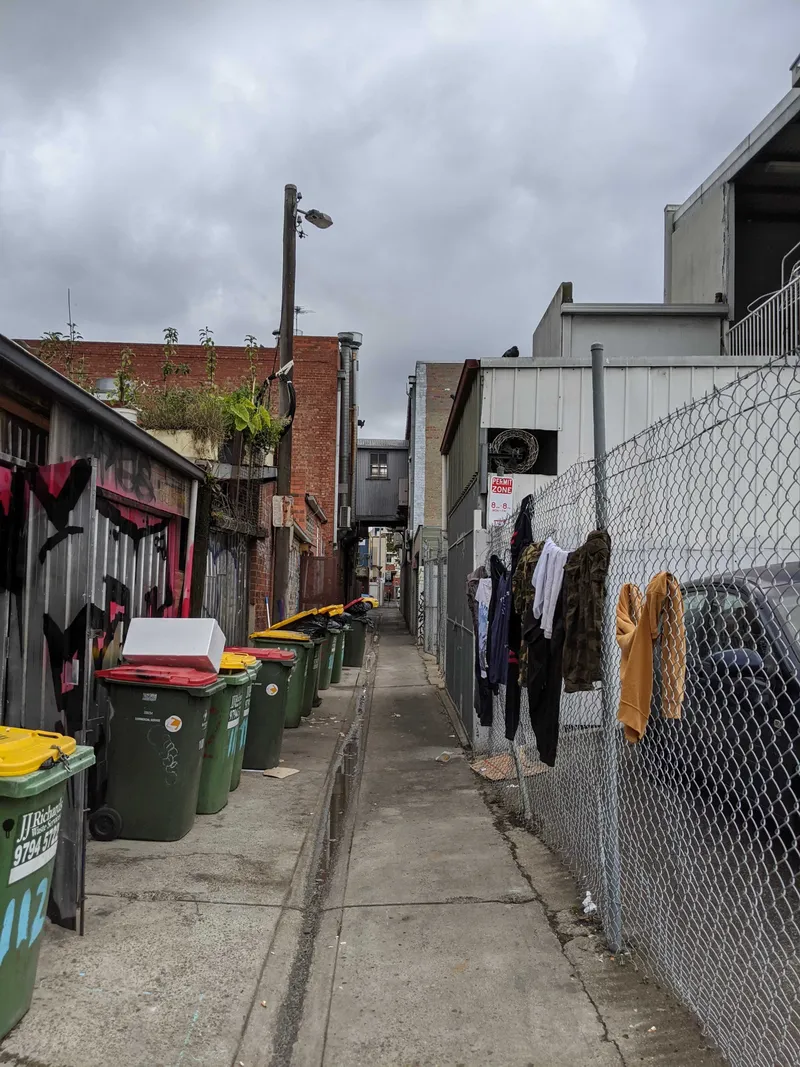 View west down Hopkins Lane
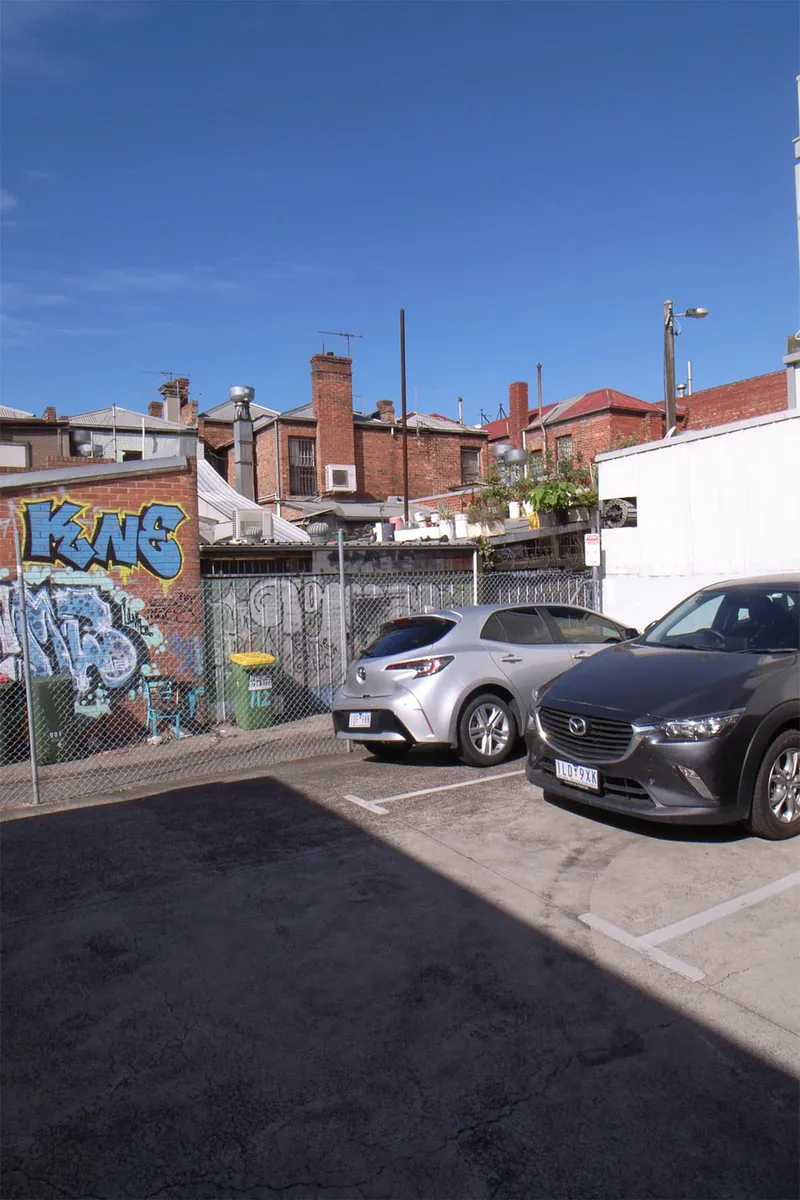 View south towards Hopkins Lane showing existing roof agriculture
Little Footscray represents the first in a proposed network of built and inhabited urban infill (grey field) domains. Interconnected infrastructure with the following goals central to the broader project –
* Home as Community
* Home as socially and culturally diverse; Home as driver of cultural habitation change
* Home as a continuum of the biosphere; Home as driver of biodiversity
* Home as the driver of sophisticated beneficial urban ecosystems; Home as adaptable
* Home as attenuator of catastrophic climate events
* Home as self-sufficient (water, food, shelter, energy); Home as non-extractive.
* Home as innovator, as research loop; Home as driver of material science and habitation unit theory
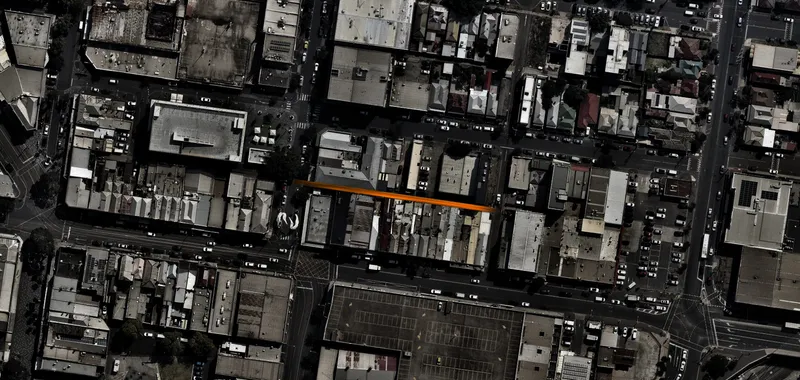 Site location plan of Little Footscray - Hopkins Lane
"If humanity continues to develop according to present trends, by 2050 it will use up twice what the planet can afford. We are clearly in a deadlock. The convergence of these changes requires a completely new form of representation, conception, and management of the planet." Philippe Chiambaretta, 2014, Inhabiting the Anthropocene, 04/05/2021,<https://www.pca-stream.com/en/articles/inhabiting-the-anthropocene-13#bibliography-13>
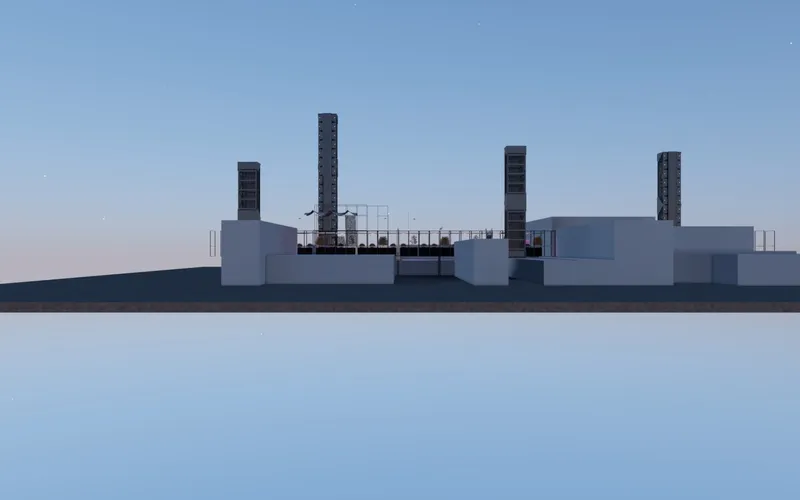 Schematic study of vertical circulation cores & platform level - view from Byron Street
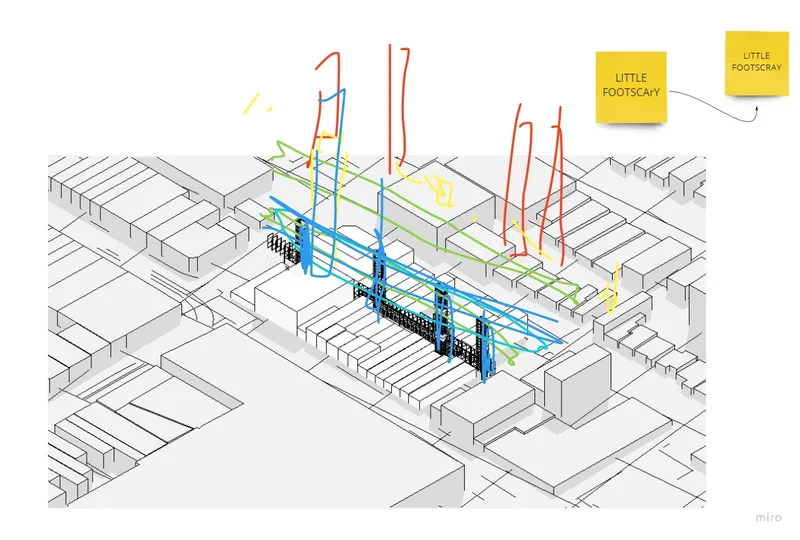 Preliminary digital sketch of the Hopkins Lane elements
The Programmatic Scheme
Programmatically Little Footscray involves three distinct component types - permanent infrastructure, adaptable infrastructure and variable/morphological space.
Permanent infrastructure - the framework of the scheme; the initial structure as robust, uncomprimising skeleton.
Adaptable infrastructure describes the critical service zones, such as water storage/treatment and agriculture, that ebb and flow in use and scale, to some degree, as community needs modify.
Variable/morphological space describes the human inhabitated spaces within Little Footscray that are constructed and adapted over the coming decades
Specifically, the scheme as shown in drawings is comprised of the following discernible elements listed in order from ground level upwards (refer to the section drawing and exploded axonometric also) –
- Existing laneway level (permanent infrastructure) – retained for continued pedestrian and vehicular access to existing ground level buildings & general thoroughfare (i.e. retention as a utilised laneway).
- Platform level (permanent infrastructure) – the first elevated level above existing laneway level. Tough, eternal structure as base for the project; essentially a linear elevated bridge with significant load-bearing capacity to support the ensuing scheme. Geopolymer concrete structure.
- Vertical circulation cores (permanent infrastructure) – stair and lift circulation for all commercial, infrastructural and residential requirements. Geopolymer concrete structure and hydrogen steel.
- Water level (adaptable infrastructure) - calibrated level for all project water requirements – stormwater retention/ filtration/ release (if required), grey water treatment, aquaculture.
- Agriculture level (adaptable infrastructure) – a dedicated level for both open cropping and internalised greenhouse agriculture, composting, vermicasting; waste-works.
- Accretive infill levels (variable/morphological space)– spatial infill built and modified/adapted over time including residential, social and commercial habitation units. i.e. a broad diversity of dwelling types, retail, restaurants/food, night-life, community spaces. The accretive spaces utilise advanced material science technologies - 4D printing/mycellium cellular enclosure/bio-welding/shape-memory polymer/drone-print construction.
- Earth-bridges (permanent infrastructure)– terminating levels structurally conjoined to the vertical circulation cores, containing deep earth for large canopy trees, plant and animal life. The project lungs; green space for the populace. Geopolymer concrete structure.
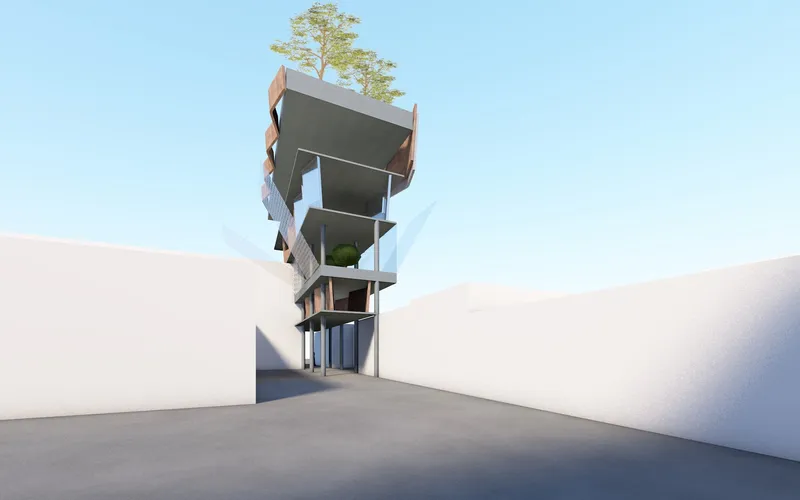 Schematic section showing program development of the scheme -laneway level; platform level; water level; agri level; accretive infill levels; earth bridges
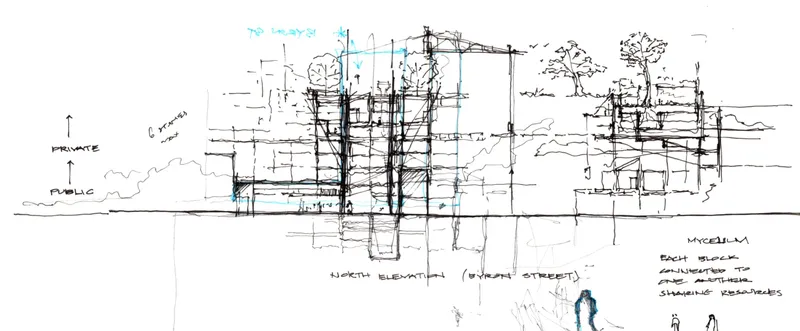 Schematic sectional sketches of Little Footscray - Hopkins Lane
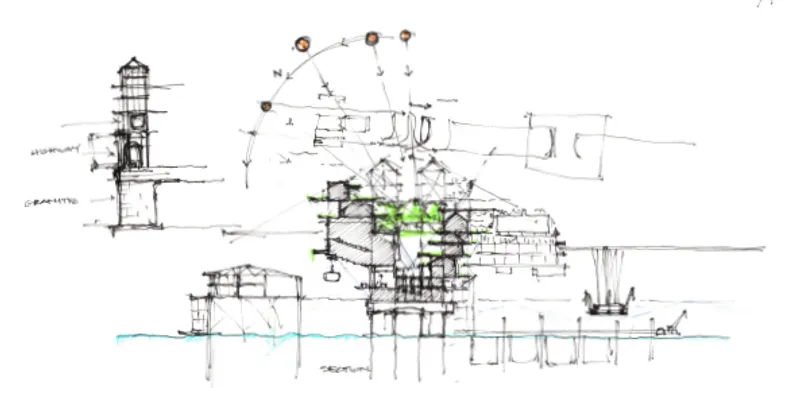 Schematic sectional sketches exploring sun-angles
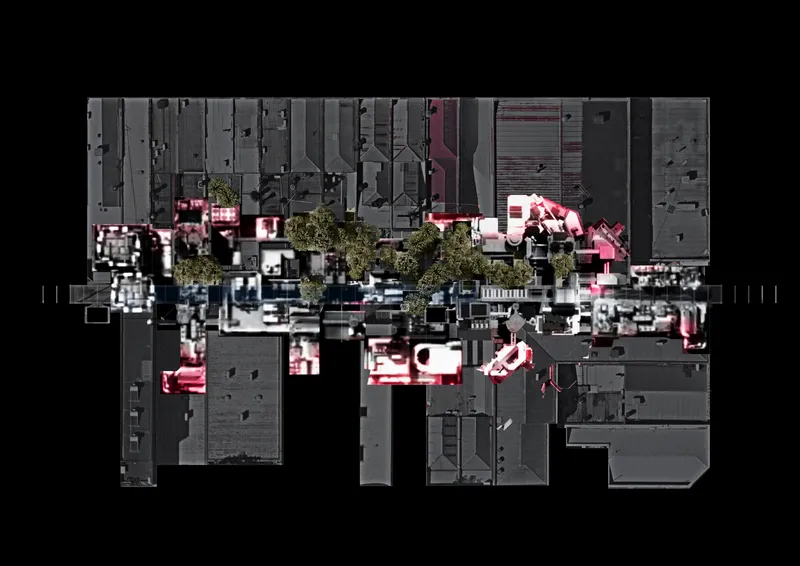 Conceptual aerial view of the accretive Hopkins Lane infrastructure in the medium term future - a dense biospheric plug-in. Little Footscray. HOME
"The naturalisation of architecture is about addressing nature in a different way, no longer as an opposition between the natural and man-made, but in a new sort of hybrid relationship. . . . Here, architecture brings together the biological and the computational, leading to a fusion of . . . “natural and synthetic systems.” These creators claim to have stopped designing architectural objects, instead producing “a process that generates objects.” . . . Through the use of modeling software, architecture aligns itself with living systems—systems equipped with a “metamorphic” nature and distinguished by their transformability and adaptability in response to their environment. . . The task at hand is no longer one of imitating nature, reproducing its external forms as was the case with biomorphism, but to simulate it through a generative approach."
Brayer, Marie-Ange. “Naturalizing Architecture.” PCA-Stream 03, 2014.
<www.pca-stream.com/en/articles/naturalizing-architecture-16>
.

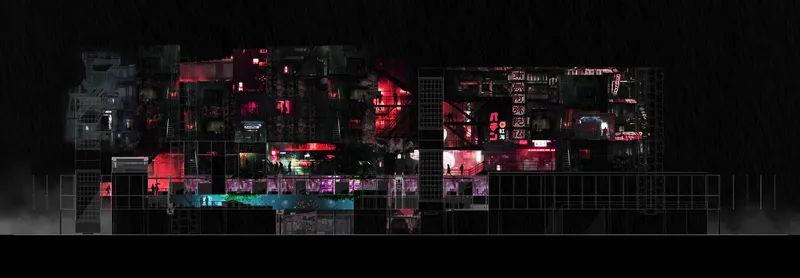 Preliminary digital collage of Little Footscray - Hopkins Lane
"There is not a single institution that acknowledges the long term danger we pose to ourselves, let alone one designed to plan for it. Our time horizon looms three months now, or four years; the corporate balance sheet; the next election. But science is telling us the time scale is measured in the billions of years. How do we maintain awareness the continuity of life's past and our personal" Druyan, Ann, and Brannon Braga. ‘Cosmos: Possible Worlds’. Streaming service. Coming of Age in the Anthropocene. National Geographic, 13 April 2020.

Kelvin Tsang

Adam Newman




Popular Articles
Popular articles from the community


Lunar Spiral: Space Architecture Shaped by the Mathematics of the Universe
Lunar Spiral reimagines space architecture through Fibonacci geometry, lunar regolith, levitating habitats, and self-sustaining Moon living.

Riyadh For All: Intergenerational Urban Design for Active Aging in Rabat
Riyadh For All reimagines urban design in Rabat with intergenerational co-living, adaptive courtyards, and Moroccan cultural exchange today.

Hill & Cross Opera: Sculptural Opera House Architecture Shaped by Tallinn’s Landscape and Identity
Hill & Cross Opera reimagines opera house architecture in Tallinn through its sculptural hill, civic plaza, glass wave and a luminous cross.

The Earth Pod: 3D Printed Homes for Resilient Refugee Communities
The Earth Pod reimagines refugee housing through 3D printed homes made from clay, combining resilience, self-sufficiency, and rapid shelter.

Similar Reads
You might also enjoy these articles

Day and Night Park: A Time-Based Urban Newsstand in Beijing
A temporary urban newsstand in Beijing blending travel, light, and reading through poetic colors, compact form, and community-focused design.

Modernist Patio Renovation in El Masnou, Barcelona by Oliver Segura Arquitectura + Cebrià Arquitectura
Modernist patio renovation blending tradition and innovation with a movable pool, leveled floors, and Catalan materials in El Masnou.

Alto Residencial Coop: Cooperative Housing Development in Santiago de Compostela by Carbajo Barrios Arquitectos
A linear cooperative housing complex blending white volumes and perforated metal façades, enhancing community living, natural light, privacy, and urban integration.
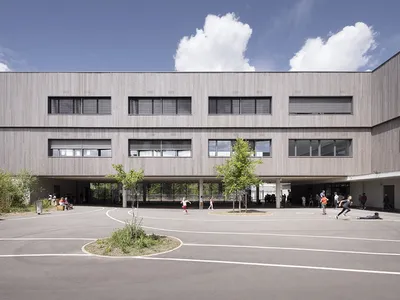
Vil Genis School by BPA ARCHITECTURE – Massy, France
Vil Genis School in Massy, France, features sustainable design, south-facing classrooms, community integration, accessible spaces, and modern educational architecture.

Comments (0)
Please login or sign up to add comments
No comments yet. Be the first to comment!