

Marident
A narrative

We started by researching existing architectural projects that had primarily used containers for a range of functions. Further, sketching the long, rectangular shape of the container and learning about what parts assembled together to make a container.
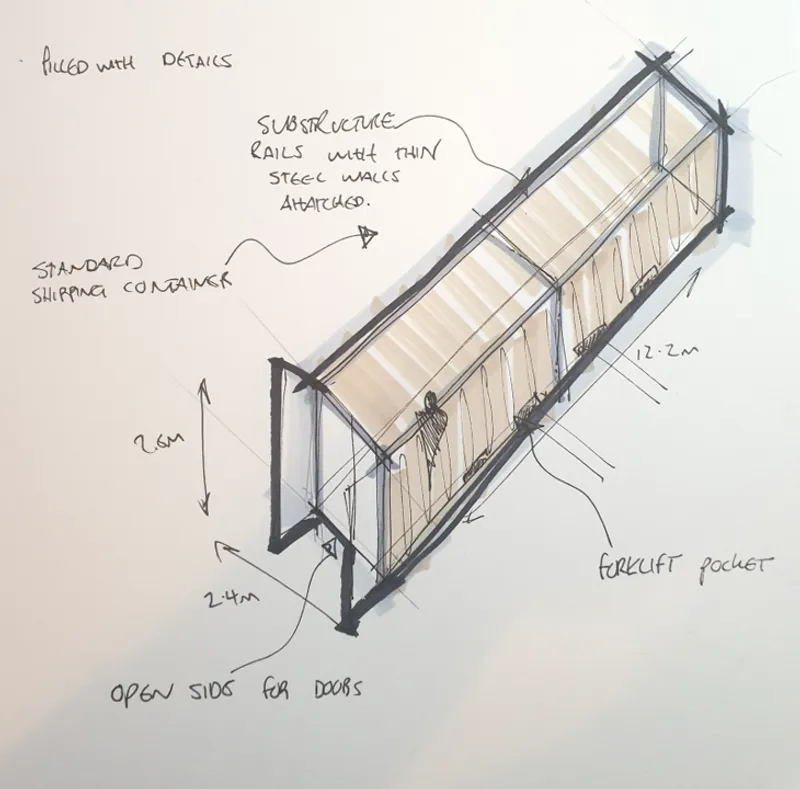
We then investigated micro houses to learn new solutions to using a small amount of space. The water deck excited our team the most; with new aspects of the environment to consider and new parameters to interact with.
Being students ourselves we had a good understanding of what the basic functions of this space would need to provide for a student to live there. Our first objectives were focused on the student. We wanted to have a space that a student would be able to relax in and be easily able to communicate with other residents. Whilst, having space to comfortably study.
This led us to create a more specific client base design, with the aspect of the water deck being key to our designing and thinking. For students who study marine biology, we found that this incorporation would be an integral part of any students learning. Allowing this group of students to gain the most from this unique location.
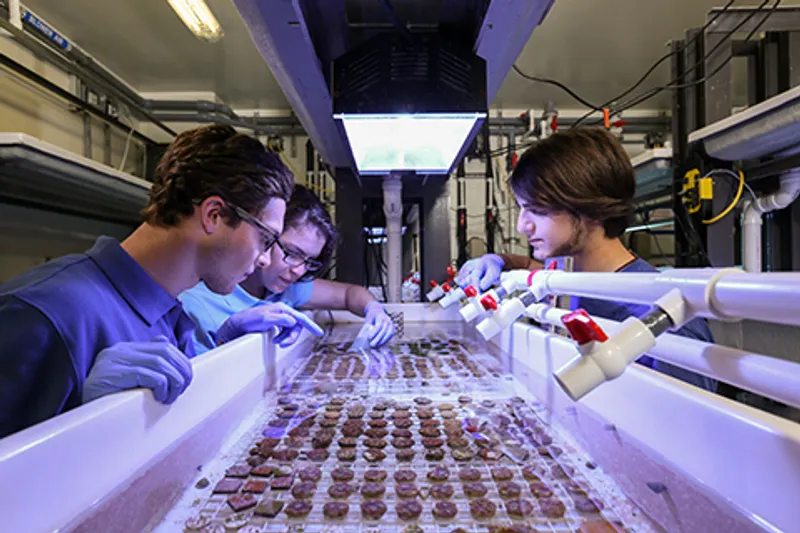
Through collecting information from mutual friends who study marine biology at our university, we asked what facilities would be needed in order for our design to be successful. They pointed out “a lab space, library, computer rooms and storage for wet gear” would be preferable. This information gave us a good foundation to develop zones for the layout of the design, allowing us to form a free-flowing design throughout each of the zones.
From the zonal diagrams, massing concepts began to develop. We used a mixture of sketches, 3D Sketchup and Lego models. The use of the Lego was efficient as the shape and size of an individual mirrored that of the container.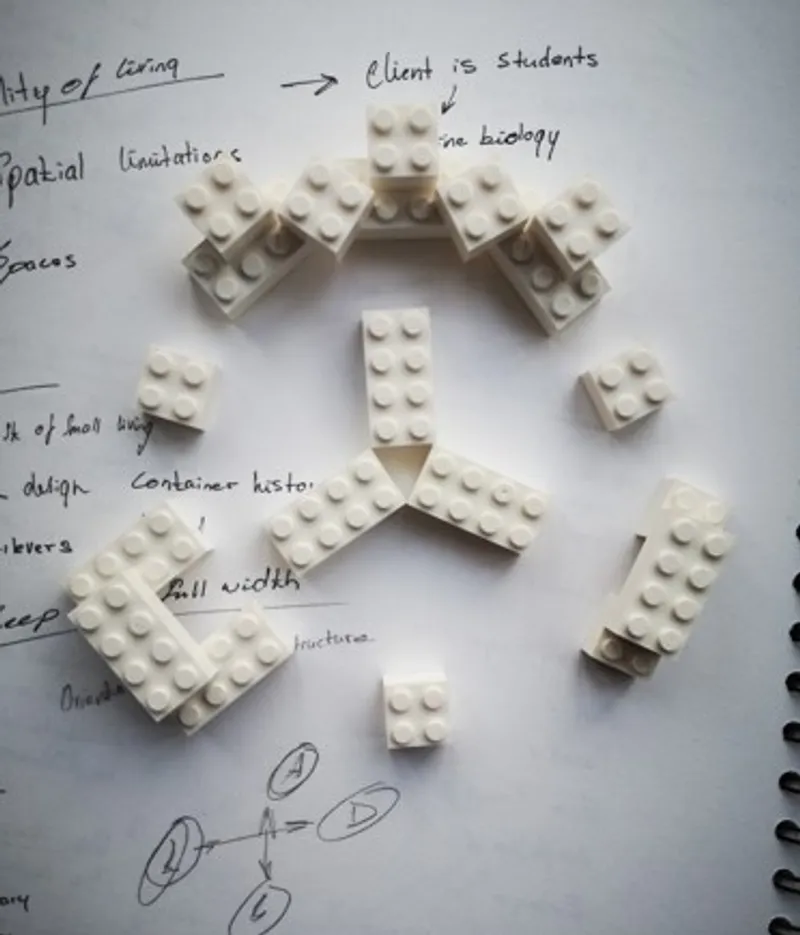
Discussions consisted of how the various zones would interact and how the water could flow through the layout and be incorporated rather than be covered. It was also at this point that the idea of partially submerging a container with the intention of acting a wet research point for the students. Ideas of stacking containers on top of each other were also experimented with to find alternative ways of connecting the zones. Arriving at the final layout after various debates and asking the marine biology students, who commented that she was “excited for the submerged container idea”, believing that it would prove useful for field research and their studies.
As designers, we were conscious to separate the study and accommodation areas as we believe it is not good to heavily mix living and study spaces. This has been further proved with our own experiences during this pandemic. This is why the laboratories and study areas are located on the north side. In the centre is the partially submerged container acting as a core for the design. As the container that best connects the water and structural deck and serves as an abstract symbol for what the students are passionate about. In line on the outside of our design, on either side are two platforms that extend out into the water. We wanted to create an area which is void of structure, a space for just the student and the water. To reflect and relax on any personal feelings they have at the time whether it be happy or sad. Farther south is the community hub and accommodation. The layout of the containers creates a protected area that is open enough to not feel isolated. The closeness allows for the students to be together and communicate easier building a community atmosphere for the water deck.
With rising sea levels and land space becoming a premium we potentially could see more water deck construction. The use of containers could easily become very mainstream and cost-beneficial. The material is highly weather-resistant and extremely durable, re-using these would heavily cut down on waste produced by the trade industry. As well they can be so easily modified to suit any client needs, students or a retirement community. We feel our design meets the needs of our specific client and allows for the changing world we live in.

Popular Articles
Popular articles from the community


The Amber Palace Opera: A Geological Fiction Surfaces on Tallinn's Baltic Waterfront
Pierre Brillard reimagines a Baltic legend as a public landscape, opera house, and waterfront promenade rooted in Tallinn's coastal identity.


Juan García Correa, John González and Claudia Rueda Sink a Circular Amphitheater into a Manizales Engineering Building
On the La Nubia campus in Manizales, Colombia, the S1 Building folds labs and offices into a hillside of ramped lawns that double as a campus route.

FCC Arquitectura Expands a Portuguese Granite House with a Board-Marked Concrete Wing
In Portugal, JV House pairs a cleaned-up whitewashed and granite dwelling with a timber-shuttered concrete extension, courtyards and a garden pool.

Aquadapt: An Underwater Habitat That Rewrites Its Rooms by the Hour
Curved modules ring the seabed while one shell shifts from breakfast room to cinema, farm and football pitch as residents' needs change.

Similar Reads
You might also enjoy these articles

Vereda Arquitetos Renovates a 40-Square-Meter Apartment Inside Niemeyer's Copan Building
A compact unit in São Paulo's most iconic residential tower gets a material overhaul that pairs exposed concrete with bold blue Formica.

Shakur's House: Exposed Brick as an Interior Organiser in a 168 m² Mashhad Residence
Brick moves indoors in this Mashhad residence, where masonry walls, glass partitions and teal planes sequence a compact home without closing it off.

Day and Night Park: A Time-Based Urban Newsstand in Beijing
A temporary urban newsstand in Beijing blending travel, light, and reading through poetic colors, compact form, and community-focused design.

Modernist Patio Renovation in El Masnou, Barcelona by Oliver Segura Arquitectura + Cebrià Arquitectura
Modernist patio renovation blending tradition and innovation with a movable pool, leveled floors, and Catalan materials in El Masnou.

Comments (0)
Please login or sign up to add comments
No comments yet. Be the first to comment!