
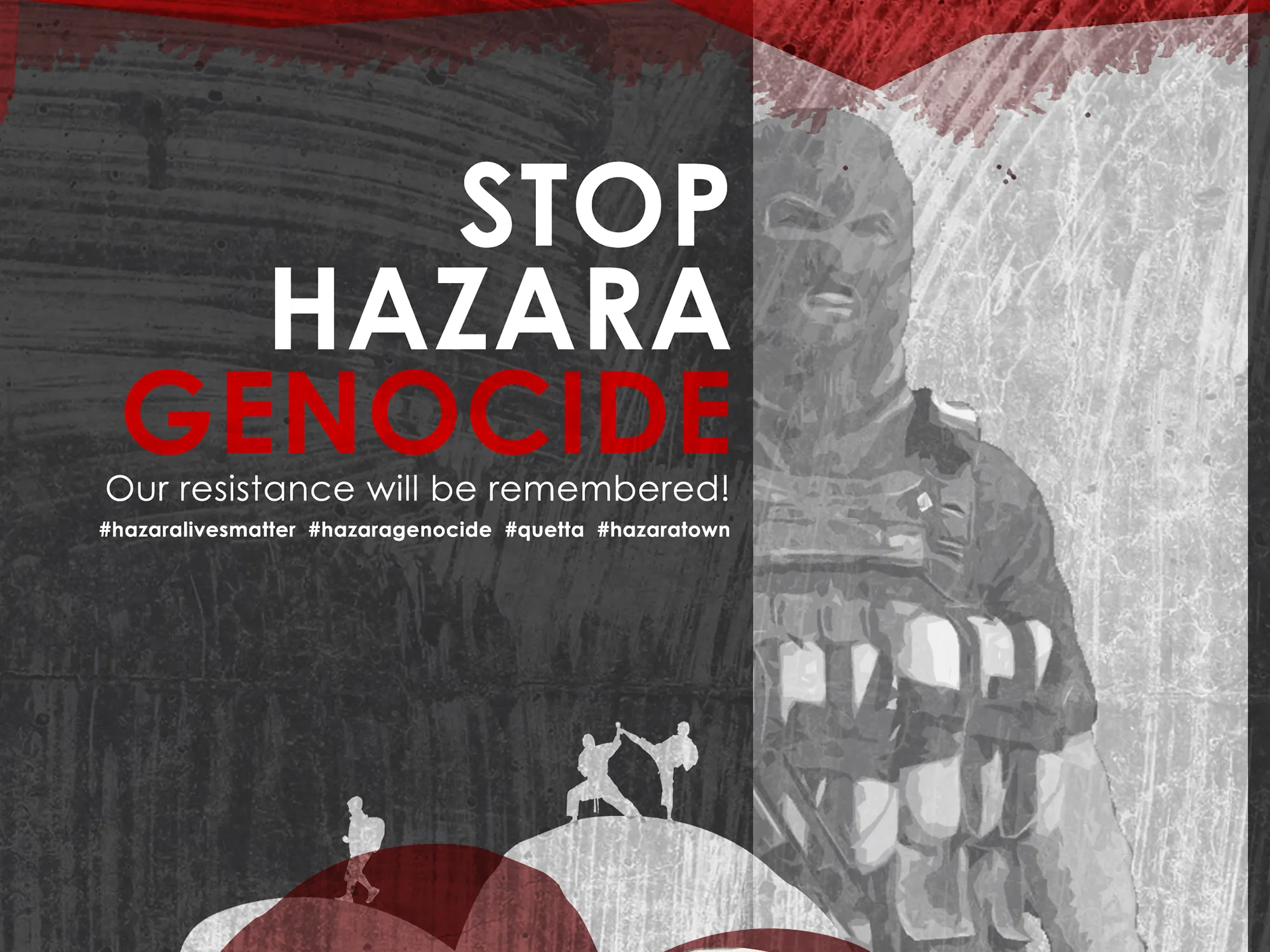
Stop Hazara Genocide
A protest space for the Hazara community

Hazaras are an ethnic group primarily based in Afghanistan. In the 1800s Hazara people migrated to Pakistan and now have a large population in Pakistan, ranging from 650,000 to 900,000.[1] The majority of Hazaras in Pakistan live in the city of Quetta, the provincial capital of Pakistan.
The people from Hazara have a facial resemblance to the ones residing in the northern region of Pakistan, but the Hazara community did a mass migration to Baluchistan around 150 years ago. They have made their contribution in every field of life there. But today, there is great intolerance between the Shia Hazaras and Sunni people. The main conflict among them arose in the 1990s and since then it has always increased.[2]
The current situation of the Hazara community is uncertain. Every day these people are struggling in getting their fundamental rights. Their movement is restricted to very few safer places even within Quetta. It is difficult for them to go get their basic necessities, for example, education, freedom, jobs, etc without placing their lives in danger. There's a continuous threat to them even when they try to roam around the city or go to Iran/Iraq to perform their religious duties.
In February 2013 a bomb blast in a market in Hazara town killed almost a hundred people due to which a wall around Hazara town was built within a few hours by frontier corps to protect the people of Hazara. Little did they know, by doing this they were not only protecting the community but also restricting their movement and limiting their opportunities. This division from the city made them sell their businesses and pull their children out of schools, and out of town.
For decades the continued negligence and injustice faced by the Hazara community have been constant. This led the Hazara community to raise their voice against the violence they faced. In January 2021 when 10 coal miners were killed on their way back home, brought their families and all of the Hazara community on the streets of Quetta to protest and demand justice for the families who lost their loved ones. The protest took place for six days straight. In the freezing cold, the families sat beside the dead bodies demanding justice and protection for their people. They refused to move or bury the bodies of the coalminers until their demands were heard by the prime minister of Pakistan.
There is a communication barrier between the Hazaras and the other communities. Being a minority, the Hazara community faces oppression and is unable to put across the point that their existence matters and the violence against them is not justified. Communication plays a vital role in expressing an idea, feeling, or sentiment, and communicating through design can maximize the impact of the cause.
“Architecture has a serious problem today in that people who are not alike don’t communicate. I’m more interested in communicating with people I disagree with than people I agree with.” – Rem Koolhaas
There are many ways through which architecture can communicate with the masses, raise awareness and unite the mass as one. The design approach is to propose an idea that not only connects with the active mass of the protest but also connects or interacts with the inactive majority through visual communication and expression.
The site is selected, keeping all these factors in mind and in respect to the design approach. The site lies on the contours of a cliff near Hazara town, Quetta. The site is prominent and clearly visible from its surroundings due to the topography of the land. It is directly approachable from the western bypass. The protest's purpose can easily be reached by the people traveling from the bypass. An intervention of the site would itself become a marker in contrast with the context.
Over the years the people of Hazara have been resisting positively to their situation in the city by putting their children into sports and education, proving that their resilience is stronger and they cannot be oppressed. Their retaliation against injustice is shown by their excellence in every field, be it sports, crafts, or education. Despite their peaceful nature, they are attacked and killed on regular basis. The proof of it is the expansion of the Hazara graveyard, which is home to many who lost their lives for belonging to a Hazara community.
The design creates a connection between the resistance and the remembrance of the community. The proposal consists of shaded structures placed throughout the whole site and modular structures that would cater to the basic needs of the protestors.
The shaded structures proposed, will be catering to the protest areas throughout the whole site. These shades are made by using tensile fabric tied to the proposed marker elements. The marker elements are permanent structures, which are in the form of thick walls and columns, infilled with on-site stones in a proposed metal structure/cage. These permanent marker elements convey the idea of the community which is left alone and caged in their sufferings.
The modular structures are proposed keeping in mind the flexibility of the needs and topography of the site. These structures are placed on hydraulic pins to achieve a proper balance of the floor. Also, these are easy to transport due to their flexible nature and have the tendency to expand and contract as per the need. The design is transformable.
In the daytime, the modules become a part of the space of active protest and can transform back to being a shelter in the nighttime. The programs that are being catered by these modular structures are the sleeping area, medical unit, kitchen area, and washrooms. The configuration of these structures forms different multi-functional spaces, which work as interactive zones.
The design is responsive to the context. The flooring of the sleeping modules is proposed with rugs that are used by the community in their homes. Moreover, these spaces have the flexibility to form a shelter for resting needs and can open up and transform into protest spaces. The medical units have enough spatial quality to cater to the needs of the protestors. It consists of a pharmacy, doctors consulting room, minor surgery room, emergency room, and a dressing room.
The whole design is transformable and has the flexibility to expand and contract with respect to the needs. The marker elements are permanent which will leave an impression on site and would symbolize the current situation of the community. Whether the protest is active or not, the whole site will translate the sufferings of the community which they went through in the past.
[1] Shakoor Ahmad Wani, “Political Indifference and State Complicity: The Travails of Hazaras in Baluchistan”, July 2019.
[2] National Commission for Human Rights, “Understanding the agonies of ethnic Hazaras”, February 2018.




Popular Articles
Popular articles from the community


Co-Life: Senior Housing Design That Reconnects Older Adults With the City
Co-Life reimagines senior housing design through healing gardens, shared streets, workshops, and a sustainable community across generations.

The Musturak Paradise: Senior Living Architecture for a Connected Future in Temara, Morocco
The Musturak Paradise reimagines senior living architecture in Temara via private homes, social spaces, culture, community, and shared care.

Conexión: Biophilic Design Reimagines High-Rise Living in Hong Kong
Conexión reimagines high-rise living in Hong Kong through biophilic design, green facades, shared spaces, daylight, water and nature within.

Riyadh For All: Intergenerational Urban Design for Active Aging in Rabat
Riyadh For All reimagines urban design in Rabat with intergenerational co-living, adaptive courtyards, and Moroccan cultural exchange today.


Similar Reads
You might also enjoy these articles
The Rhythm of Seasons
A Farmers' Market Connecting Nature and the City

More Than a Building-Designing a Living System
More Than a Building-Designing a Living System
Base Beyond
DESERT COMPOUND ARID: TOURISM OF ABSENCE AND ABUNDANCE


Explore Cultural Architecture Competitions
Discover active competitions in this discipline


Challenge to design a shop stop sunk in the city

Bring back Drive In's
Comments (0)
Please login or sign up to add comments
No comments yet. Be the first to comment!