
Through the Hatter
Introspective Freedom

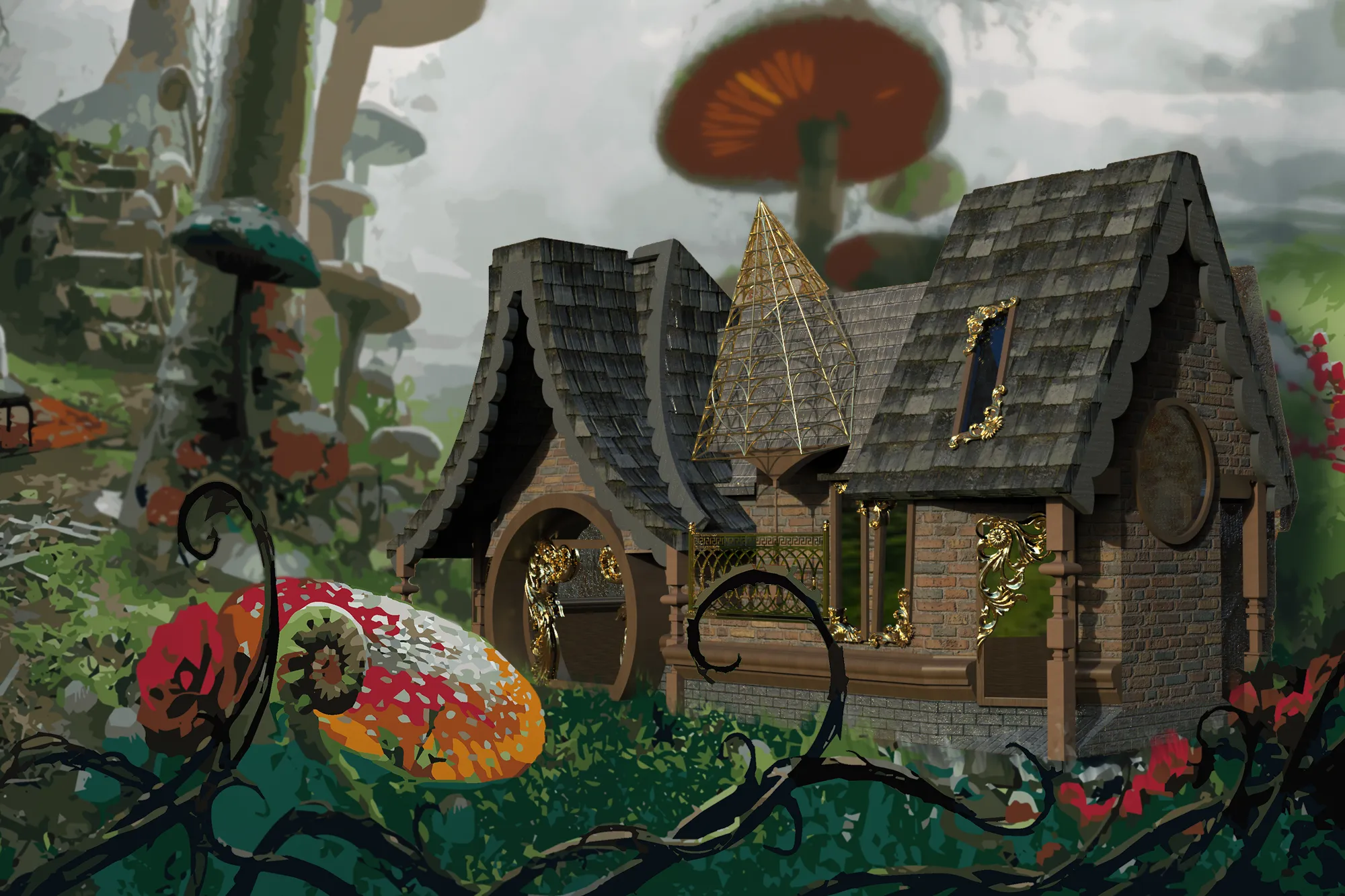
In Alice in Wonderland, the Mad Hatter is perpetually frozen in a time loop, after escaping his death sentence by the Queen of Hearts for “murdering the time.” As a result, he is imprisoned in a world where Time has halted “himself”, as the Hatter refers to it, at 6:00 PM; never a second earlier or later. Thus, the Hatter is often found having tea with his closest companions and appears as a mad man for his lunacy to strangers as he constantly recites peculiar riddles and speaks of unheard-of thoughts. Thus, the Mad Hatter’s closet, Through the Hatter, is designed not only to be a representation of his persona, complexities, and inner mind, but also a refuge from time, with endless possibilities of pseudo entrances and portals created by a matrix of windows and mirrors.
 Conceptual Collage of Layered Windows and Doors
Alluding to the dichotomy between insanity and clarity, Through the Hatter mirrors the Mad Hatter’s estranged relationship between himself and society, as it showcases an orderly exterior yet houses a frenzied interior. And although the interior may appear to be in a manic state to outside observers, an underlying codification exists that is designed and programmed specifically towards the Mad Hatter’s needs. As the Hatter himself says, “if I had a world of my own, everything would be nonsense. Nothing would be what it is because everything would be what it isn’t,” which is exactly what the Through the Hatter aims to achieve; a world of his own that only makes sense in the Hatter’s mind.
Thus, Through the Hatter echoes the perplexing logic that governs the Mad Hatter’s life. The exterior of his closet consists of a mystifying arrangement of mirrors and faux doorways dappled along the façade. An ode to 19th century Victorian architecture, using a multitude of elements from the style, the closet’s exterior appears dark and somber with hints of exquisite ornamentation, which have a decaying golden appearance hinting to the Hatter’s rejection of regality.
On the roof, the scalloped turret frame symbolizes the Mad Hatter’s chaotic mind through a lens of an inability to conform to a unified, traditional Victorian exterior. Rather than a solid form, the frame outlines this traditional element of Victorian architecture, so that is not functional, but a pure form of ornament; a decision expressive of what the Mad Hatter may have come up with himself. The elaborate ornamentation on the balconies and parapets of the closet pays homage to Victorian-era architectural norms, yet a closer look at these details divulges exaggerated proportions and non-traditional entrances. These seemingly awkward proportions allude to Wonderland’s peculiar interpretation of scales and sizes of objects and characters. And although bizarre to outsiders, the closet’s appearance best suits the Hatter, as the exterior's overall erratic assembly exists in harmony with the Mad Hatter’s mind.
 Conceptual Collage of Traditional Victorian Architecture
Gazing upon the walls, one can discover numerous “portal” types: a window, a mirror, a doorway, and a frame. While some are functional, others are purely ornamentation, but all ultimately provide multiple permutations of entry and exit. And while some are mirrored, and others are transparent, the portals create the illusion of other dimensions that exist beyond the confinements of the closet. Thus, this labyrinth of entries, perplexing to almost all others, were designed with the intention to be an ode to the Mad Hatter’s persona; a riddle to others, but not to himself.
Interiorly, Through the Hatter is organized in an eccentric yet distinctive system through a rotating series of hanging clothes. The inside of the closet contains a potpourri of clothes, textures, fabrics, and colors, reflective of the Hatter’s bright and unconventional personality to contrast the somber exterior of the Victorian era. Intentionally disorientating to the viewer, the interior system is an illusion of chaos, yet in the Mad Hatter’s reality, the clothes swivel on the overhead system in the exact schematized formation of colors, styles, and textures he desires for each of the tea parties he attends. Furthermore, the revolving clothing system aims to be a futuristic representation of closet storage, with the clothes on hand constantly evolving and changing on an as-needed basis. For the Hatter specifically, this is represented by the podium found in his closet, which is to display his “hat of the week.” Moreover, the colorful textures parallel the eccentricity of the Mad Hatter’s personality, particularly in regard to his infinite database of bizarre riddles. Therefore, the elaborate wallpaper and curtains that line the interior of the closet are meant to complement the Mad Hatter’s extravagant accessory collection of vibrant ties, ribbons, bow ties, and socks.
Thus, perpetually misunderstood, the Mad Hatter finds refuge in his own closet, which exists both within and beyond the wildest confines of his own imagination. A haven where his foes, such as the Queen of Hearts and time “himself,” cannot hurt him. Through the Hatter is a safe space where the Hatter can be his truest self, a place where he is finally free.
 Conceptual Collage of Victorian Detail


Popular Articles
Popular articles from the community


Lunar Spiral: Space Architecture Shaped by the Mathematics of the Universe
Lunar Spiral reimagines space architecture through Fibonacci geometry, lunar regolith, levitating habitats, and self-sustaining Moon living.

Co-life: Sustainable Architecture for Age-Friendly Community Living
Co-life reimagines sustainable architecture for seniors through courtyards, rammed earth, shared gardens, and spaces designed for belonging.

The Musturak Paradise: Senior Living Architecture for a Connected Future in Temara, Morocco
The Musturak Paradise reimagines senior living architecture in Temara via private homes, social spaces, culture, community, and shared care.

Hill & Cross Opera: Sculptural Opera House Architecture Shaped by Tallinn’s Landscape and Identity
Hill & Cross Opera reimagines opera house architecture in Tallinn through its sculptural hill, civic plaza, glass wave and a luminous cross.


Similar Reads
You might also enjoy these articles

Bao Huynh Watercolor Atelier: A Serene Art Retreat in Hội An
Bao Huynh Watercolor Atelier in Hội An blends multifunctional art spaces, sustainable design, local materials, and family-friendly living in a serene environment.

Atelier Macri Concept Store Interior Design by CASE-REAL
Atelier Macri store features a "ko" counter, walnut wood details, cork displays, blending retail, gallery, and seamless customer experiences.

Manuel Vargas Izquierdo Stadium and High-Performance Sports Center: Architectural Excellence in Jalpa de Méndez
The Manuel Vargas Izquierdo Stadium blends sustainable design, inclusive sports facilities, and cultural-inspired architecture, revitalizing Jalpa de Méndez’s public spaces.

KAKR Buluh Awar Hall: Revitalizing Community and Ecology Through Bamboo Architecture
Community built bamboo hall revitalizes Buluh Awar village, empowering youth, restoring ecology, celebrating vernacular craftsmanship through sustainable architecture and culture.
Explore Conceptual Architecture Competitions
Discover active competitions in this discipline



Challenge to merge furniture with learning

Competition to design a workstation for architects
Comments (0)
Please login or sign up to add comments
No comments yet. Be the first to comment!