
Urban Playground
Journal Entry for Forestphilia

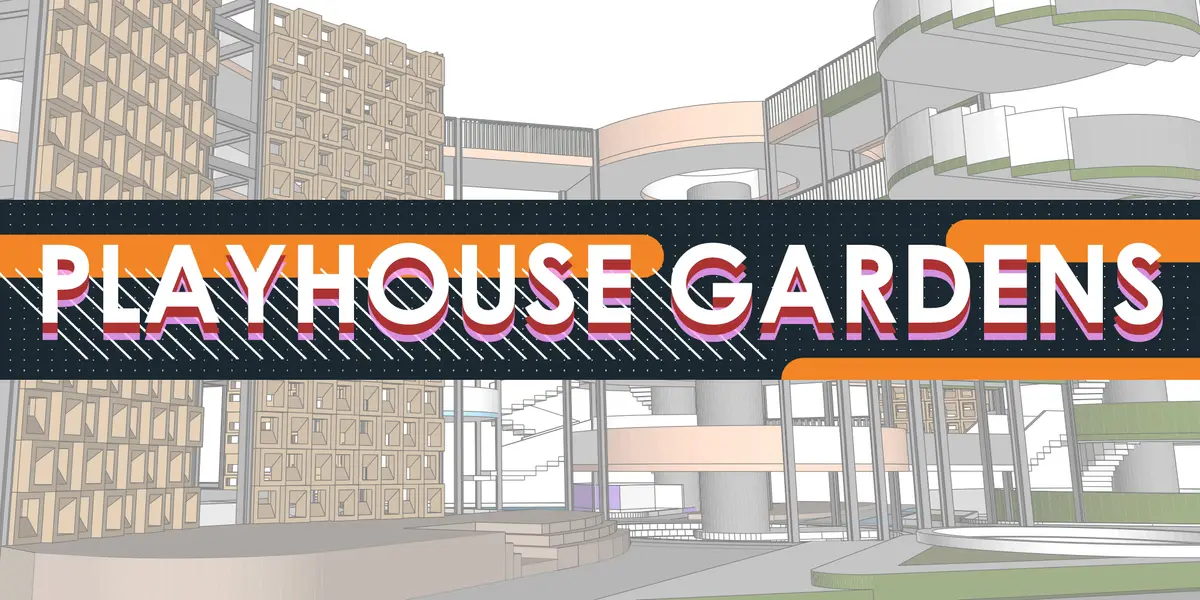
The idea behind Playhouse Gardens is to create a space that mirrors Hong Kong in many aspects. The maximalist approach to buildings was certainly a design philosophy that I espoused, although I added a twist with this particular philosophy. Instead of the technique of building out of nothing, I followed a reductive approach to the evolution of the form (as seen in the boards). I wanted to 'chisel' the design out of a proverbial block of marble instead of building it brick by brick, as is the custom. The reductive approach to the design was a way for me to ascertain that one of the priorities of the design was met clearly, which was the foot traffic. I wanted to ensure that the foot traffic of the site was properly placed. Since there are streets/walkways around the site that are currently being utilized, I wanted to incorporate the natural flow of that into the design and I believe that the results were a success (in that regard). That plus the addition of the setbacks as walkways provides the site with ample walking routes.
Conceptually, the idea of a Life-size Terrarium was my main driving force. The idea that this microcosm could be created and appreciated by those who lacked the requisite public space was alluring. The prospect of designing a terrarium-esque project appealed to me more due to its simplicity vis-à-vis the main goals of the brief. Having to create a design that not only encompasses the biophilic aspect but also tackles the lack of public space in a city like Hong Kong was ideal, in my opinion. Our civilization (since the Industrial Revolution) has always seen nature as a detriment to nation and city building. In addition, the city of Hong Kong is one of the most notoriously packed spaces on the planet. The combination of the ideals regarding nature and the space problem in Hong Kong was my main consideration in this design. I believed that there would be a way to create an interesting, albeit experimental, design that would meld the two problems into one, which in turn, can be solved by Playhouse Gardens.
The name, Playhouse Gardens, is an homage to the space scarcity in Hong Kong. The designated site for the brief is a place where fairs are held. In that spirit, I wanted to continue the primary function of the site and incorporate it into the ever-growing list of aspects to consider. Nonetheless, the result, Playhouse Gardens, is a structural blank canvass in that sense. It's a space where you can do everything and nothing. It's a playhouse for all of Hong Kong to use. It's a democratic space that has a considerable amount of biophilia infused into its spirit, hence the name Playhouse Gardens.
The Towers (as I like to call them) were all designed within the four sectors of the twice bisected site. They all fulfill a purpose within the design matrix of the project. Since the design caters to all, I thought it best to consider the introversion and extroversion of the spaces (on top of the aforementioned aspects). The relationship between democratic public space and the introversion/extroversion of space would help better tailor some activities in the project. I.e., the area with arguably the best vista is Terrace Tower - I placed this particular node in the area nearest the water because I believe that there is something to be gained by quietly observing a beautiful vista, hence the placement. Simply put, the space is a bit introverted. On the other hand, a space like the Colosseum allows for more movement and interaction. The sheer size of it, paired with its designed function, automatically makes it an extroverted/ambivert space. Once more, simply put, I designed the areas to cater to introversion/extroversion. That isn't to say that I prefer one side over another but I have afforded the users that decision. For every little tree amphitheater, I added to the design (and the other 'interactive' designs), I simply wanted to ensure that the entire arsenal and width of the spectrum of introvert/extrovert can be explored at the users' leisure.
With regard to materials and expansion, I wanted to make that an aesthetic homage to what brought us here in the first place: industrial building materials. Materials such as concrete and steel I-beams first come to mind with these discussions, and as such, I placed them in the design as the foundation (no pun intended) of the structure. I imagine that the expansion of the design (not shown on the boards) would be an antithesis to what a skyscraper is, i.e., I expect it to eventually become untamed and unruly albeit in an interactive way. The design can physically be expanded into the other unused areas in the vicinity with perhaps the same design and premise but I would add more activities to the program of the design (i.e., movie night at the park, mini courts, a longer jogging route, outdoor exercise equipment, etc.). Right now, the program is more inclined to honor the current purpose of the site (fairs, carnivals, retail, food establishments, sports like ping pong, etc.), but I imagine that an extension would unlock more activities in the program.
I also included EGD in the design in an attempt to ensure that everybody is on the same page when it comes to what the spaces do. For example, the blue strips on the ground that are scattered around the site (see perspectives or SDP) are designated retail or activity areas, meaning, there is enough space to set up small shops on those spaces or alternatively can be used for outdoor activities (like ping pong). The proximity of those areas to the main walkways was integrated due to the purpose of the site. It would be a shame to remove the essence of the site simply because a project was being laid on top of it. Conjecture aside, the goal of the EGD was so that the users wouldn't get lost or have a misunderstanding with what the spaces do. In some cases, EGD was used to guide the users to different interest points, for example, there are wayfinding strips on the ground to lead to the rich greeneries, the Colosseum, the Central Tower, etc.
In summary, Playhouse Gardens is a mix of biophilic and post-modern architecture. It is, in itself, an experiment. It's a modern utopian dream. The perfect mix (if there ever is such a thing) of modern industrial city building paired with the respect for the natural environment. On top of that, it also promotes introvert/extrovert/ambivert activity programs as well as EGD to help guide the users through the forest.

Popular Articles
Popular articles from the community


Little Red Riding Hood: Architectural Design as a Journey Through Fear, Light, and Storytelling
Little Red Riding Hood reimagines the fairy tale through architectural design shaped by fear, light, scale, memory, uncertainty, and choice.

Hill & Cross Opera: Sculptural Opera House Architecture Shaped by Tallinn’s Landscape and Identity
Hill & Cross Opera reimagines opera house architecture in Tallinn through its sculptural hill, civic plaza, glass wave and a luminous cross.

Co-Life: Senior Housing Design That Reconnects Older Adults With the City
Co-Life reimagines senior housing design through healing gardens, shared streets, workshops, and a sustainable community across generations.

Play: Fragments of Their World
Familiar architecture becomes modular playground design, creating safe spaces where displaced children can learn, connect, imagine and play.

Similar Reads
You might also enjoy these articles

Day and Night Park: A Time-Based Urban Newsstand in Beijing
A temporary urban newsstand in Beijing blending travel, light, and reading through poetic colors, compact form, and community-focused design.

Modernist Patio Renovation in El Masnou, Barcelona by Oliver Segura Arquitectura + Cebrià Arquitectura
Modernist patio renovation blending tradition and innovation with a movable pool, leveled floors, and Catalan materials in El Masnou.

Alto Residencial Coop: Cooperative Housing Development in Santiago de Compostela by Carbajo Barrios Arquitectos
A linear cooperative housing complex blending white volumes and perforated metal façades, enhancing community living, natural light, privacy, and urban integration.
Vil Genis School by BPA ARCHITECTURE – Massy, France
Vil Genis School in Massy, France, features sustainable design, south-facing classrooms, community integration, accessible spaces, and modern educational architecture.

Comments (0)
Please login or sign up to add comments
No comments yet. Be the first to comment!