
V-FARM: Where Modular Farming Units Become the Building Blocks of Urban Housing
A vertically stacked system of residential, hydroponic, and livestock modules connected by bridges and wrapped in kinetic hexagonal facades.

What if the apartment building itself grew your food? V-FARM takes that question literally, proposing a vertically stacked architecture where residential flats, hydroponic laboratories, communal farming terraces, and even livestock paddocks occupy distinct layers of a single modular structure. The result is not a tower with planters bolted on but a genuinely new building typology: one in which agricultural production is the organizational logic of the section, not a decorative afterthought.
Designed by Erinc Dogan and Berk Denizci, V-FARM received an Honorable Mention in the FarmUrban competition. The project reimagines vertical density as productive density, replacing the typical residential floor plate with a kit of scalable modules that can be assembled across different urban contexts. Each module responds to a specific programmatic need: living, growing, raising, or gathering. Bridges link the modules along horizontal planes, while the vertical stack separates functions for light, access, and biosecurity.
Reading the Section: Four Zones, One Productive Stack
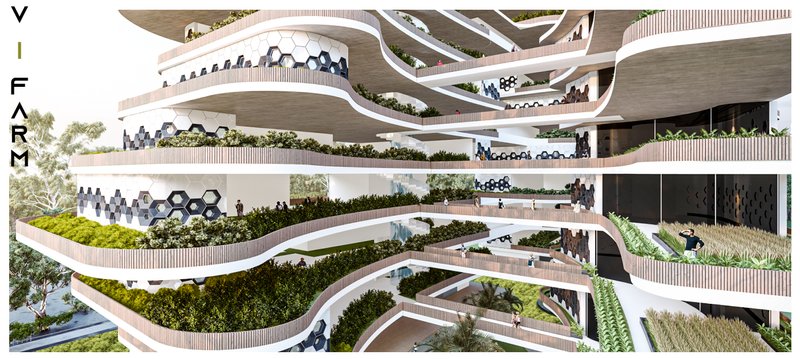
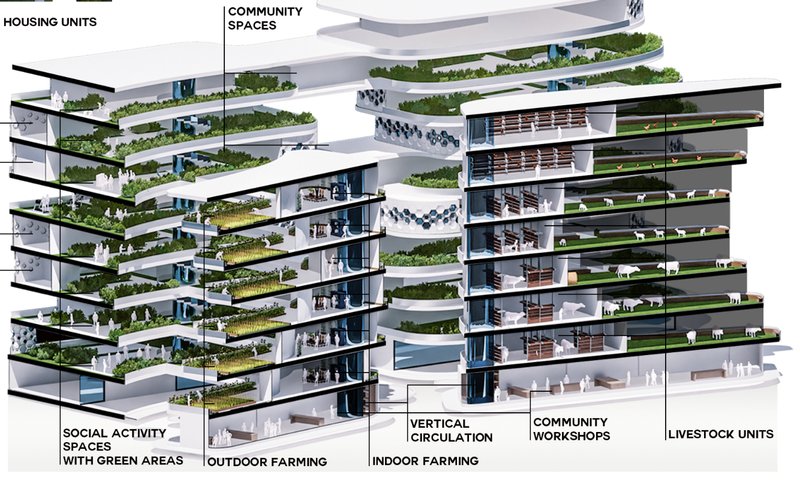
The section perspective and axonometric diagram reveal V-FARM's organizational clarity. Four core unit types are stacked vertically: residential flats conceived as detached homes with private garden terraces, semi-open communal farming floors, fully enclosed indoor growing laboratories, and livestock modules with paddocks and sheltered enclosures. Continuous planted terraces run along each floor plate, turning the building's edge into a productive landscape rather than a simple balcony. Exposed concrete soffits span between these green layers, giving the structure a legible rhythm of solid and cultivated.
The axonometric section makes the programmatic distribution explicit, showing how greenery is not confined to one zone but threaded through the entire building. Bridges along the horizontal planes handle circulation and connect masses, allowing residents to move between living quarters, farm spaces, and social areas without descending to grade. This separation of flows, combined with the vertical stacking logic, ensures that farming activities, livestock needs, and domestic privacy each receive appropriate environmental conditions.
Hydroponic Labs and Hands-On Plots Side by Side
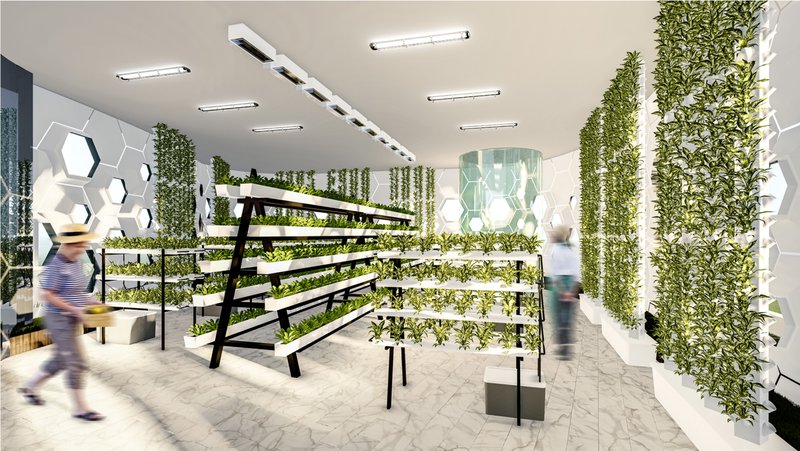
V-FARM splits its farming program into two complementary modes. Semi-open floors provide communal space for traditional, hands-on cultivation, while fully enclosed indoor zones house advanced hydroponic systems, smart irrigation, climate-controlled growth chambers, AI-powered crop monitoring, and automated harvesting. The interior rendering captures the latter: tiered grow beds and vertical plant towers fill a daylit volume, with people moving through what reads more like a research facility than a rooftop garden. This layered typology maximizes yield per square meter and minimizes water consumption, but it also creates an educational infrastructure where residents and visitors can engage directly with the food cycle.
Kinetic Hexagons: A Facade That Adjusts Like a Camera Shutter
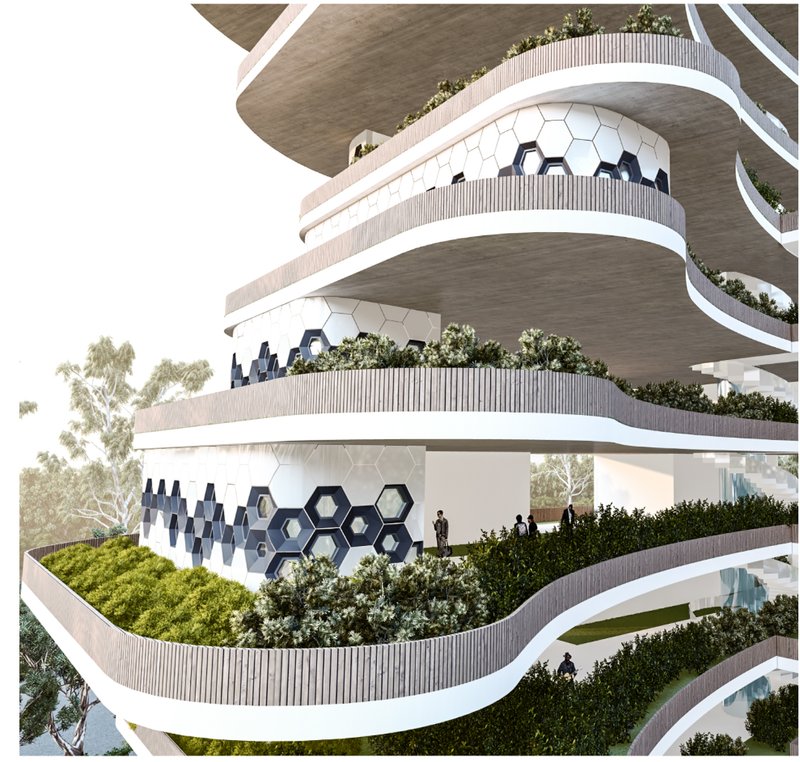
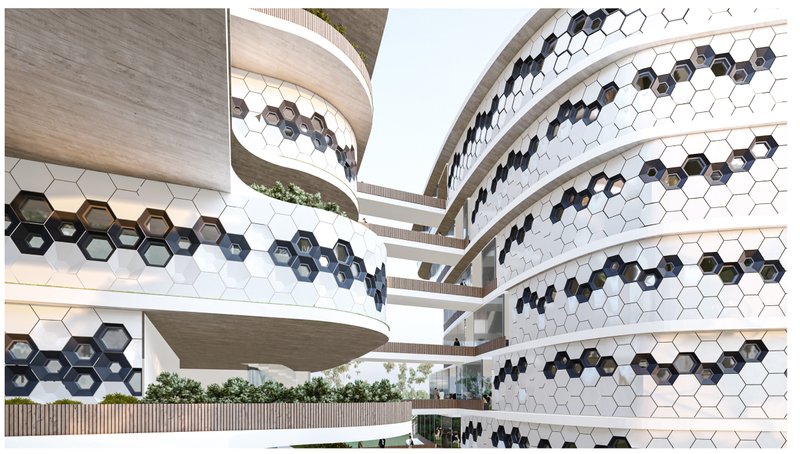
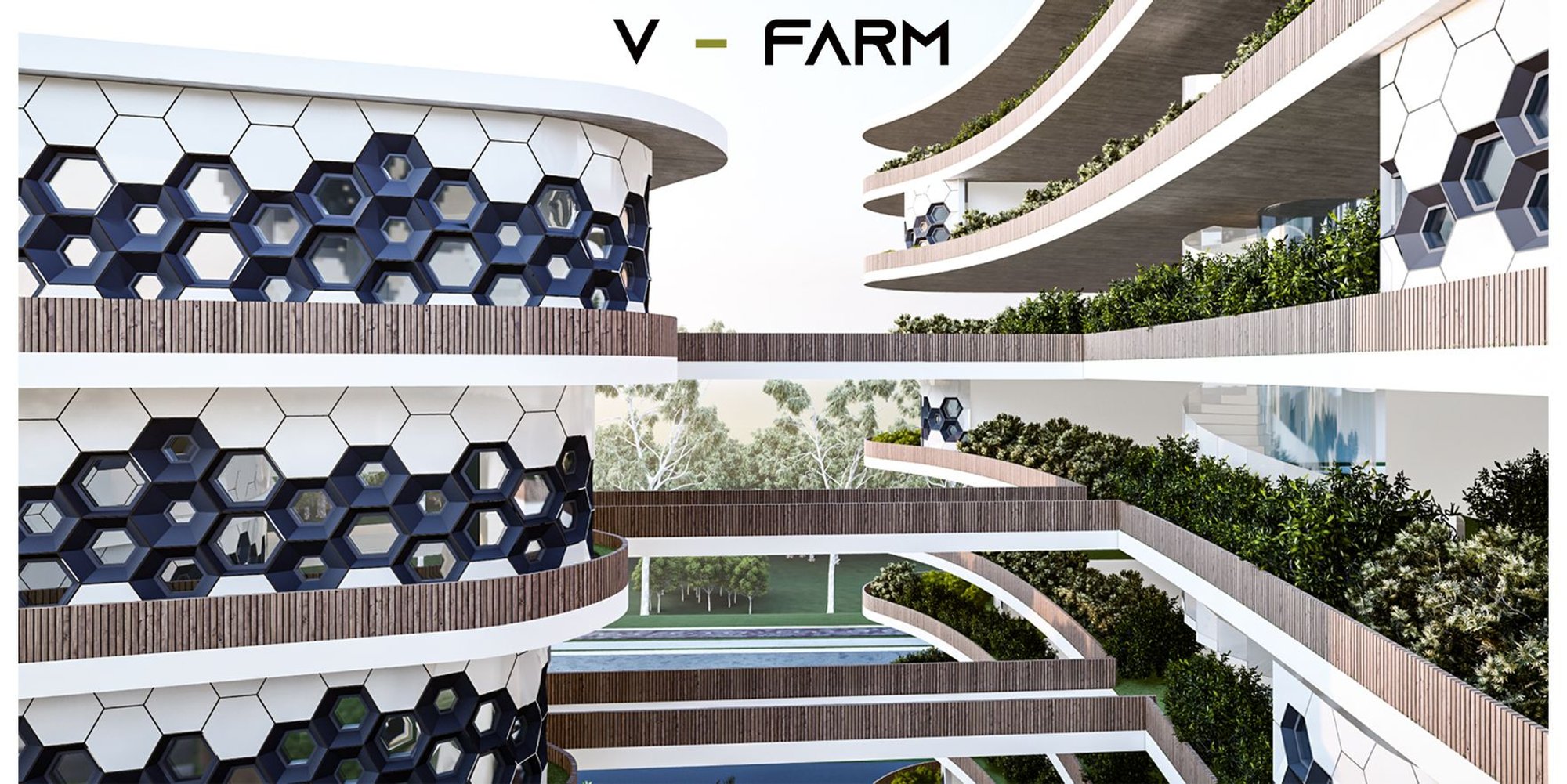
The most visually striking detail of V-FARM is its adaptive modular facade. Inspired by biomimicry and hexagonal geometries, the system combines operable glass panels with white metallic solar-integrated surfaces arranged in a tessellated pattern. A kinetic framing mechanism, described by the designers as similar to a camera shutter, lets occupants adjust each panel's transparency, airflow, and solar gain depending on the season, time of day, or activity behind the wall. The corner detail image shows these hexagonal tiles wrapping curved balcony volumes, while vertical slat railings and planted edges soften the geometry.
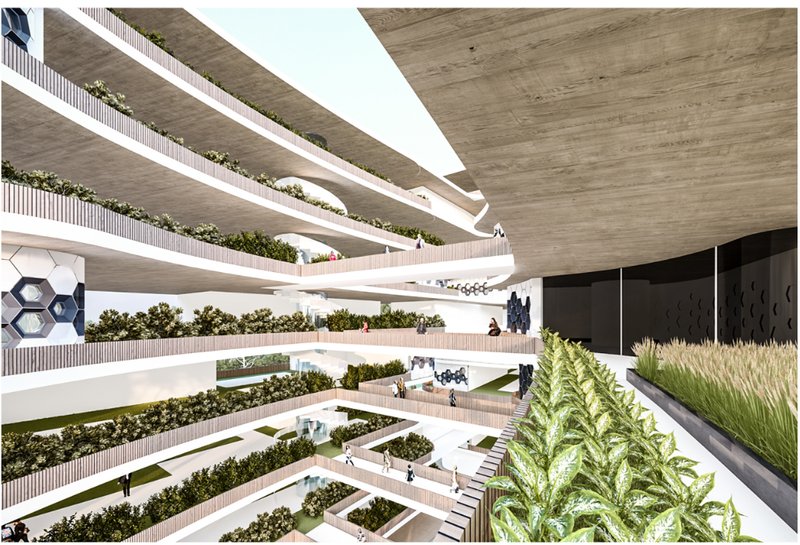
The interior atrium view demonstrates the effect of this facade strategy from inside: planted terraces sit beneath board-formed concrete slabs, bathed in daylight that the hexagonal panels filter rather than block. For the farming floors, this user-driven adaptability is critical. Indoor growing conditions demand precise control of light and temperature, and the kinetic facade provides it without relying solely on mechanical systems. For residents, the same mechanism supports mental wellness and comfort by putting environmental control directly in their hands.
Green Roofs, HVAC Integration, and Circular Resource Loops
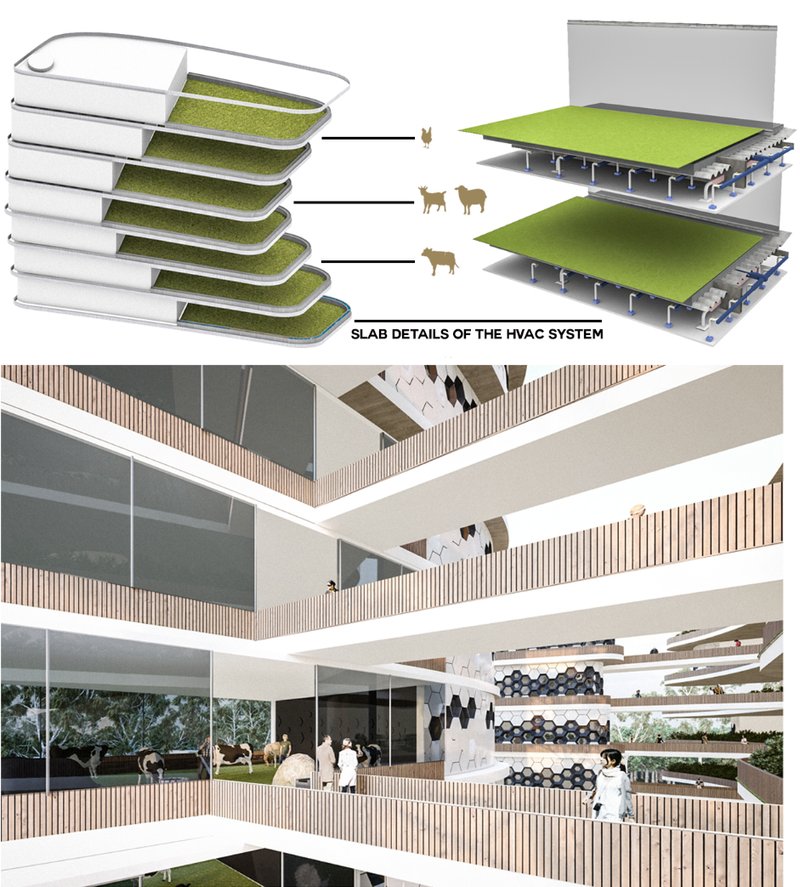
V-FARM's sustainability ambitions extend beyond the facade. The technical diagram and interior rendering show green roof slabs with integrated HVAC systems and timber slatted balustrades, revealing how the project embeds environmental services within its structural layers. Livestock modules incorporate biomass recycling, automated feeding, digital health monitoring, and sustainable poultry practices, contributing to a circular resource economy where waste from one module becomes input for another. Renewable energy generation, low-carbon material selection, and the modular construction approach itself all reinforce a framework designed to minimize ecological impact at every scale.
Why This Project Matters
Most urban farming proposals treat agriculture as an amenity: a green roof here, a community garden there. V-FARM is more ambitious and more specific. By making food production the organizing principle of the building section, Dogan and Denizci argue that farming is not a supplement to urban life but a fundamental component of it. The project addresses land use, energy, food security, animal welfare, and community building within a single modular system, which is exactly the kind of integrated thinking that vertical density demands.
The kinetic hexagonal facade alone deserves attention as a design contribution, but what elevates V-FARM beyond formal experimentation is its insistence on programmatic rigor. Every module has a clear spatial logic, every connection has a functional purpose, and the entire assembly scales from a single unit to a neighborhood-sized system. As cities confront the intersecting crises of food access, housing shortage, and carbon reduction, proposals like V-FARM offer a credible spatial framework for addressing all three simultaneously.
View the Full Project
About the Designers
Designers: Erinc Dogan, Berk Denizci
Enter a Design Competition on uni.xyz
uni.xyz runs architecture and design competitions year-round that reward proposals with spatial conviction and real site intelligence.
Project credits: V-FARM by Erinc Dogan, Berk Denizci FarmUrban (uni.xyz).




Popular Articles
Popular articles from the community

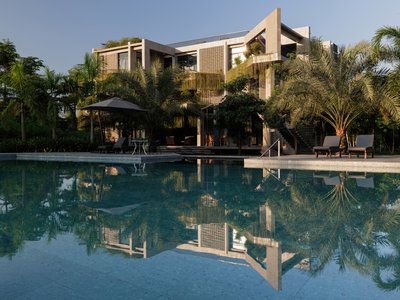
Reincarnation Weaves a Three-Story Retreat into the Green Landscape of Rural Bangladesh
Ara Manor in Narsingdi dissolves the line between domestic architecture and its lush surroundings through screens, courtyards, and planted rooftops.
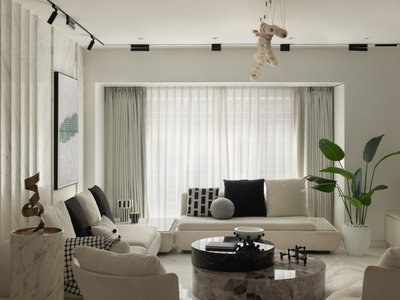
Inside a Timeless Mumbai Residence by Aether Studio
Aether Studio's 2,250 sq ft apartment in Malad, Mumbai uses marble, brass, boucle, and disciplined restraint to build a quiet retreat from the city.
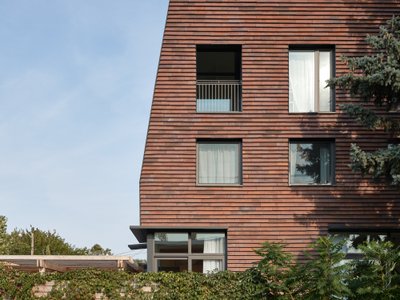
LGA Architectural Partners Build Toronto's First Multiplex Condo on a Single-Family Lot
Ulster House packs five zero-carbon units into a Harbord Village lot, proving gentle density can be market-ready and livable.
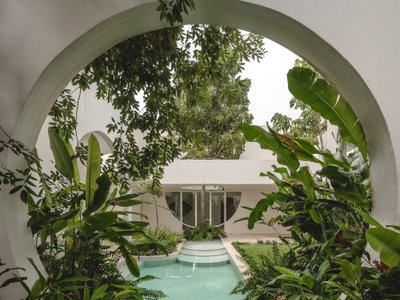
Etea and Ghostframe Carve a Surreal Domestic World from Arches and Circles in Mérida
Casa Eclipse wraps 385 square meters of sculptural living space around a lush courtyard pool in Mexico's Yucatán Peninsula.
Similar Reads
You might also enjoy these articles

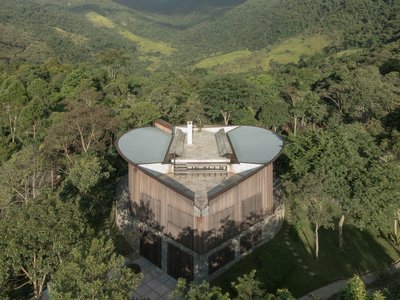
House in Bocaina by Ana Altberg + Cesar Jordão: A Circular Retreat Embracing the Atlantic Forest
Circular forest home in Brazil by Ana Altberg and Cesar Jordão, blending sustainable materials, passive design, and immersive landscape integration.
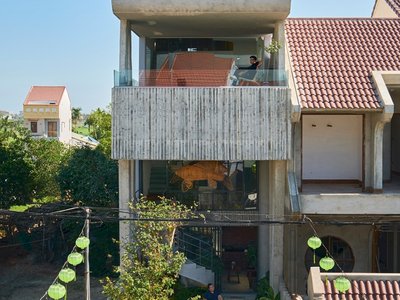
Cherry Homestay: A Harmonious Blend of Modern Design and Traditional Hoi An Architecture
Cherry Homestay blends modern architecture with traditional Hoi An elements, featuring spiral stairs, rooftop mezzanine, sustainable materials, and open, airy spaces.
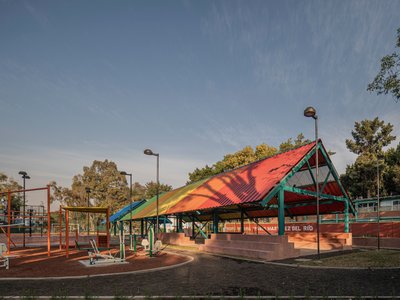
Revitalizing Culhuacán: Housing Unit Infonavit CTM Square by AMASA Estudio
AMASA Estudio revitalized CTM Culhuacán Square, transforming neglected housing unit spaces into vibrant, accessible, community-focused public areas with sustainable design elements.
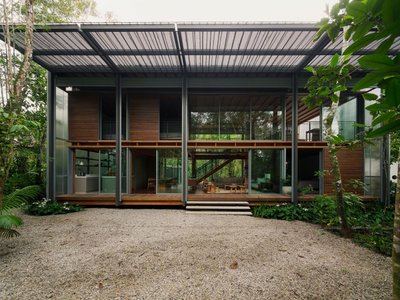
FR House by Andrade Morettin Arquitetos Associados: A Coastal Retreat Embedded in Brazil’s Native Landscape
Coastal vacation house blending into native vegetation, using translucent polycarbonate, timber structure, passive shading, and elevated design for climate-responsive living.


Explore Residential Building Competitions
Discover active competitions in this discipline




The Global Benchmark for Architecture Dissertation Awards


Challenge to design mud housing for contemporary communities
Comments (0)
Please login or sign up to add comments
No comments yet. Be the first to comment!