
Apeiron: An Underwater Athenaeum Where VR Revives Architecture's Lost Buildings
A submerged concrete and glass structure uses virtual reality to teach architectural history through play, curation, and creative reassembly.


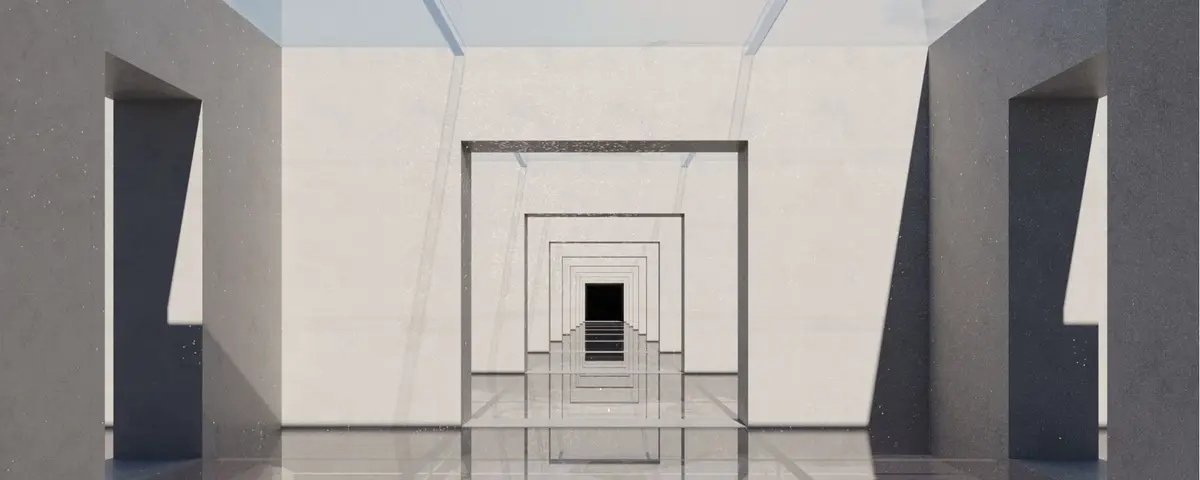
What if the word "architecture" itself could become a building? Apeiron: Athenaeum Testimonium Architecturae takes the etymological roots of the discipline, Arche (beginning, origin) and Tekton (builder), and translates them into a monumental linear structure that stretches from shore into the ocean before plunging beneath the surface. Above the waterline: concrete, light, a glowing entrance deck. Below it: glass-ceilinged chambers where refracted light, water, and virtual reality dissolve the boundary between architectural memory and active design. The concept is philosophical at its core but spatial in its ambition, proposing a place where destroyed, unbuilt, and forgotten buildings are resurrected through immersive gameplay.
Developed by Mateusz Fret, the project positions itself at the intersection of digital heritage and architectural education. The Athenaeum is not a static museum; it is a three-stage educational loop in which visitors learn about lost architecture, build new spatial compositions from collected historical fragments, and ultimately become curators who teach others. Concrete and glass serve as the material expression of Tekton, the act of building, while water and infinity represent Arche, the unknowable origin. The result is a hybrid world where philosophy, physical space, and immersive technology share the same address.
A Tapered Pier That Turns Etymology Into Form
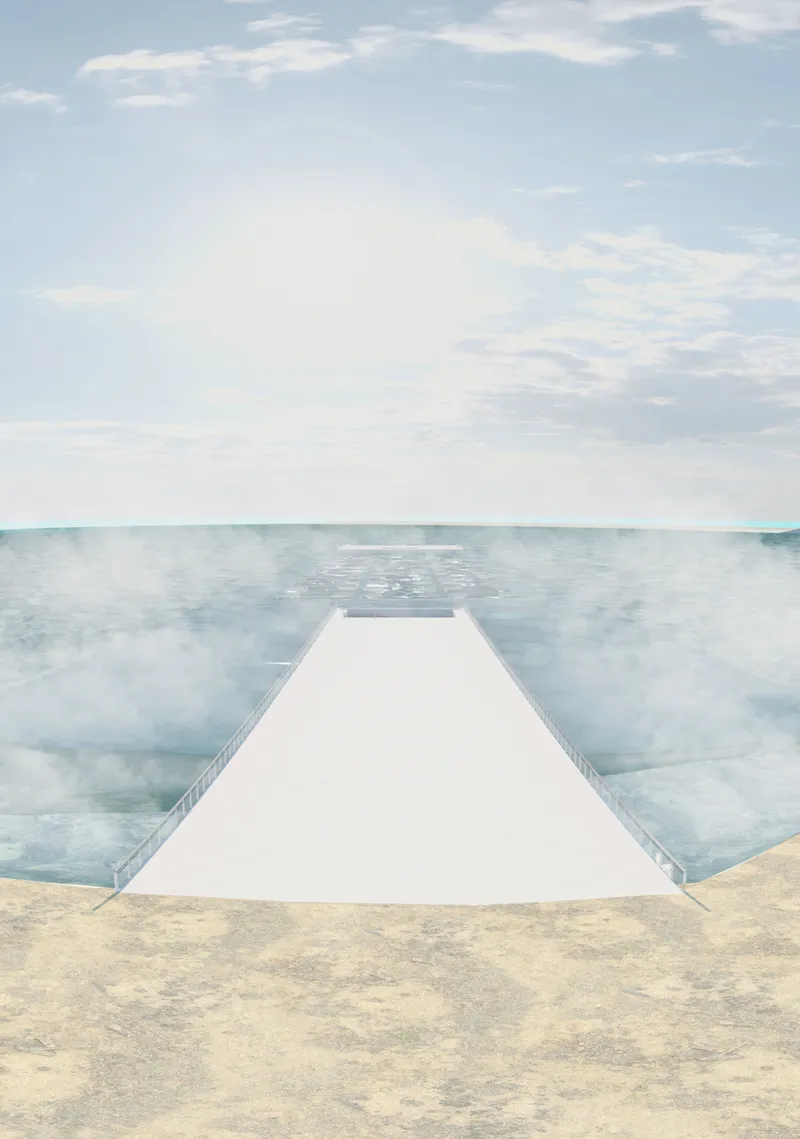
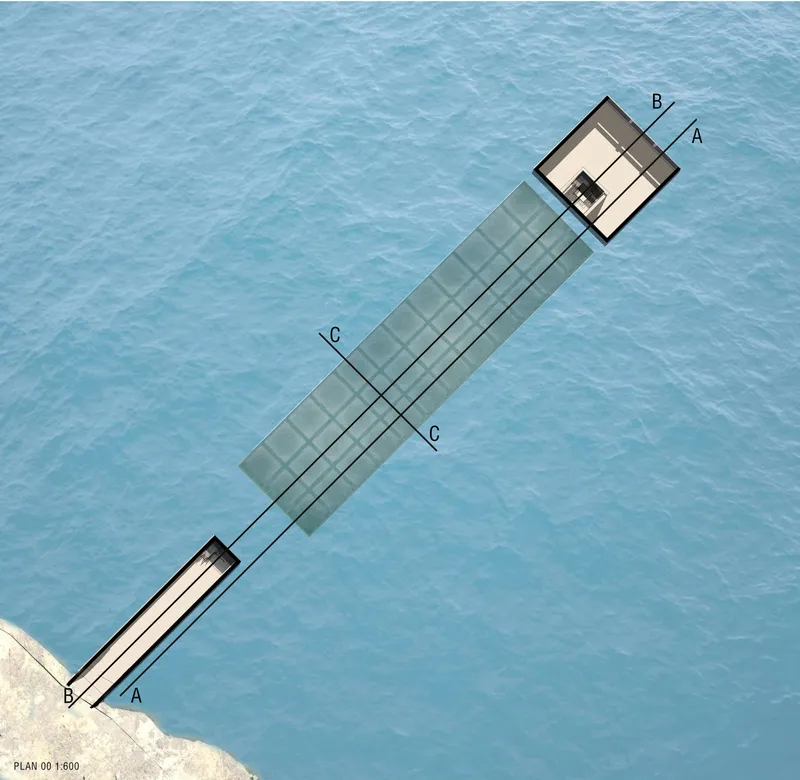
The building's primary gesture is its elongated, linear form: a white triangular pier that extends from the coastline into calm water, narrowing as it advances toward the horizon. The plan drawing reveals two pavilions connected by a transparent walkway, making the procession from land to sea legible as a spatial sequence. Visitors move from solid ground through a tapered bridge, passing reception and mapping zones before entering the VR chambers below the waterline. The taper itself is a deliberate formal choice, compressing perspective and heightening the sensation of crossing a threshold between the known and the unknown.
The plan's clarity is deceptive. What reads as a simple linear diagram on paper becomes something far more charged in section, where the structure splits into above-water social spaces (bookshop, reception, mapping zones) and a submerged world of modular cubic game chambers, exhibition corridors, and even an underwater restaurant with panoramic ocean views. The duality between the luminous deck and the surreal subaquatic interior mirrors the project's founding concept: Arche below, Tekton above.
Site Conditions: Rocky Shoreline, Open Bay
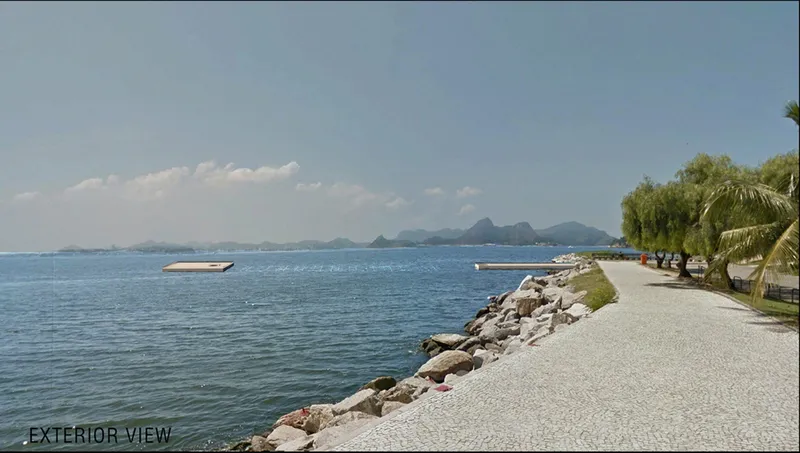
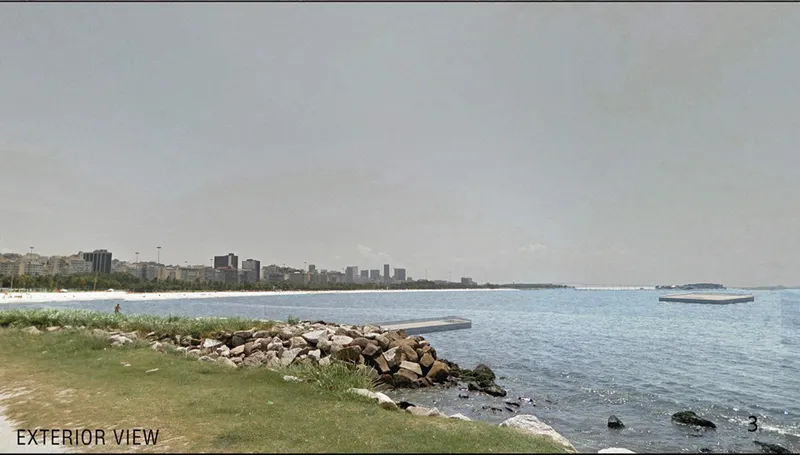
The site context reinforces the project's conceptual ambitions. A stone riprap shoreline with paved paths and palm trees establishes the transition zone between urban ground and ocean. The rocky, grassy embankment visible from the bay side suggests a landscape that already negotiates between land and water, between the constructed and the natural. A floating platform in the bay hints at the kind of hybrid infrastructure the Athenaeum proposes at a much larger scale.
These site photographs do important work for the project. They demonstrate that the coastline is not a blank canvas but a textured, inhabited edge. The riprap and the rocky embankment are evidence of ongoing negotiation between human settlement and tidal force. Placing a partially submerged structure here is not an arbitrary provocation; it extends an existing dialogue between shore and sea into something programmatic and pedagogical.
Coastal Horizon as Conceptual Backdrop
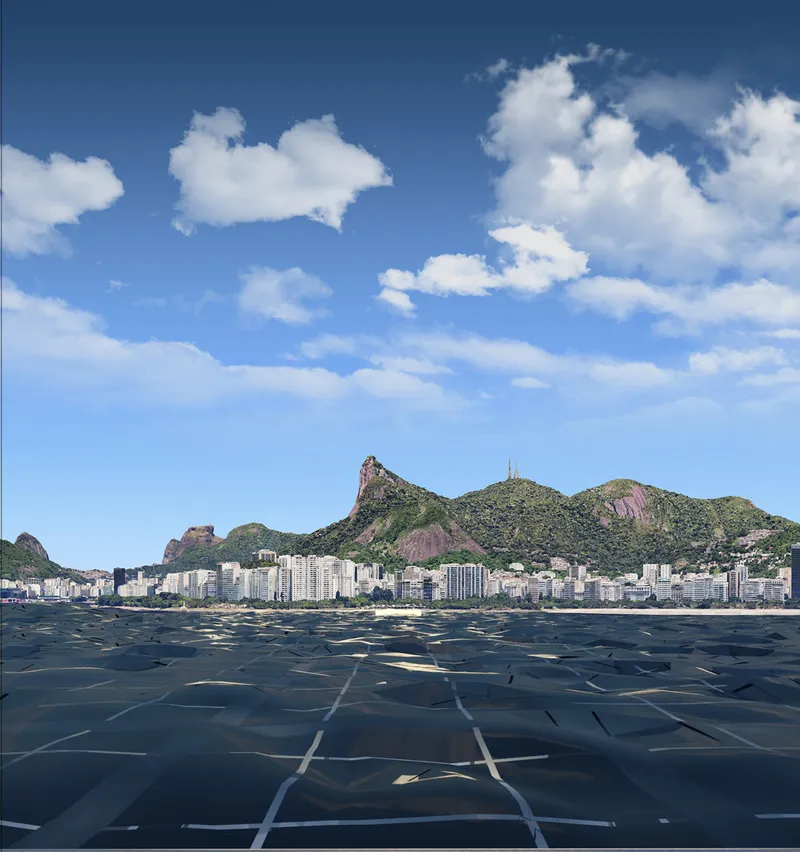
The view across dark water toward a coastal hillside with an antenna tower captures the atmospheric conditions the Athenaeum is designed to inhabit. The horizon line, where sky meets water, is the conceptual datum against which the entire building operates. Everything above it belongs to the world of Tekton: reception, orientation, the physical act of arrival. Everything below belongs to Arche: the unknown, the submerged, the virtual. The distant antenna tower is a quiet reminder that this landscape is already laced with invisible networks of information, a condition the project amplifies by embedding VR infrastructure within its underwater chambers.
Submerged Galleries on Piles: The Section Tells the Real Story
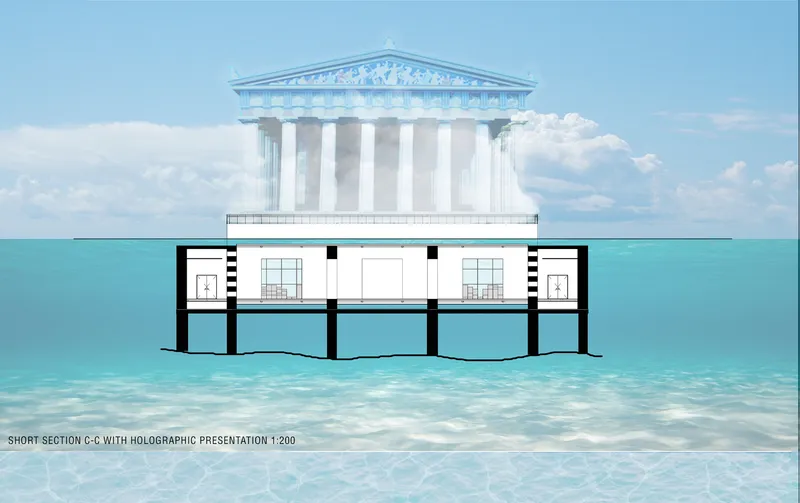
The section drawing is where Apeiron's ambition becomes most legible. A columned pavilion sits above the waterline, its classical proportions almost temple-like, while below the surface an entirely different world unfolds: submerged gallery spaces supported on structural piles, with glass ceilings that allow light to filter down through the water. The mirroring effect between the composed above-water pavilion and the cavernous below-water volumes is striking. It suggests that the visible architecture is only half the story, that the real program, the VR game chambers and exhibition corridors, exists in the territory typically hidden from view.
The three-stage educational model finds its spatial counterpart in this vertical organization. Learning, the first stage, happens in a grid of twelve 3-by-4 squares where players explore VR exhibitions of dead or unborn architecture. Creating, the second stage, provides tools for reassembling historical fragments into new compositions. Teaching, the final stage, transforms players into curators who contribute to a shared database of virtual structures. Each stage occupies a distinct zone within the submerged volume, and the section drawing makes clear that the journey downward is also a journey inward, from passive reception to active authorship.
Why This Project Matters
Apeiron takes a genuine risk by grounding its speculative technology in a rigorous conceptual framework. Many VR-forward architectural proposals rely on the novelty of the medium alone. Fret's project does something different: it uses the etymological structure of "architecture" as a spatial diagram, then populates that diagram with a clear pedagogical program. The three-stage loop of learning, creating, and teaching is not decorative. It proposes a model for how architectural heritage might be preserved, interrogated, and extended by future generations who engage with buildings not as static artifacts but as recombinant material.
The choice to submerge the primary program beneath the ocean surface is more than theatrical. It positions the act of discovery, both intellectual and spatial, as something that requires deliberate descent. You cannot stumble into the Athenaeum's core; you must commit to the crossing, to the pier, to the plunge. In an era when architectural knowledge is increasingly flattened into screen-based consumption, the insistence on bodily immersion and spatial sequence feels pointed and necessary. The project argues that architecture's origins deserve an architecture of their own, one that is as deep, literally and conceptually, as the discipline it seeks to teach.
View the Full Project
Apeiron: Athenaeum Testimonium Architecturae
View the full project with all boards on uni.xyz.
uni.xyzAbout the Designers
Designer: Mateusz Fret
Enter a Design Competition on uni.xyz
uni.xyz runs architecture and design competitions year-round that reward proposals with spatial conviction and real site intelligence.
Project credits: Apeiron: Athenaeum Testimonium Architecturae by Mateusz Fret.


Popular Articles
Popular articles from the community

Faces of the Soviet Avant-Garde: Turning Moscow's Street Names into an Open-Air Museum
A network of sculptural installations across a Moscow residential district transforms forgotten architect names into spatial encounters with cultural memor

Singing Woman: An Opera House That Performs Before the Curtain Rises
Ovidiu Cristian Pavel's conceptual opera house translates Estonia's choral identity into a sculpted waterfront landmark facing the Baltic Sea.

Extended Shell: Retrofitting Kolkata's Balconies as Living Urban Thresholds
A modular retrofit system recovers the social and environmental intelligence of Kolkata's historic verandas for contemporary Park Street residents.

Manzana Morphosis: Stretching Barcelona's Grid into a Living Landscape for 2050
A radical reworking of the Eixample manzana turns density into a tool for generous public space, vertical ecology, and environmental performance.

Similar Reads
You might also enjoy these articles

Play: Fragments of Their World: Remembered Architecture Rebuilt as a Modular Playground for Refugee Camps
Tom Gardner abstracts domes, arches and towers from the homelands of displaced families into a kit of child-scaled play parts for camp settlements.
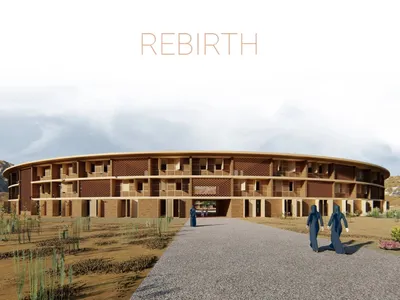
REBIRTH: A Circular Settlement Where Afghan Widows and Their Children Rebuild Life Together
A shortlisted Resile entry turns the circle into a protective ring of timber and brick, gathering homes, classrooms and gardens around a shared landscape.
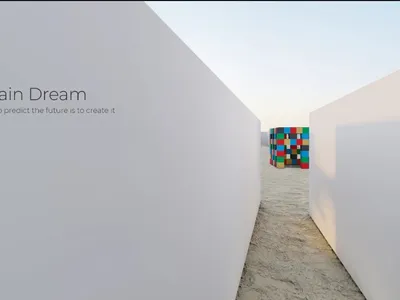
The Main Dream: A Recycled Plastic Kit That Lets Refugee Children Build Their Own Playground
Thirty-centimetre interlocking cubes that connect on three axes turn play into construction, letting children author the spaces they occupy.

Lunar Spiral: A Fibonacci-Driven Moon Settlement Rising from Shackleton Crater
Golden-spiral geometry organises buried infrastructure and orbiting habitable spheres into a lunar base designed to grow as life on the Moon expands.

Comments (0)
Please login or sign up to add comments
No comments yet. Be the first to comment!