
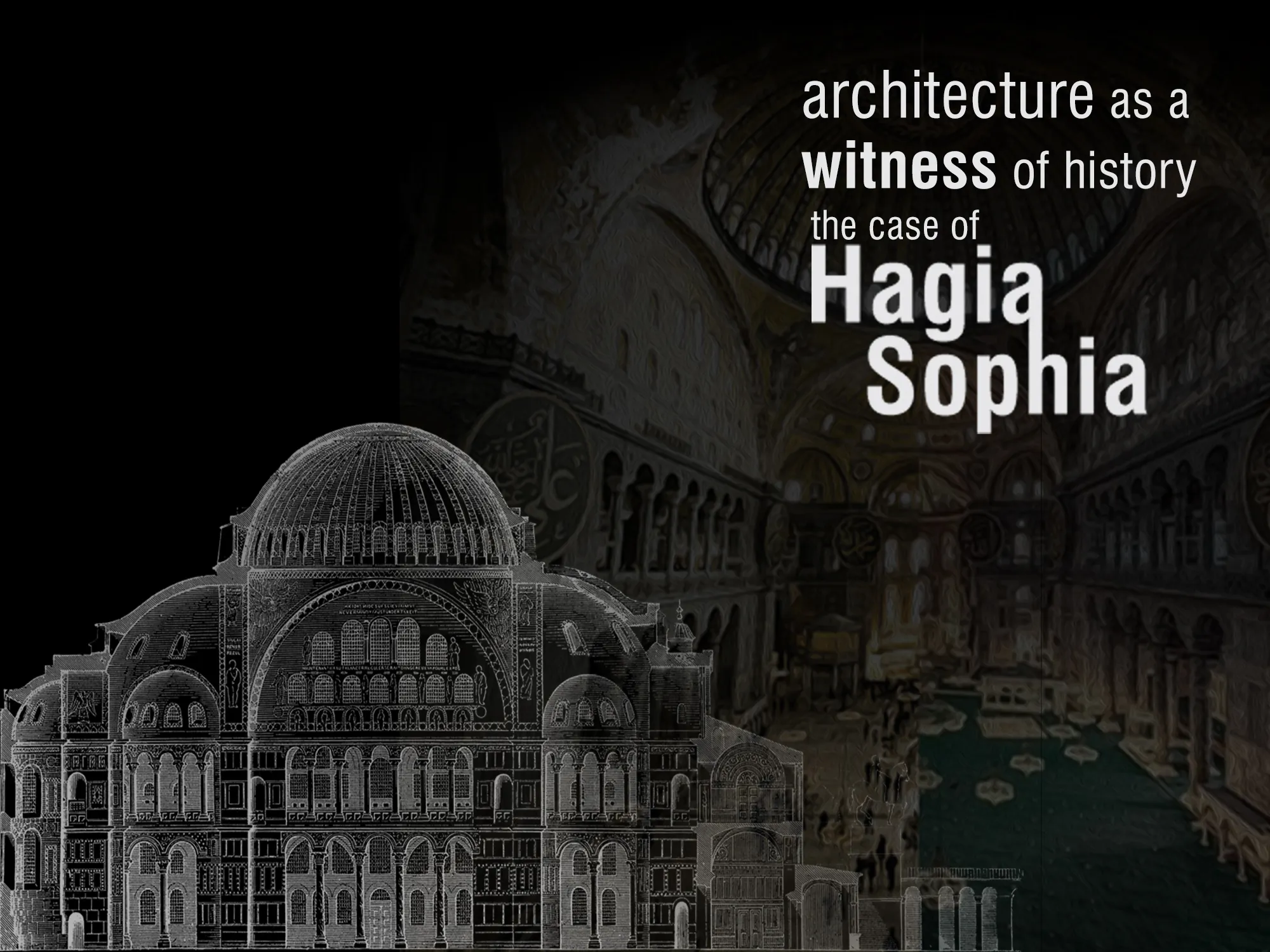
Architecture as a witness of history: The case of Hagia Sophia
Ezgi Çırpanlı
Architecture is The Witness of History
Charles Darwin once said about humanity “It is not the strongest of the species that survives, nor the most intelligent that survives. It is the one that is the most adaptable to change.”(4) Architecture is a part of this journey of humanity to adapt to the changes and try to survive. In every age, in every era, we try to find solutions to deal with the problems of that era. Finding solutions to problems, the essence of architecture… When we need to settle, we built settlements; when we need to gather and need a public space, we designed forums, when we need a place for religious activities, we built first temples… The history of architecture is a crucial element to understanding the history of humanity, to experience the soul and the atmosphere of different eras in the world and to analyze the methods and movements of architecture in regards to historical progress in the world because Architecture is the first-hand witness of history. According to Octavia Paz, since it is not possible to talk about a building regardless of its witness of an era, culture and its society, architecture is the incorruptible witness of history(3). However, we have to remember that it is incorruptible as long as we protect its authentic atmosphere and texture(3) .
Multi-Layeredness and Turkish Architecture
Different textures and atmosphere designs different fragments, different fragments design different layers. Multi-layered structured contexts have collective fragmentations of different eras, cultures, etc(2).
I grew up in a multi-layered country Turkey. In this land, there was different fragments, different cultures and different values built up on each other. From first communities and remaining of the world, Göbeklitepe, to modern Turkish architecture; all those layers create unique identity in the Architecture history because Anatolia had different cultures, different societies and different layers. If we try to analyze remaining, structures and buildings, we can reach a lot of information of different eras of the world and different cultures. In other words, the Architectural Layers in Turkey are witnesses of varied eras.
Preserving historical texture of places should be mandatory because historical texture is important to analyze and understand historical background of places and build new information, fragment, layer(2). I mentioned about authentic atmosphere and texture in architectural context and how they are important to have least incorruptible witness of history. The unique texture of Turkish Architecture; historical identities and architectural values in Turkey have been preserved and analyzed to have better understanding about the journey of humanity.
The Case of Hagia Sophia
Hagia Sophia is one of the great examples in Turkey that shows multilayered, unique texture of Turkish Architecture. Moreover, Hagia Sophia has a role of bridge between different cultures and values in the world. I have been interested in the case of Hagia Sophia and during the discussion of The Conversion of Hagia Sophia into a Mosque, me and my friends decided to conduct a mini interview format survey. In that study we try to analyze the controversial aspect of conversion process and we want to raise an awareness towards universal value of Hagia Sophia.
We, as a group of four, prepared and asked eight questions to eight people from different occupation and social groups. Unfortunately, due to pandemic we couldn’t enhance our studies and target group.
Some Questions and Analysis
First question was about historical and political values of Hagia Sophia. In the field of conservation, values of conservation objects and areas cannot be prioritized over each other. However, there could be some misunderstanding and misconceptions towards this issue and we aimed to analyze this possible misconception and raise an awareness about this issue. The majority of people prioritized the building’s historical value. Only 1 person prioritized its religious value. 2 people think that its religious and historical values are equal(1).
The architectural qualities of Hagia Sophia are significant for architectural development and expressions in the world. One of the features is its acoustical properties. Acoustical design of Hagia Sophia is very fragile and detailed, even a little change of used material could destroy the whole acoustics of Hagia Sophia. Unfortunately, in conversion of Hagia Sophia, floors covered with carpet some parts of the place. The majority of the interviewees are either not aware of this quality or do not think that is an important thing to worry about primarily. The general perception is towards the fact that the carpet on the floor is required due to religious reasons. One person proposed that people can bring their own prayer rugs. Also, there is a similar issue about the frescoes and mosaics and how they should be treated with the information of they are not covered till 18th century. Majority of interviewees weren’t aware of this factor and majority of them thinks they should be covered without damaging them if Hagia Sophia turns to be a mosque(1).
We also questioned about cultural and religious values of Hagia Sophia; how Hagia Sophia witnessed different religions and different cultures and how those conversions affected Hagia Sophia. There were different approached to this question. 3 people think that it should be preserved as a museum but if it is open to worship to Islam, it should also be open to worship for Christianity. 3 people think that the changes in the function of the building through time is normal because the building has been an important landmark for every culture it has hosted. They also noted that we should focus on preserving Hagia Sophia as archeological heritage(1).
As a result of this interview we reach the conclusion that the awareness towards its features, values and historical fragments are lacking.
Maybe we are not that aware of what we have, what we surrounded with.
Raising Awareness on Architectural History
The case of Hagia Sophia should show us that we have to aware of what we have. We have to preserve, analyze and question historical structures to understand the journey of humanity, to see details and methods that are used in those structures and analyze them to design better solutions for current problems by improving our knowledge and to experience the atmosphere of volumes, to feel the spirit of history. If we don’t aware of them, we might not be able to understand and adapt the changes of the world, we might lose our identities. Or maybe…
References (4)



Popular Articles
Popular articles from the community


The Musturak Paradise: Senior Living Architecture for a Connected Future in Temara, Morocco
The Musturak Paradise reimagines senior living architecture in Temara via private homes, social spaces, culture, community, and shared care.

Co-life: Sustainable Architecture for Age-Friendly Community Living
Co-life reimagines sustainable architecture for seniors through courtyards, rammed earth, shared gardens, and spaces designed for belonging.

Conexión: Biophilic Design Reimagines High-Rise Living in Hong Kong
Conexión reimagines high-rise living in Hong Kong through biophilic design, green facades, shared spaces, daylight, water and nature within.

Riyadh For All: Intergenerational Urban Design for Active Aging in Rabat
Riyadh For All reimagines urban design in Rabat with intergenerational co-living, adaptive courtyards, and Moroccan cultural exchange today.


Similar Reads
You might also enjoy these articles

Bao Huynh Watercolor Atelier: A Serene Art Retreat in Hội An
Bao Huynh Watercolor Atelier in Hội An blends multifunctional art spaces, sustainable design, local materials, and family-friendly living in a serene environment.

Atelier Macri Concept Store Interior Design by CASE-REAL
Atelier Macri store features a "ko" counter, walnut wood details, cork displays, blending retail, gallery, and seamless customer experiences.

Manuel Vargas Izquierdo Stadium and High-Performance Sports Center: Architectural Excellence in Jalpa de Méndez
The Manuel Vargas Izquierdo Stadium blends sustainable design, inclusive sports facilities, and cultural-inspired architecture, revitalizing Jalpa de Méndez’s public spaces.

KAKR Buluh Awar Hall: Revitalizing Community and Ecology Through Bamboo Architecture
Community built bamboo hall revitalizes Buluh Awar village, empowering youth, restoring ecology, celebrating vernacular craftsmanship through sustainable architecture and culture.





Comments (0)
Please login or sign up to add comments
No comments yet. Be the first to comment!