
Astronaut Training Facility: Modular Architecture for India's Next Space Hub
A 400-acre campus in Challakere, Karnataka, draws on ISS modularity to prototype planetary habitats and astronaut training grounds.


What does a city designed for space look like when it's planted firmly on the ground? In Challakere, Karnataka, a 400-acre site earmarked by the Indian government for space innovation becomes the testing ground for a radical proposition: an entire architectural ecosystem built around astronaut training, extraterrestrial simulation, and closed-loop sustainability. The Astronaut Training Facility treats architecture not as a fixed container but as a living modular organism, one that can grow, adapt, and reconfigure itself in the same way the International Space Station adds new modules over time.
Designed by Vishnu Jangir and published on uni.xyz, the project operates under a concept called "Interstellar Nexus." It positions the campus as both a prototype for future planetary habitats and a catalyst for socio-economic transformation in the region, aiming to turn Challakere into a science hub where architects, engineers, and scientists collaborate on life-support systems, AI technologies, and resource-extraction research.
A Circular Masterplan Built for Continuous Expansion

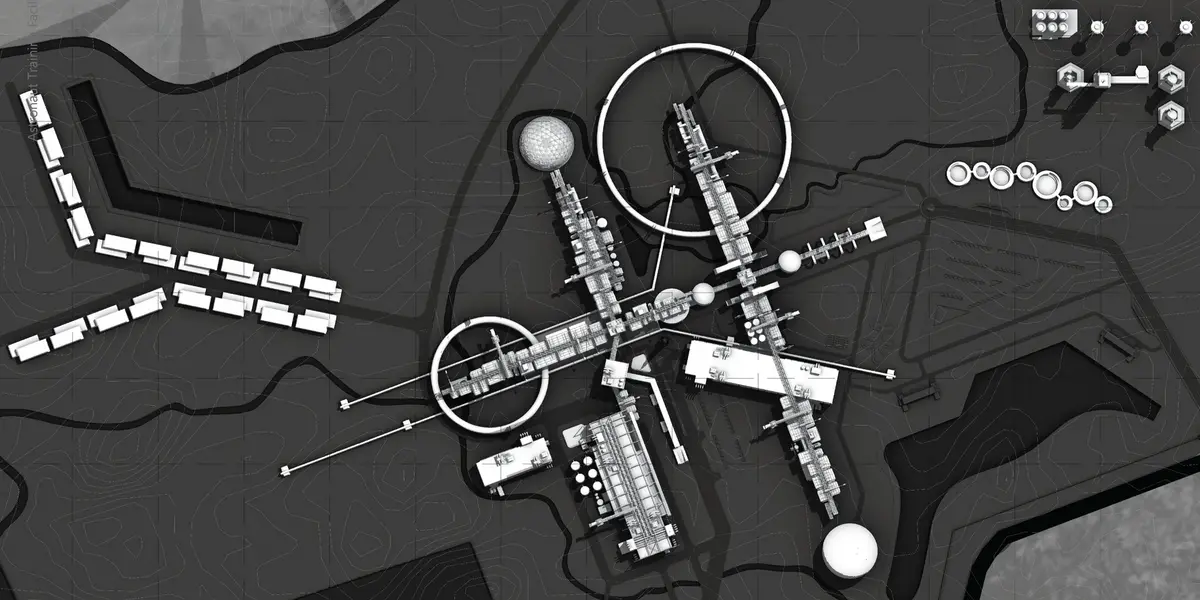
The isometric site plan reveals the organizational logic at a glance: a dense circular core radiates outward to specialized perimeter facilities, each labeled and purpose-built. AI and biomechanics labs sit alongside centrifuge and vacuum chambers. Simulation zones designed for virtual mission environments neighbor space mining test beds and hyperloop testing rings. Geodesic domes and a planetarium face the public edge of the site, signaling the project's dual commitment to cutting-edge research and popular education. The attachable modular structure means no zone is terminal; every building can grow or be replaced without disrupting the whole.
What separates this plan from a conventional campus layout is its insistence on interconnection. Circulation bridges, covered walkways, and shared service spines link disparate programs into a single continuous network. Accommodation blocks and buoyancy labs sit close enough to training zones that the boundary between living and working dissolves. Jangir frames the result as a blueprint for future research cities, and the drawing supports that ambition: it reads less like a campus and more like an urban district organized around a single purpose.
Steel Trusses and Filtered Light: An Industrial Aesthetic for Cosmic Ambitions


Step inside the facility and the mood shifts from speculative urbanism to raw, high-tech atmosphere. An elevated steel truss bridge casts precise geometric shadows onto the floor below as sunlight filters through its framework. The rhythm of the structure draws directly from ISS modular geometry, but the scale is terrestrial and monumental. Horizontal pipes, black steel frameworks, and elevated industrial platforms create layered compositions that feel simultaneously like a spacecraft interior and a construction site in perpetual evolution.
One striking perspective shows a flooded plaza overlooked by a raised platform, where a robotic dog occupies the scene like a sentinel. The juxtaposition of water, steel, and autonomous technology captures the project's ethos in a single frame: the facility is a place where the mechanical and the organic, the built and the natural, coexist in deliberate tension. Cranes, trusses, and circulation bridges are left exposed rather than concealed, reinforcing the idea that this architecture is never finished, always adapting.
Monumental Stairs and Winter Light as Spatial Experience
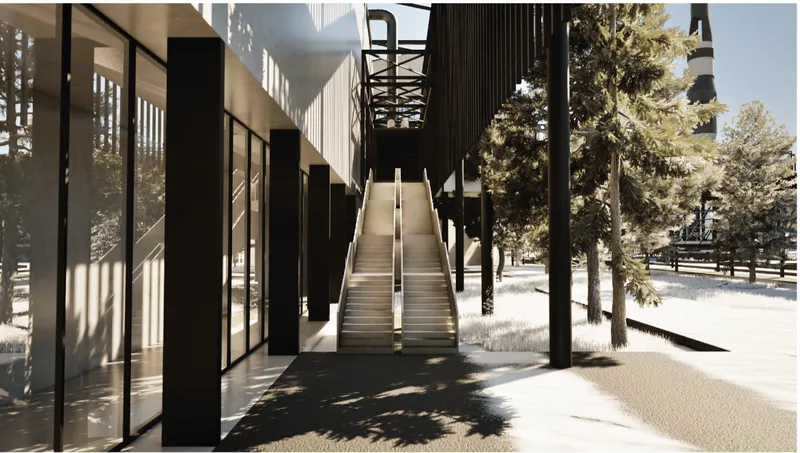
A broad staircase ascending beneath exposed steel trusses reveals how Jangir handles the transition between scales. Glazed volumes and trees visible in low winter sunlight soften the industrial language without undermining it. The staircase is generous enough to serve as a gathering space, not just a circulation route, and the structural grid overhead provides a canopy that modulates light across the day. It is a moment where the facility pauses its relentless technological program and offers something more contemplative: a place to move slowly, to look up, to feel the weight and ambition of the structure overhead.
Red-Lit Cores and Circular Paths at Dusk

The axonometric rendering at dusk is perhaps the most evocative image in the set. Stacked levels glow with red-lit interior spaces while illuminated circular circulation paths trace the building's organizational DNA on the exterior. The color palette shifts from the daytime grays and blacks to something warmer and more theatrical, suggesting that the facility transforms after hours into a different kind of environment: one oriented toward observation, reflection, and perhaps the kind of controlled-atmosphere simulations that demand reduced ambient light. The circular paths echo the masterplan's radial logic at a smaller scale, reinforcing the idea that every level of design, from site to section, follows the same generative geometry.
From Digital Vision to Physical Prototype
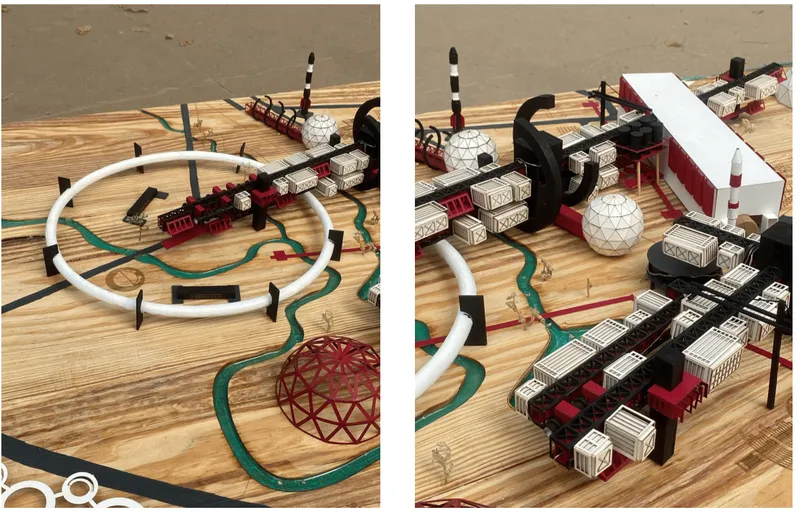
Jangir's commitment to physical model-making grounds the project's speculative ambitions in tangible reality. The model, built on a plywood base, translates the masterplan's complexity into a legible spatial artifact: a curved white rail loop connects modular blocks and dome elements, making circulation logic and programmatic relationships immediately graspable. For a project of this conceptual density, the model serves a critical pedagogical function, bridging academic theory and real-world application by forcing decisions about scale, connection, and environmental systems that digital tools can sometimes obscure.
The model also reveals something the renderings hint at but don't fully articulate: the campus's relationship to its terrain. The plywood base reads as flat, arid ground, consistent with Challakere's semi-arid landscape. Dome elements rise above the baseline, modular blocks cluster at varying densities, and the rail loop provides a legible spine that holds the whole composition together. It is a prototype of a prototype, a physical rehearsal for a facility that is itself conceived as a rehearsal for off-world living.
Why This Project Matters
The Astronaut Training Facility operates at a scale and level of ambition that most student projects avoid. Rather than designing a single building, Jangir proposes an entire district, one that fuses research, habitation, education, and public engagement into a coherent architectural system. The ISS-inspired modularity is more than a formal gesture; it provides a genuine operational logic for a campus that must accommodate technologies and programs that do not yet exist. That willingness to design for uncertainty, to build in adaptability as a first principle rather than an afterthought, is what gives the project its conceptual weight.
More broadly, the project asks a question that architecture will increasingly need to answer: how do we design terrestrial environments that prepare us for extraterrestrial ones? Jangir's response is not to mimic the aesthetics of science fiction but to engage seriously with the systems, simulations, and spatial typologies that space training actually requires. The result is a facility that looks forward without losing its footing on the ground, rooted in Karnataka's landscape and India's space ambitions while reaching toward a future where the boundary between Earth-based architecture and planetary habitat design becomes productively blurred.
View the Full Project
About the Designers
Designer: Vishnu Jangir’s
Enter a Design Competition on uni.xyz
uni.xyz runs architecture and design competitions year-round that reward proposals with spatial conviction and real site intelligence.
Project credits: Astronaut Training Facility by Vishnu Jangir’s.


Popular Articles
Popular articles from the community


Opera on the Sea: Driftwood Logic Shapes a Timber Opera House on Estonia's Coast
Trevor Orgill's opera house translates the entangled drift of floating timber into a civic building where wood, water, and music converge.


David Ortega Stacks a Two-Story Mexico City Penthouse Around a Steel Stair and a Pergola-Shaded Roof Terrace
In Colonia Roma, a 300 m² penthouse uses oak joinery, a planted steel stair and a slatted roof pergola to make a new-build apartment feel like a house.

graciastudio Turns a Viewless Tijuana Lot Inward Around a Courtyard of Concrete, Timber and Trees
In Tijuana, Jorge Gracia's GA2 House stacks a timber-clad private floor over exposed concrete and replaces a missing view with a planted interior patio.

Aquadapt: An Underwater Habitat That Rewrites Its Rooms by the Hour
Curved modules ring the seabed while one shell shifts from breakfast room to cinema, farm and football pitch as residents' needs change.

Similar Reads
You might also enjoy these articles
Yenisei Monitoring Center: A Sun-and-Moon Sphere Anchors a Research Campus on Siberia's Great River
In Krasnoyarsk, shifting square blocks, a glazed central sphere and descending window rhythms turn river science into a public spectacle on the Yenisei.
Andretta Artist's Village: A Node-Based Masterplan That Lets the Hills Write the Plan
A cultural landscape strategy for Palampur's artist colony threads studios, residences and stages along a porous spine shaped by the Dhauladhar terrain.
Street Children Rehabilitation Center: A Brick Campus That Eases Children From Street to Safety
A low-rise courtyard campus where learning streets, uthans and shaded verandahs stage a gradual passage from street into protective, family-scale life.

The NEON Culture: A Field of Pavilions Built for the 24-Hour City
Smaran Alva spreads galleries, stages, clubs and markets across a varied site, treating light, sound and ramped movement as the real building materials.


Comments (0)
Please login or sign up to add comments
No comments yet. Be the first to comment!