
ATHENEUM
A polygon for architectural sensations

Architecture purely as a built space erected at a given plot is disappearing nowadays. We're not designing a building, but an experience. A space of exploration and an interactive journey.
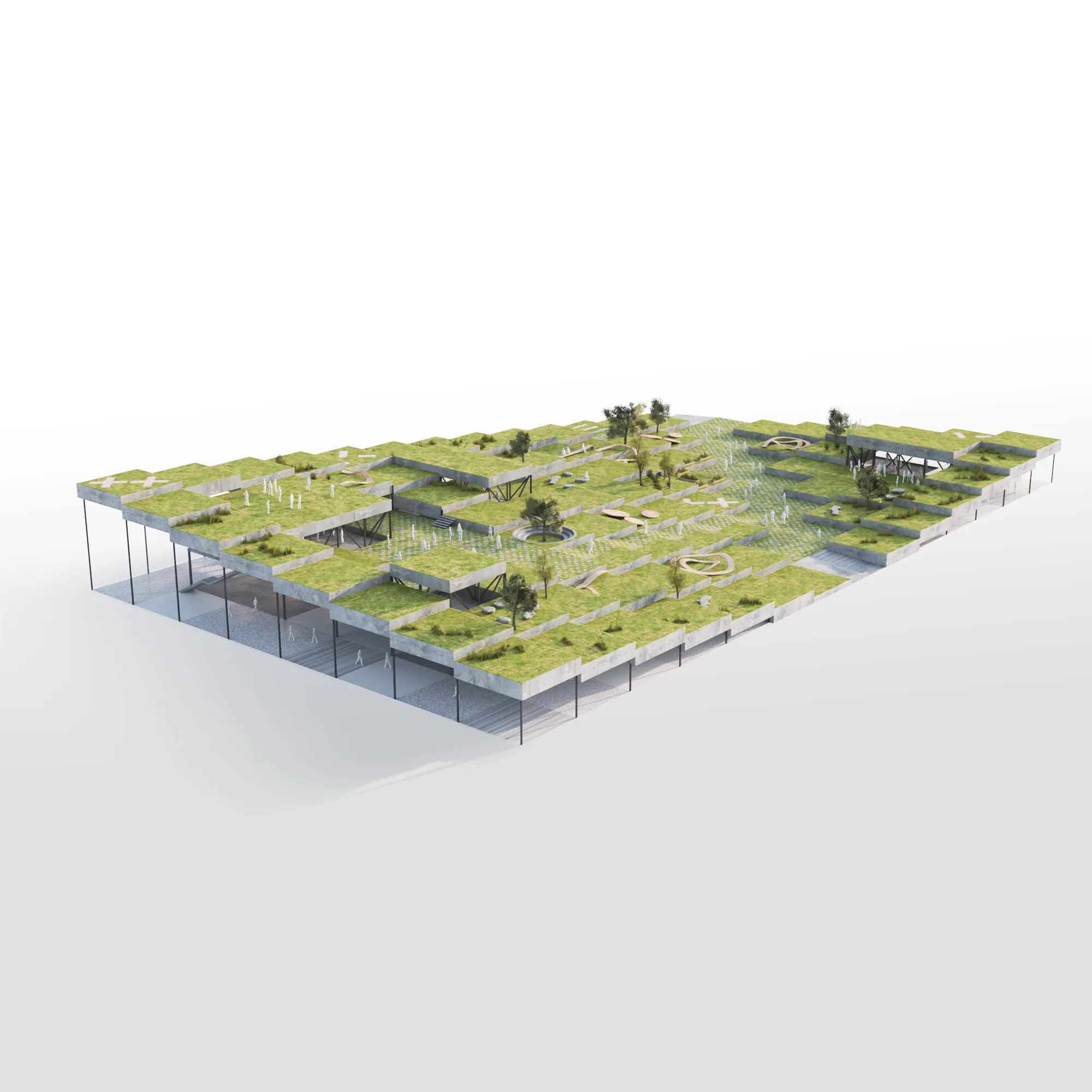
We see Atheneum as a polygon for architectural sensations – and interactive organism through which we explore and examine diverse architectural tools and phenomena.
Playground, park, garden, oasis, sea square, exploration polygon… this inhabited green slope is all that simultaneously.
We see Atheneum as an interactive space, so our design doesn’t offer previously prepared answers, but gives the users the opportunity to find their own approach, we just give the base, on which an individual or a group explores.
While inquiring the contrasts and sensations (introverted-extraverted, full-empty, green-built, pubic-private, soft-hard…), we decided to engage all the senses of the users, therefore Atheneum is experienced through touch, sight, hearing, taste and smell.
It’s a place to study and explore how to approach life and sustainability by designing. This building is a green park that reuses all available sustainable resources.
There are two main space zones: exterior auditorium-park and the interior organism. They are connected through test-rooms in which we will be able to inquire different layers of the space. Flexible construction with diverse dividing panels leaves users the freedom to redesign this space as they explore it. In that way, they each time leave a different scenario for the incoming users.
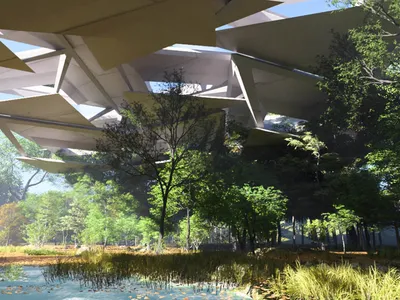
All hall areas spread out and reach for the sea through the park-square. Exhibition and exploration boxes float in space, connecting the indoor space with the outdoors slope. The boxes go from perfectly illuminated and air conditioned "black box" for exposure and interaction (when curtains are on), to the open, naturally lit boxes that are merging with the exterior.
We noticed that the site area is a special place in Copenhagen regarding it’s position opposite to the historical Kastellet, we follow the architecture history timeline just by looking over the sea. Seeing this specific genius loci as a sort of an architecture timeline, we travel from the 17th century Kastellet (that has the reminiscence of the original Viking encampments present in it’s green bastion walls), through landmarks of Marmor kirken, st. Alban’s church and many more, our sight reaches back all the way to the Langelinie pavilion and to 20th century. The timeline finishes with Atheneum and with the idea of space we as designers and architects have to offer today.
Respecting this praiseworthy context, we see our site partly as an auditorium for the historical concepts that are pregiven around the site, and partly as a classroom in which we learn to explore our environment, both space-wise and sustainability-wise.
We understand the importance of the “emptiness” and “auditorium” concepts when faced with this specific genius loci. We are not making a design that is trying to “compete” with it, but that respects and complements it.
From our green-auditorium, one can perceive the surrounding buildings as if they were the “stage” and the focus, and the Atheneum is it’s audience, engaged fully in an experience of space exploration.
In some of the modules overlooking specific Copenhagen’s buildings, there will be a presentation of the given landmark and it’s historical period, combined with the materials used in that period for visitors to explore.
Our wish is to keep the unique identity of this “void”, pedestrian, cycling, green – and enrich it with all the key qualities of Danish approach to life. We’re incorporating them in the green pixelated fabric of the park.
That is why we design a building that is aware of its surroundings, environment, learning processes in architecture and design, and most important of all, that is encouraging visitors to explore. The “green” and the “Atheneum” content work together the whole year round.
The element of the “test-box” spaces is used to form the terraces and intimate spaces that flow one into another. It connects the interior content with the park-auditorium and it’s context.
Open auditorium is formed as a sort of an outdoor living room, with the room, square and street qualities that are juxtapose on some points, and merged on the others, through the building’s landscape. The gardens oasis are connected by sets of auditorium slopes, squares, ramps and stairs.
While designing ATHENEUM we concluded that bringing the active learning process into the museum is just as important as the museum exhibits, and creating a space of gathering where the users are be able to discuss, think and comprehend new ideas regarding our environment and built space, as the main focus of our design.


Popular Articles
Popular articles from the community


Co-life: Sustainable Architecture for Age-Friendly Community Living
Co-life reimagines sustainable architecture for seniors through courtyards, rammed earth, shared gardens, and spaces designed for belonging.

The Ocean Hive: Sustainable Architecture for a Self-Sufficient Civilization at Sea
The Ocean Hive imagines sustainable architecture at sea, where modular habitats, algae, wave power and ocean waste sustain a growing colony.

Riyadh For All: Intergenerational Urban Design for Active Aging in Rabat
Riyadh For All reimagines urban design in Rabat with intergenerational co-living, adaptive courtyards, and Moroccan cultural exchange today.

Lunar Spiral: Space Architecture Shaped by the Mathematics of the Universe
Lunar Spiral reimagines space architecture through Fibonacci geometry, lunar regolith, levitating habitats, and self-sustaining Moon living.


Similar Reads
You might also enjoy these articles
The Rhythm of Seasons
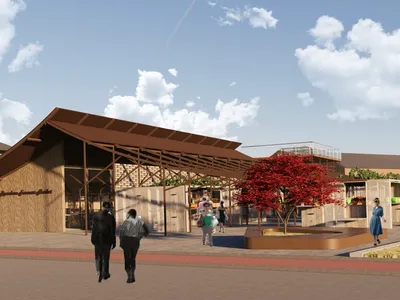
A Farmers' Market Connecting Nature and the City

More Than a Building-Designing a Living System
More Than a Building-Designing a Living System
Base Beyond
DESERT COMPOUND ARID: TOURISM OF ABSENCE AND ABUNDANCE






Comments (0)
Please login or sign up to add comments
No comments yet. Be the first to comment!