
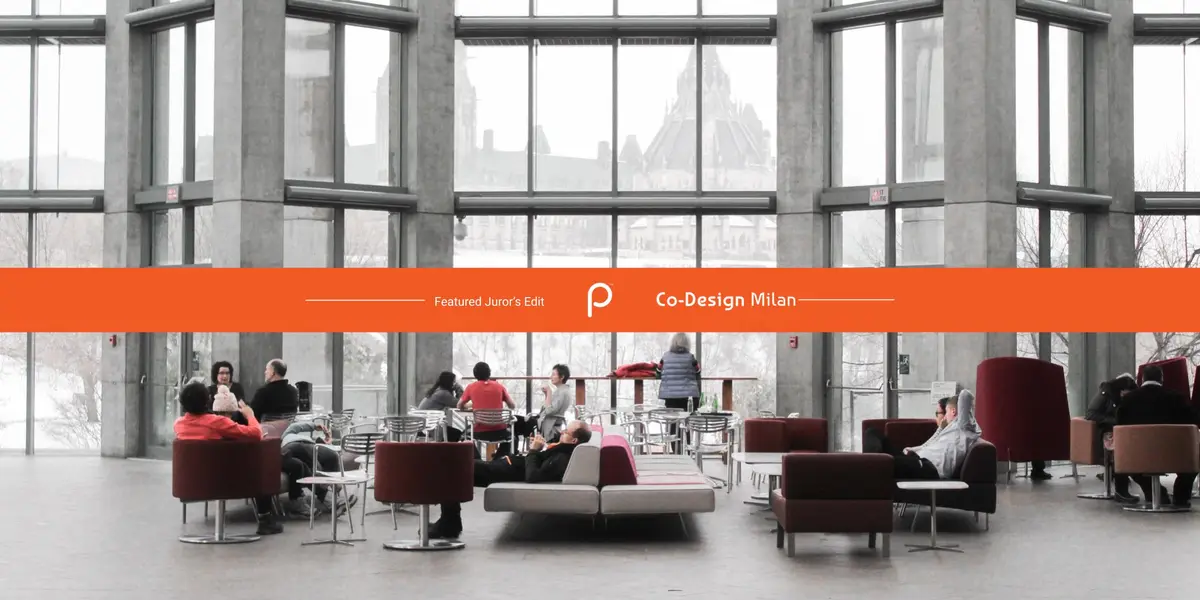
Creating evolutionary co-working spaces
Co-Design Milan Juror's interview


The average lifespan of any building/structure is about 40-50 years, and after this, they often become inoperative and defunct. It automatically turns into a liability for the environment as well as the city. A resolution to tackle this issue is adaptive reuse, practised widely to prolong the physical age of a building. With technology and needs growing exponentially, our buildings are becoming incapable of merging with needs and keeping pace with change.
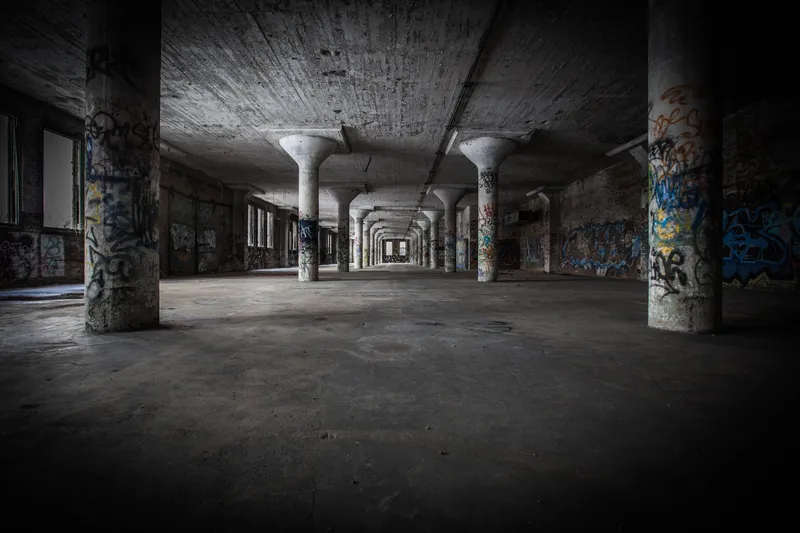
Milan is one of the post-war cities that was left with millions of square meters of abandoned buildings within the city. It has also been the hub of designers and an important centre for economic activity in Milan. It has now become an open territory for exchange among experts, enthusiasts and amateurs alike. “Unfuse” has launched a Co-Design Milan challenge that has urged the participants to propose a Designer’s Hub in CityLife, Milan that can inhabit shared studio spaces for young design firms and freelancers in and gives an opportunity to solve the problem of outdating buildings by constructing something evolutionary for the designers by the designers. The Lead Jurors from the Jury panel of this challenge have shared their perspectives on the same.
1. How can one cater to multiple uses of a building so that it can be used completely before the physical death of the building?
The true architectural challenge of contemporary cities is to build the new or reuse the existing taking into account that can be lived and modified over time. The fluidity that characterizes the urban life puts the architects with a question about how to design places increasingly eclectic, multifunctional and adaptable to the evolution of ways of working and living. Only in this way we can win the challenge of time and put the buildings in a condition to be a point of reference for different generations.
-Michele Rossi
At Breathe, we adopt an approach of “build less, give more.'' We think very carefully about each material we specify, ensuring they are environmentally sustainable, locally sourced where possible and are either recycled or recyclable at the end of the building life.
Adaptive reuse is a strategy we use to extend the functionality and life cycle of a building. From a car park repurposed into apartments at QV8 in Melbourne to a family home occupying an old warehouse in Brunswick – Warehouse Greenhouse, we are always seeking opportunities to give a building new life. The existing building fabric is often expressed and celebrated to reveal traces of the building’s past life and continue the narrative for years to come. Warehouse Greenhouse incorporates original timber purlins re-purposed into stair treads and benchtops and an original steel truss component is given new life as a pendant light.
-Madeline Sewall
The traditional link between form and function has dissolved; the "type", the typology is not the main characteristic that connotes an architecture.
The same shape accommodates multiple functions that change over the course of an increasingly narrow time.
Flexibility has taken the place of fixed typology, but, it is only the basic data of an adaptive architecture that allows the architecture to be inclusive and open to multiple uses.
-Giovanni Vaccarini
2. How should shared studio spaces be treated differently from shared office spaces while designing?
In recent years the differences between studio and office are decreasing; the use of open and convivial spaces is now patrimony of the contemporary office. The studio, by its nature, has always had a very strong connection with the world of laboratories and production and now it is always better adaptable to the reuse of industrial and semi-industrial spaces. The studio spaces of new conception can certainly have even more versatility both in the sense of space and in that of use.
-Michele Rossi
A shared studio environment should be designed to foster collaboration. Rather than focusing on cellular offices that offer visual and acoustic privacy, studio spaces seek to nurture interaction and creativity by focusing on group spaces that build a sense of community and teamwork.
-Madeline Sewall
The sharing of spaces is the basis of the concept of community. A shared architecture should take its forms around the set of possible thematic connections, this is the main focus of design: to make possible, indeed, become the trigger for possible interactions and "spontaneous" connections.
Architecture is a machine for exchanging information and triggering new visions.
-Giovanni Vaccarini
3. How should shared studio spaces be treated differently from shared office spaces while designing?
If we design a very popular place, capable of attracting talent, start-ups and young professionals, this can be the commercial engine for the entire area. The significance of a project of this kind could go beyond what is strictly a commercial and financial value, it would take meaning for the life and vitality that can trigger and then become a point of reference for the entire community that frequents the area.
-Michele Rossi
Protecting affordable studio space starts at the planning and development levels. At Breathe we talk a lot about improving conventional development models to create opportunities for more meaningful outcomes.
To create affordable spaces for studios or other low or non-profit initiatives, the community needs to advocate for these businesses. Nightingale One made a decision to do this by subsidising rent for a not-for-profit café, Home. One, which trains homeless youths in hospitality. Subsidising a space for values-aligned, meaningful tenants, not only gives back to the broader urban fabric but ensures diversity in our communities. It also ensures that artists and other tenants (such as not-for-profit organisations) can afford spaces that they may not have previously been able to.
-Madeline Sewall
Shared studio spaces must be thought of as collective places, places for meeting and sharing. Spaces "open" in the sense of open to multiple configurations depending on workgroups, work themes (thematic areas), living/meeting areas, etc.
-Giovanni Vaccarini
4. How does one start designing on a piece of land that is surrounded by buildings designed by iconic architects?
The most interesting contemporary architecture developments are precisely those where the approaches to the project are diversified, unlike most of the ones developed in the years 70 and 80. I believe that this variety in design is preferable to a mono-stylistic composition, even accepting the risk of dystonia. At City Life there are related architectures with a very strong identity that we cannot ignore; we must, therefore, be able to create a dialogue with what surrounds the new project.
-Michele Rossi
At Breathe, we put our ego aside, to design with a priority towards environmental, economic and social sustainability. The form should follow function and importantly, each project should contribute to the life of its users and give back to the broader community.
We think strategically, question the status quo, and strive for better outcomes. Our design process is conceptual and always starts with a story or character unique to the client, site or brief. Every project we design is bespoke and what is right for one client is not right for every client.
We consider it our professional responsibility to help clients understand that they often need less than they may originally think – smaller footprints, less applied finishes, more robust materials and more efficient construction. At Breathe, we approach each project with a “build less, give more” mantra. We don’t get swept away with what is stylish or iconic, and we refer back to our core values with every decision we make.
-Madeline Sewall
Posing with an attitude for listening.
Listening to the site with its multiple instances, listening to the landscape, urban design,
Listening to the multitude of internal instances of the logical/functional / iconic/communicative
the program, etc.
… And finally trying to translate all this information into spaces.
-Giovanni Vaccarini
Discover the design brief here: https://uni.xyz/competitions/co-design-milan/info/about
Discover the full results here: https://uni.xyz/competitions/co-design-milan/entries
Follow us on social media: Facebook | Instagram | LinkedIn | Twitter | Youtube
Discover other design competitions to participate here: https://uni.xyz/competitions


Popular Articles
Popular articles from the community


Co-life: Sustainable Architecture for Age-Friendly Community Living
Co-life reimagines sustainable architecture for seniors through courtyards, rammed earth, shared gardens, and spaces designed for belonging.

Little Red Riding Hood: Architectural Design as a Journey Through Fear, Light, and Storytelling
Little Red Riding Hood reimagines the fairy tale through architectural design shaped by fear, light, scale, memory, uncertainty, and choice.

Co-Life: Senior Housing Design That Reconnects Older Adults With the City
Co-Life reimagines senior housing design through healing gardens, shared streets, workshops, and a sustainable community across generations.

The Ocean Hive: Sustainable Architecture for a Self-Sufficient Civilization at Sea
The Ocean Hive imagines sustainable architecture at sea, where modular habitats, algae, wave power and ocean waste sustain a growing colony.

Similar Reads
You might also enjoy these articles
Garden: Sustainable Architecture Reimagines the Urban Void Beneath Leaside Bridge
Garden transforms the void beneath Leaside Bridge through sustainable architecture, greenery, social spaces, and circular stormwater design.

BUBHUB: Underwater Bubble Clusters That Grow Like Coral Reefs
A modular underwater habitat system designed to blur the line between architecture and marine ecosystem through biomimicry and incremental growth.
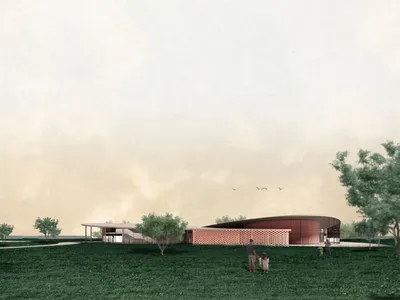
SCENTLAND: An Animal Shelter Designed Through the Nose of a Dog
Winner of Strays 2020, this proposal uses scent mapping to generate circulation, form, and program for a sensory-driven shelter.
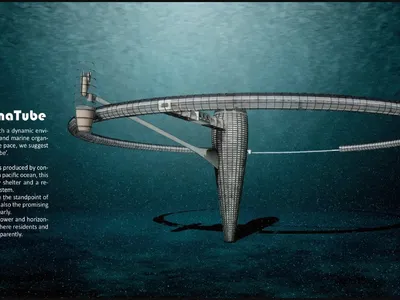
The Sub-MarinaTube: A Plastic-Recycling City Beneath the Pacific Garbage Patch
Vertical towers and horizontal tubes organize an underwater settlement that combines habitation, marine research, and ocean waste recovery.

Explore Architettura E Design Competitions
Discover active competitions in this discipline

Challenge to design luxury tourism on rails

VR headsets Storefront design competition

Designing a staircase for a client

Design challenge to reuse E-waste
Comments (0)
Please login or sign up to add comments
No comments yet. Be the first to comment!