Using Japanese methods to help conserve its culture with new generations
Cultural Center in Shirakawa-go, Japan

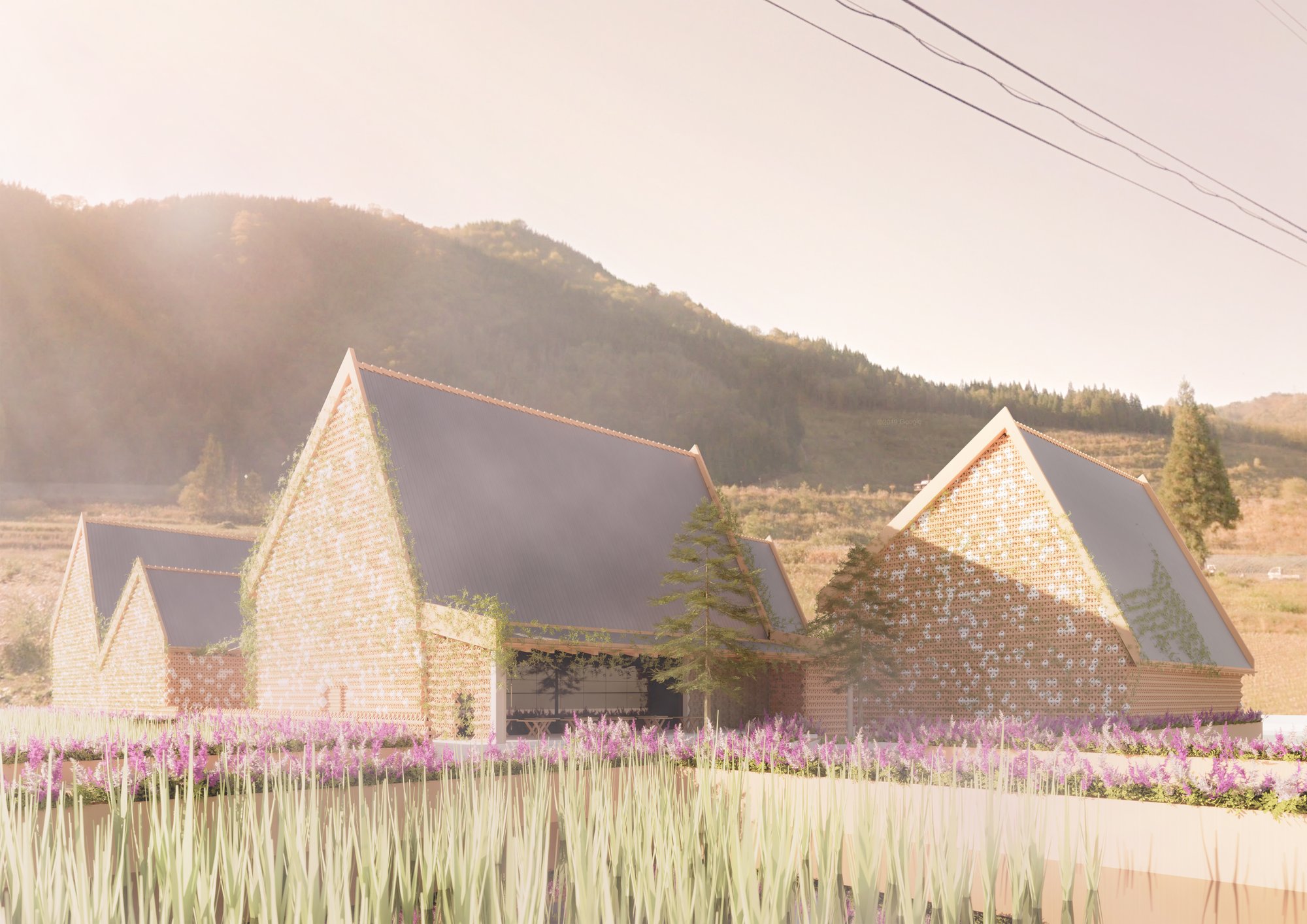
This design challenge is to develop a cultural center for the remote village of Shirakawa-go. The project is intended to promote heritage management, landscape conservation, and tourism. The center should reflect the mission and values of old village. As a whole, the project illustrates a tectonic agenda in detail and as a primary driver of architectural quality.
Shirakawa-go is specialized in its Gassho House style, which is still maintained in the town and led it to be considered a UNESCO Site. As for that, design process started with the modules, which utilize the 60 degrees used in the house’s roofs. Similarly, wood is found abundantly in the town and is used in the town’s classic architecture, from structure to the wood used in facades. This inspired the decision to choose wood, specifically Japanese Cyprus due to its longevity and historical use with Japanese joints, as the main material for the module. Other versions of the module are made of white ceramic, a cultural production in the area, and steel roofs that match the colour of thatched roofs. Due to this choice of building, the expertise of the town’s people is intended to be used in construction. In renewals that might need to occur to the façade, generations will continue to participate in the center.
Workshops can be used for a variety of activities for many people due to their expansion to the yard; however, as mentioned above, producing the module used for the façade and partitions will be the main aim for involvement. As for that, the production of wooden Japanese joints and ceramics can extend to not only be sole for the town’s people but also to teach both tourists and youngsters. This emphasizes the involvement of visitors with the architecture due to learning the intricate craft and technicality used in making a large-scale project. Simultaneously, it emphasizes the relation between generations as elderly pass down the tradition of renewing the building’s modules like they would a thatched roof, a tradition persistent in Shirakawa-go’s culture.
The small village of Shirakawa-go suffers the movement of its newer generations to larger cities to seek education or jobs. This leads to slow modernization and low active working hand in town as the number of its elderly increase. However, by including a large-scale project that is intended to be a gateway for tourists and largely involves the village’s traditions, youngsters grow to learn how the past is not old or limited. For instance, Japanese joint used in the module, the Ari kata sanmai hozo komisen uchi, was used for hundreds of years in Japanese architecture, and yet it remains a factor in the building technique.
The culture of Shirakawa-go stands as a remenent of Japanese past, and respecting it is one of the locations where modernity should be held with delicate hands to help and not impose. Through the use of modules, a generative matrix is created to form modern forms in the old town. At the same time, modules, or pixels, stand as a remnant of Japanese heritage. Due to the modularity of the project, its purpose can be altered as is needed. Modules are produced in town, and they are the main component of partition walls. As for that, areas can be repurposed as is needed. As was suggested by architecture critique Sybil Moholly Nagy, a matrix is like a reproducing womb, referencing the way it regenerates and allows prosperity when used in planning. The ability of a modular project to reproduce leads to its fertility and the way it yearns for tp be seen less as a rigid piece of architecture and more like a set of building toys for people to try cpnstruct.
Shirakawa-go was not discovered until the 1950s, and now it is a cultural site and global reserve. As for that, it remains to a level independence from globalization that Japan has acing. Visiting a town that is frozen in time after passing by the city’s neon lights and concrete skyscrapers is an experience that should be respected and not scorned. As for that, having a monument of contemporary architecture that respects and reflects the village’s style is a gateway for tourists to transition to or from a quieter setting.