

Fallen Leaves: Translating the Physics of a Leaf's Descent into Parametric Form
Amir Ahmed's vase turns sine curves and computational logic into a customizable sculptural object inspired by organic motion.


A leaf does not fall in a straight line. It spirals, oscillates, catches air in unpredictable pockets before settling. Capturing that transient motion in a fixed object sounds contradictory, yet that is precisely what the Fallen Leaves vase achieves. Built through parametric logic, the design encodes the sine-curve rhythms of a descending leaf into a twisted, ribbed vessel that feels simultaneously computed and alive.
Designed by Amir Ahmed, Fallen Leaves earned a Best in Category distinction in the BeeGraphy Design Awards. The project was developed entirely within BeeGraphy's parametric editor, a platform that enables generative modeling where form is never fixed but continuously redefinable through user-controlled parameters. What results is not a single vase but a family of geometries, each one a different reading of the same natural phenomenon.
From Simple Curves to Sine Waves to Leaf
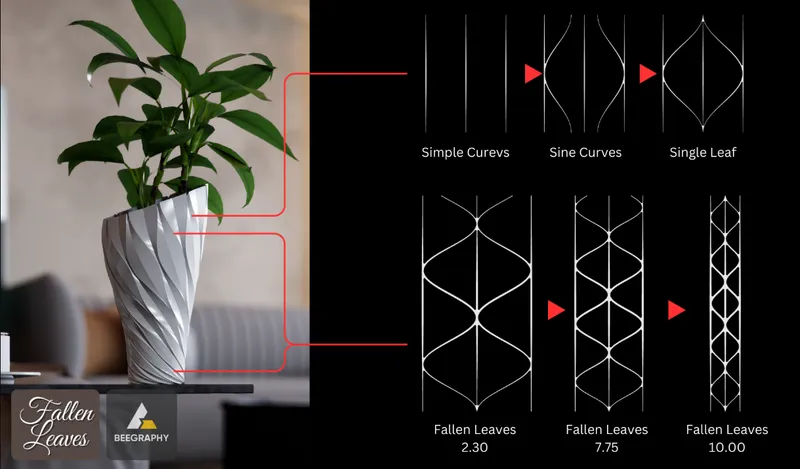
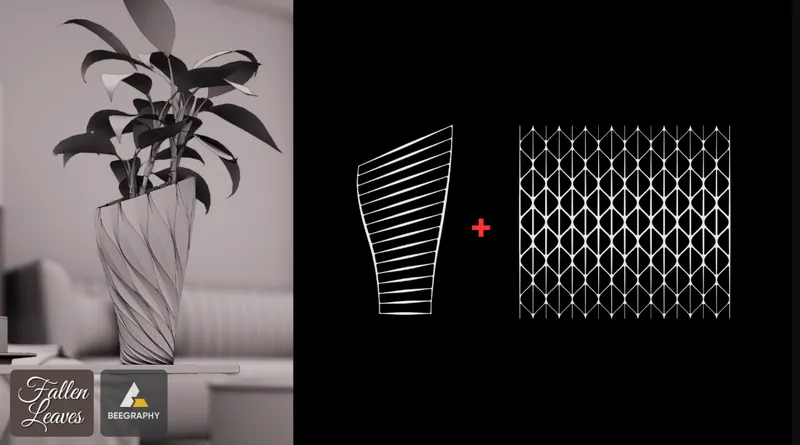
The design's lineage is visible in its technical diagrams. The process starts with a basic curve, reparametrizes it as a sine wave, and then resolves into the final leaf-derived profile. Diagonal striping and geometric tessellation patterns combine to produce the vase's characteristic helical ribbing, a surface articulation that gives the form its sense of rotational momentum. Each step in this evolution captures a gradual transformation: organic observation becoming architectural language, natural irregularity meeting digital precision.
What makes the parametric approach compelling here is the level of control it affords. Amplitude, frequency, and curvature intensity are all adjustable, meaning the same underlying logic can generate wide, open profiles or tightly wound spirals. The diagrams make this explicit: variations at parameter values of 2.30, 7.75, and 10.00 each produce distinct textures and rhythms, demonstrating that a single mathematical framework can hold infinite formal outcomes.
One Algorithm, Three Personalities
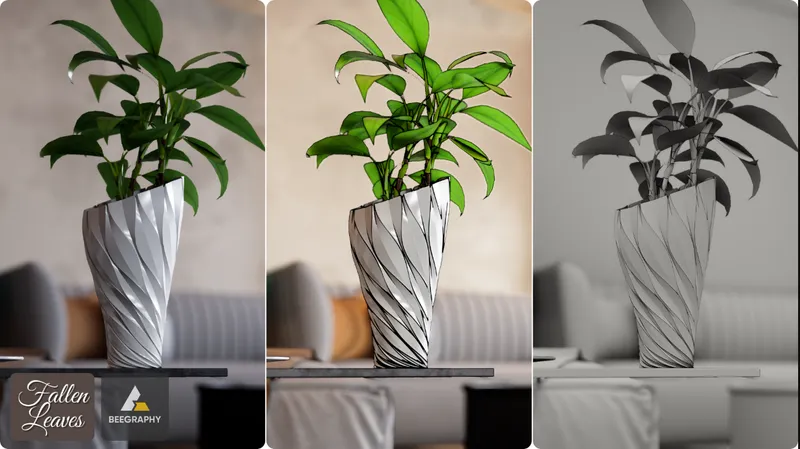
Placed side by side in soft interior daylight, three color variations of the vase reveal how material finish and hue shift the object's character without altering its geometry. A houseplant sits inside one of them, grounding the parametric form in domestic reality. The ribbed surface catches light differently across each version, creating shadow gradients that accentuate the helical twist. It is a quiet demonstration that parametric design is not only about generating shape; it is about generating relationships between shape, light, and context.
Sculpture Under Warm Light
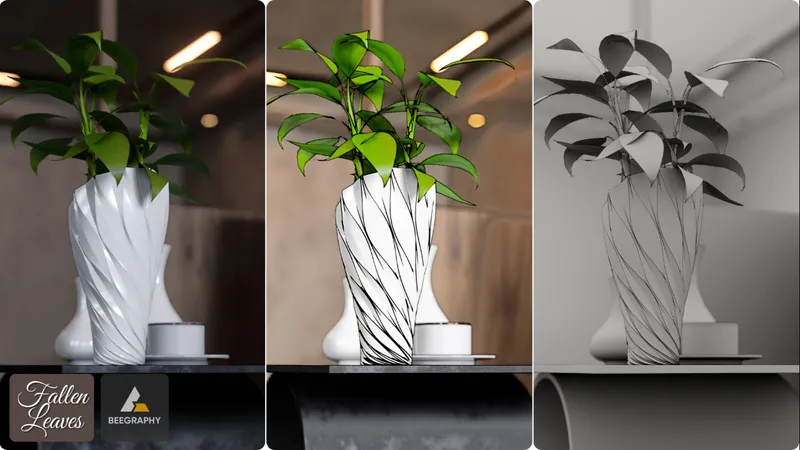
A triptych under warm task lighting presents the vase in white, line-art, and monochrome renderings. Seen together, they strip the object back to its essential qualities: surface continuity, proportional balance, and the tension between the vertical axis and the spiraling ribs that wrap around it. The line-art version is especially revealing, exposing the tessellation logic that underlies the smooth exterior. The subtle folds evoke movement while the computed geometry ensures structural stability, merging artistic emotion with engineering discipline.
What these renderings reinforce is that Fallen Leaves operates convincingly at multiple levels of abstraction. As a white physical object it reads as a sculptural vase. As a wireframe it reads as a parametric study. Neither reading cancels the other; they coexist, which is the hallmark of well-resolved computational design.
Why This Project Matters
Parametric design often announces itself at the scale of buildings and pavilions. Fallen Leaves argues convincingly that the same thinking can reshape objects we hold in our hands. By translating the physics of a leaf's descent into a mathematically generated vessel, Amir Ahmed demonstrates that the boundaries between product design, sculpture, and architecture are dissolving. The project is not a miniature building; it is architectural thinking applied to a domestic artifact, making technology poetic rather than spectacle-driven.
BeeGraphy's open generative modeling philosophy is central to the project's significance. Fallen Leaves is not a finished file but a living system: each user who adjusts its parameters produces a new version, a new interpretation of the same natural observation. In an era where customization is increasingly expected, this approach turns the act of personalizing an object into a creative act in itself. Even the simplest natural gesture, a leaf falling, can seed an entire ecosystem of form-making.
View the Full Project
About the Designers
Designer: Amir Ahmed
Enter a Design Competition on uni.xyz
uni.xyz runs architecture and design competitions year-round that reward proposals with spatial conviction and real site intelligence.
Project credits: Fallen Leaves by Amir Ahmed BeeGraphy Design Awards (uni.xyz).


Popular Articles
Popular articles from the community


Juan García Correa, John González and Claudia Rueda Sink a Circular Amphitheater into a Manizales Engineering Building
On the La Nubia campus in Manizales, Colombia, the S1 Building folds labs and offices into a hillside of ramped lawns that double as a campus route.

longwave studio Reorganizes a 112 m² Tainan Apartment Around the Daily Routines of a Family and Two Cats
In Tainan, Taiwan, birch plywood, rust-red furniture and a freestanding plaster wall link arrival, storage, work and family life in one apartment.

David Macias Steps a Doorless Stone and Plaster House Down a Tropical Colombian Hillside
In the humid hills of Colombia, Threshold House replaces the front door with an open void and terraces its 850 m² down the slope instead of fighting it.

Cube Design Draws an Ecological Corridor Between Two Shenzhen Hills with the Nankai Building
Beside Shenzhen's container docks, the Nankai Building pairs stacked balconies with a climbing green screen to connect two hillsides across its height.

Similar Reads
You might also enjoy these articles


Aquadapt: An Underwater Habitat That Rewrites Its Rooms by the Hour
Curved modules ring the seabed while one shell shifts from breakfast room to cinema, farm and football pitch as residents' needs change.

Play: Fragments of Their World: Remembered Architecture Rebuilt as a Modular Playground for Refugee Camps
Tom Gardner abstracts domes, arches and towers from the homelands of displaced families into a kit of child-scaled play parts for camp settlements.
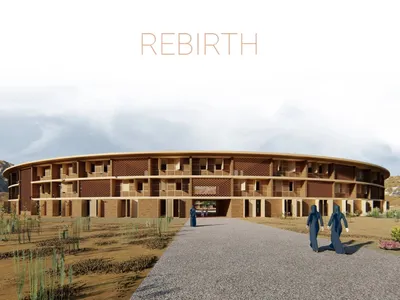
REBIRTH: A Circular Settlement Where Afghan Widows and Their Children Rebuild Life Together
A shortlisted Resile entry turns the circle into a protective ring of timber and brick, gathering homes, classrooms and gardens around a shared landscape.
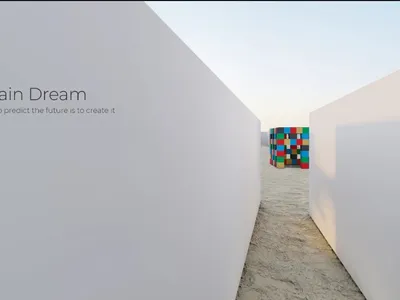
The Main Dream: A Recycled Plastic Kit That Lets Refugee Children Build Their Own Playground
Thirty-centimetre interlocking cubes that connect on three axes turn play into construction, letting children author the spaces they occupy.

Explore Nature Inspired Competitions
Discover active competitions in this discipline

Design challenge to equip cities with modern furniture

Packaging challenge - Design meets sustainability
Comments (0)
Please login or sign up to add comments
No comments yet. Be the first to comment!