
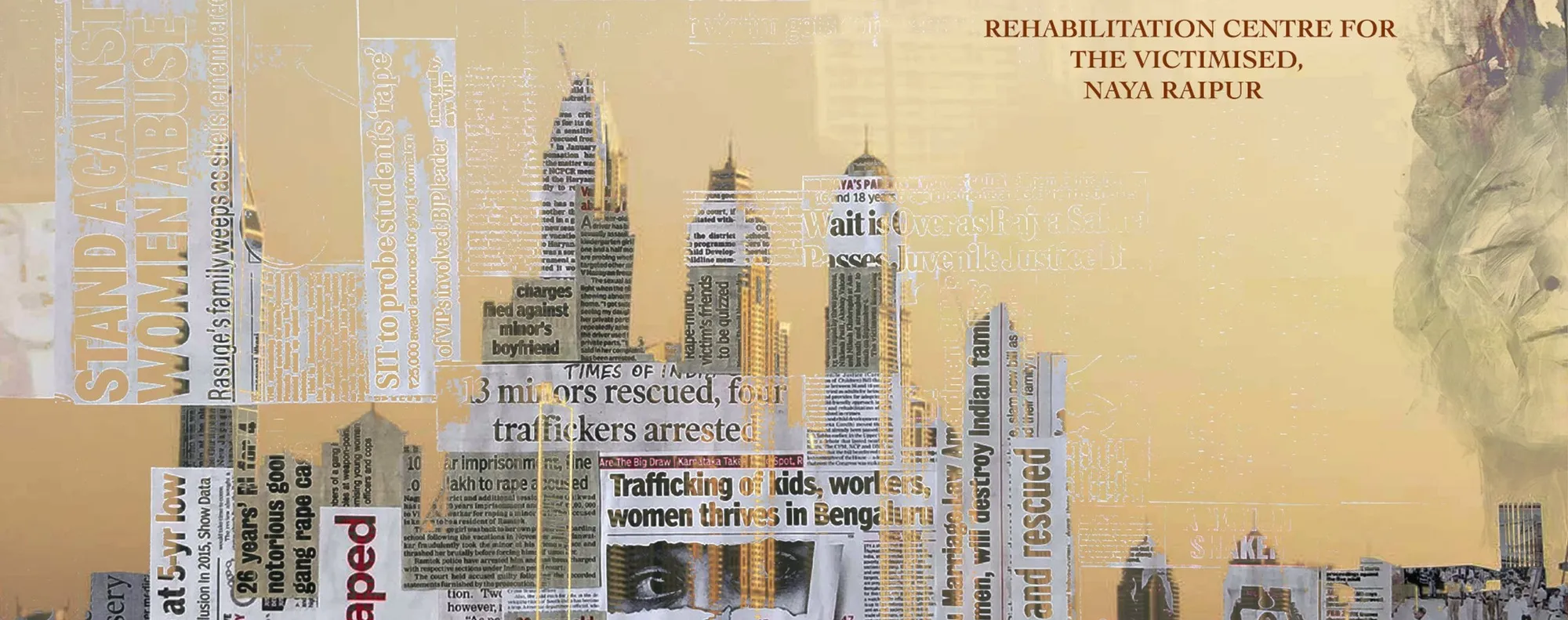
Healing Architecture for Social Justice: Rehabilitation Centre for the Victimised, Naya Raipur
A trauma-informed healing architecture in Naya Raipur designed to restore dignity, safety, and empowerment for survivors of gender violence.


India’s profile as an emerging modern nation has been overshadowed by the persistent rise in gender-based violence. In response to this urgent social crisis, the Rehabilitation Centre for the Victimised, Naya Raipur proposes a powerful architectural intervention rooted in healing architecture and trauma-informed design.
Designed by Pragya Hotwani, the project envisions architecture not merely as built form, but as an instrument of recovery, empowerment, and social reintegration. Located in the developing capital of Chhattisgarh, this centre becomes a symbol of resilience, an architectural commitment toward restoring dignity and rebuilding lives.
The Vision: Trauma-Informed Rehabilitation Centre Design
At its core, the project is guided by the principles of trauma-sensitive spatial planning. The campus integrates health, therapy, accommodation, vocational training, and public engagement into a cohesive and secure environment.
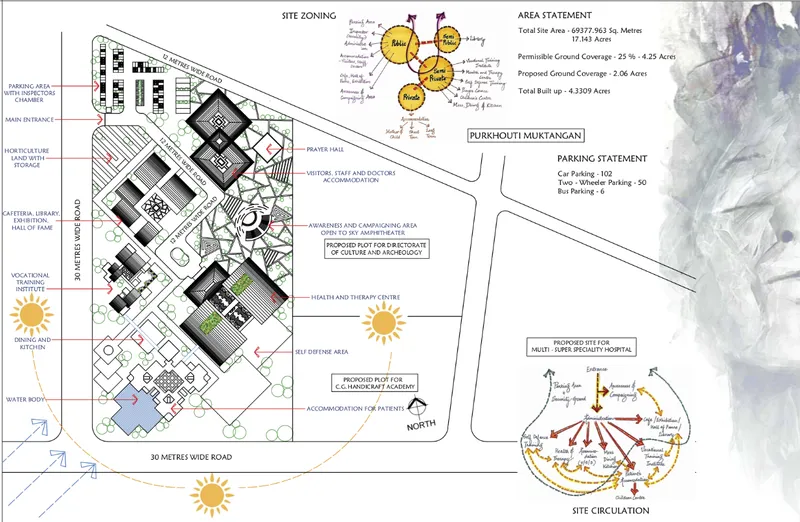
The master plan reflects a carefully zoned layout comprising:
- Health and Therapy Centre
- Accommodation for Patients
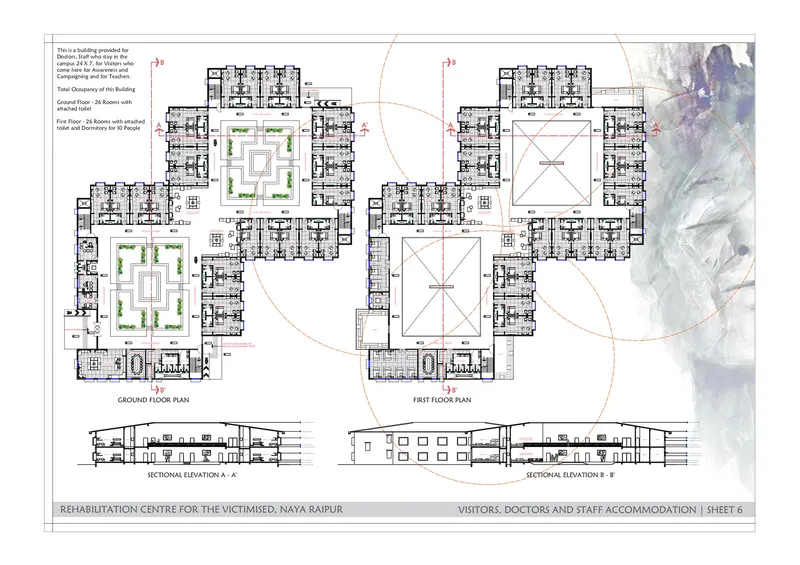
- Visitors, Doctors, and Staff Housing
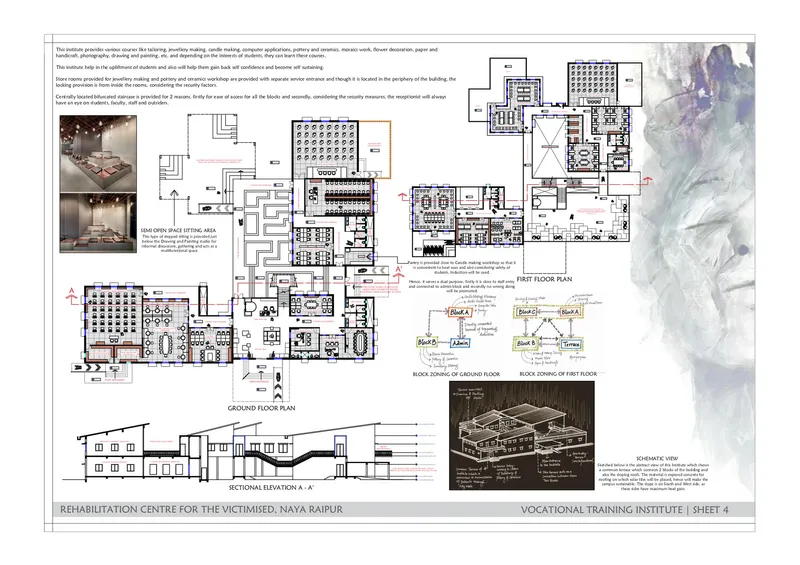
- Vocational Training Institute
- Cafeteria, Exhibition, Library and Hall of Fame
- Awareness and Campaigning Areas
- Sensory Gardens and Courtyard Clusters
Each zone is strategically positioned to balance privacy, safety, and openness, essential pillars in healing architecture.
Site Planning and Zoning Strategy
Spread across a thoughtfully organized site in Naya Raipur, the campus demonstrates clarity in circulation and functional hierarchy. Public, semi-public, and private zones are distinctly articulated to maintain both accessibility and protection.
Wide 30-meter roads define the site edges, while internal 12-meter roads create a navigable yet secure campus. Parking areas, inspection chambers, horticulture zones, and water bodies contribute to a holistic environment that supports emotional recovery.
The zoning diagram illustrates how movement flows from public engagement areas toward more intimate therapeutic and residential spaces, ensuring that survivors experience gradual transitions rather than abrupt spatial shifts.
Courtyards as Healing Devices
A defining architectural element of the project is the clustered courtyard system. Inspired by traditional Indian planning, these open-to-sky spaces allow natural light, ventilation, and visual connectivity with greenery.
Hexagonal and geometric courtyard configurations foster:
- Passive cooling and daylight penetration
- Visual transparency without compromising safety
- Community bonding and informal interaction
- Psychological comfort through biophilic design
The sensory garden further enhances healing through tactile pathways, therapeutic planting, and calm reflective zones, transforming landscape into therapy.
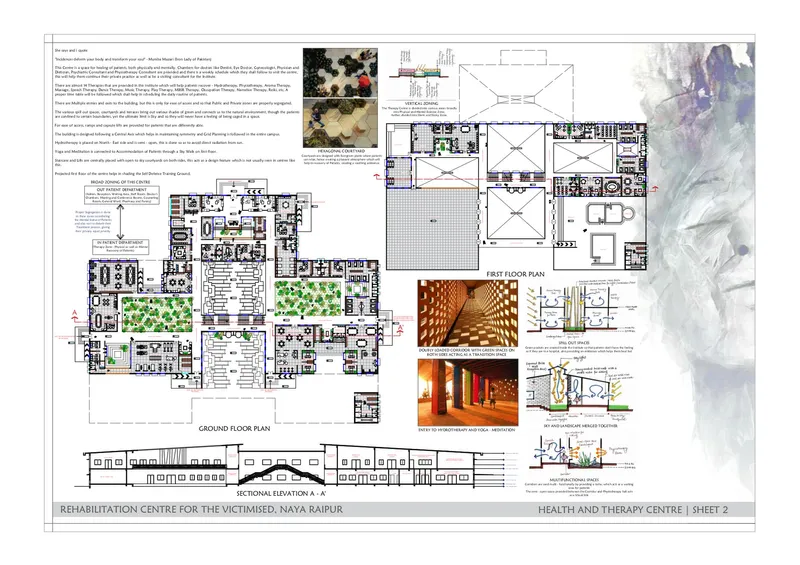
Health and Therapy Centre: Architecture for Recovery
The Health and Therapy Centre serves as the heart of the campus. Designed with spill-out spaces, transitional corridors, and double-loaded hallways softened by greenery, the building reduces institutional rigidity.
Key therapeutic spaces include:
- Hydrotherapy rooms
- Yoga and meditation halls
- Counseling chambers
- Medical consultation areas
- Semi-open transitional corridors
Natural light filters through patterned facades, creating dynamic interior atmospheres that encourage calmness. The corridors act not just as circulation spaces but as psychological buffers, reducing stress and supporting recovery.
Accommodation for Patients: Safety with Dignity
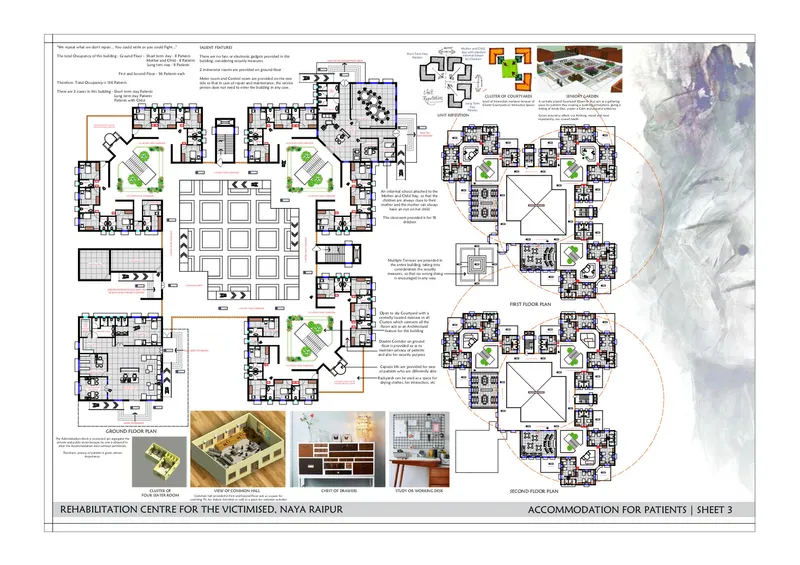
The residential blocks are organized into clusters around internal courtyards. This planning ensures both supervision and freedom, essential for trauma recovery.
Ground and upper floors provide:
- Short-term and long-term patient rooms
- Mother and child units
- Common halls
- Secure circulation cores
- Controlled access entry points
The spatial layout prevents isolation while respecting privacy. Visual connectivity to greenery, shaded terraces, and open courts allows residents to feel protected without being confined.
Vocational Training Institute: Architecture of Empowerment
Healing is incomplete without economic independence. The Vocational Training Institute integrates skill-based learning into the campus ecosystem.
Workshops include:
- Tailoring and textile craft
- Jewellery making
- Candle and handicraft production
- Pottery and ceramics
- Computer applications
- Photography and visual arts
Semi-open stepped seating areas act as multifunctional learning spaces. The central bifurcated staircase ensures visibility and security, reinforcing safety while promoting collaboration.
By merging architecture with skill-building, the centre empowers survivors to regain confidence and self-sufficiency.
Public Engagement: Breaking the Silence
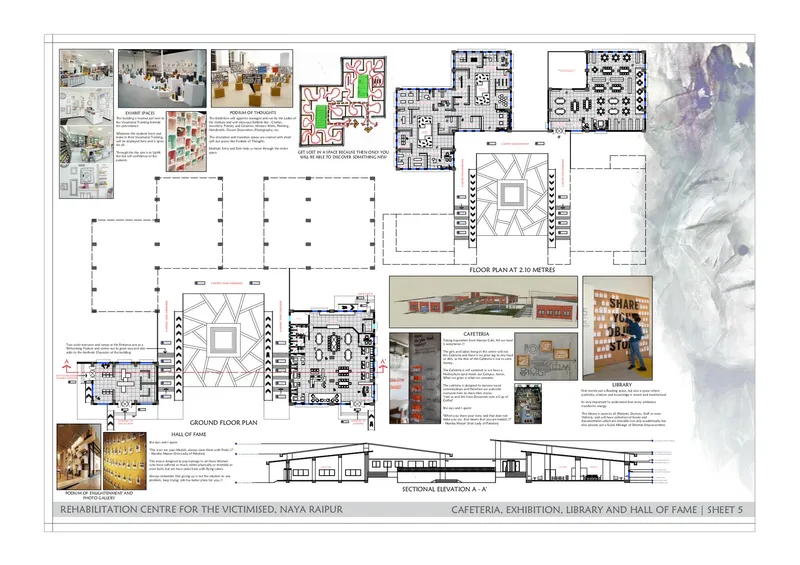
The Cafeteria, Exhibition Hall, Library, and Hall of Fame form the public interface of the project.
- The Exhibition Spaces display creative outputs from residents.
- The Podium of Thoughts encourages expression and dialogue.
- The Library acts as a knowledge hub and reflective retreat.
- The Hall of Fame celebrates resilience stories.
These spaces bridge the gap between survivors and society, transforming stigma into awareness.
Architectural Language and Sustainability
The sectional elevations reveal sloping roofs optimized for maximum heat gain control and passive ventilation. Thick masonry walls and shaded corridors reduce thermal load, making the campus climatically responsive.
Key sustainable features include:
- Courtyard-based passive cooling
- Controlled daylight penetration
- Water body integration for microclimate improvement
- Landscape-driven planning
- Solar orientation strategies
The architecture blends institutional functionality with humane sensitivity.
Security Integrated with Compassion
Unlike conventional institutional facilities, the design avoids fortress-like rigidity. Instead, security is embedded subtly through:
- Layered zoning
- Controlled entry points
- Visual supervision corridors
- Centralized circulation cores
- Spatial hierarchy
This approach ensures protection without psychological oppression, an essential balance in trauma-informed healing architecture.
A Landmark of Healing Architecture in India
The Rehabilitation Centre for the Victimised in Naya Raipur stands as a powerful example of healing architecture in India. It redefines the role of architecture in addressing social injustice.
Rather than functioning as a mere shelter, the campus becomes:
- A therapeutic landscape
- A safe transitional habitat
- A platform for empowerment
- A community awareness catalyst
- A symbol of social reform
Through careful zoning, courtyard planning, trauma-sensitive interiors, and integrated vocational training, Pragya Hotwani’s project transforms architecture into an agent of humanity.
In a time when urban development often prioritizes infrastructure over empathy, this rehabilitation centre places humanity at the forefront. It demonstrates how rehabilitation centre design rooted in healing architecture can rebuild broken lives and restore social confidence.
More than a building, this project is a spatial manifesto: proving that architecture can be a silent yet powerful advocate for justice, healing, and dignity.



Popular Articles
Popular articles from the community


Hill & Cross Opera: Sculptural Opera House Architecture Shaped by Tallinn’s Landscape and Identity
Hill & Cross Opera reimagines opera house architecture in Tallinn through its sculptural hill, civic plaza, glass wave and a luminous cross.

AL-JANNAH: Sustainable Architecture and Permaculture for Afghan Widows
AL-JANNAH uses sustainable architecture and permaculture to create resilient oasis of housing, learning, work and renewal for Afghan widows.
EW PARK: Sustainable Architecture Reimagines the Future of Urban Parking
EW PARK reimagines city parking as a modular wooden tower combining automation, solar energy, electric mobility, and adaptable urban design.

Conexión: Biophilic Design Reimagines High-Rise Living in Hong Kong
Conexión reimagines high-rise living in Hong Kong through biophilic design, green facades, shared spaces, daylight, water and nature within.


Similar Reads
You might also enjoy these articles

Eco Chapel: A Green Architecture Pavilion Designed in Symbiosis with the Forest
Eco Chapel uses green architecture to weave prayer, learning and reuse into a forest pavilion shaped by modular hexagonal canopies for life.
Kaffeebühnen: Coffee Shop Architecture Designed as a Civic Stage Between Vienna’s City and Park
Kaffeebühnen turns coffee shop architecture into a civic stage, linking Vienna’s park edge, urban life, warm timber yards, and coffee craft.
Healing Façade: Sustainable Architecture for Reforestation, Community, and Sacred Ecology in Ethiopia
Healing Façade reimagines sustainable architecture as a living wall that restores soil, catches water and renews Ethiopia's forest churches.


Urban Forest: A Vertical Ecosystem for 5,000 Workers in Singapore's Changi Business Park
Radially stacked pods and layered green decks turn a 7-acre plot into 47 acres of ecological workspace projected for 2040.


Comments (0)
Please login or sign up to add comments
No comments yet. Be the first to comment!