
House of the Dyad
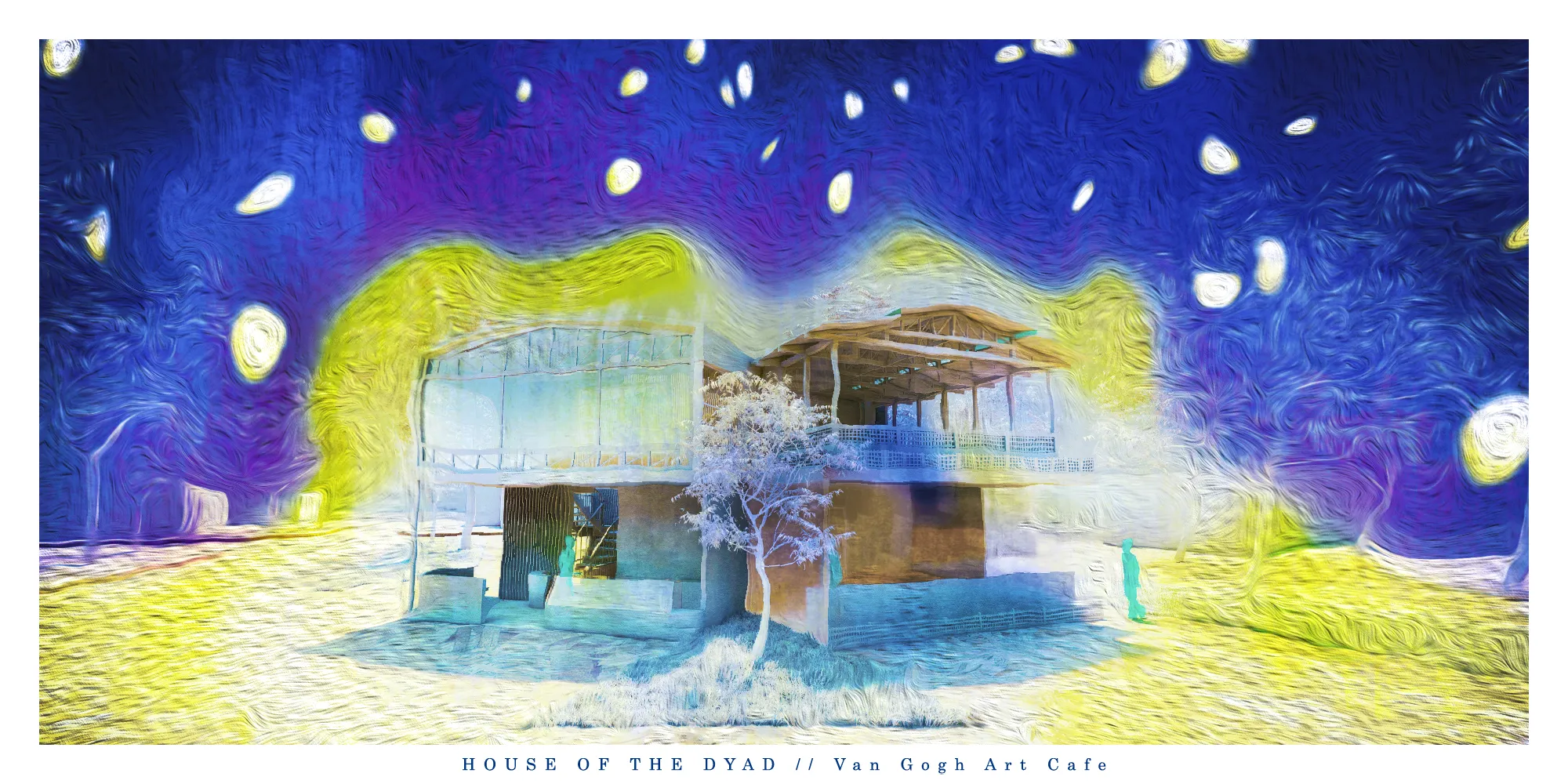
An Art Café inspired by the life and works of Vincent Van Gogh.
Introduction
They say that to truly understand a person, one must ‘walk a mile in their shoes’ – The House of the Dyad does exactly this. The subject of the design is Vincent Van Gogh, and the object of the project is to simply walk a mile in Van Gogh’s proverbial shoes. The thing that truly resounded with me is that not a lot of people pay attention to the significance of the relationships he had with people (chief among them, is his relationship with his brother, Theo).
The House of the Dyad was designed to highlight the significant relationships (significant dyads) in Van Gogh’s life – because to truly understand him, we must also experience his relationships with people (not just his work).
Concepts
The all-encompassing concept of the design is to experience the many aspects of Van Gogh in different forms.
Those can be broken down into 3 specific aspects:
The Dyad Concept – The Dyad Concept focuses on Van Gogh’s significant relationships, specifically: with Theo (who supported his career as an artist), Paul Gauguin (his friend and the instigator of the infamous ear incident), and finally, with himself (in a sense of Man vs. Self, or as a personification of his mental health issues vs. himself).
The Immersion Aspect – This aspect focuses on not only reading about Van Gogh or viewing his work but experiencing things as he experienced them. This aspect focuses on the visceral side of the experience as opposed to the intellectual side of it. After all, most, if not all, of Van Gogh’s work appeals to people in a very visceral nature.
The Imitation Aspect – This aspect focuses on relating to Van Gogh as an artist and as a person. As the old saying goes, “When in Rome, do as the Romans do” – this aspect deals with doing just that but in actions directed towards an artist. This aspect and the immersion aspect go together to allow for a more holistic experience.
Each of these aspects has been personified architecturally in the project.
Form Concept
The base form of the structure is a personification of the Dyad Concept. One slightly curved mass and one firm rectangular box. This form was conceptualized from the idea of Van Gogh’s relationships and how in his dyads, there was always someone more creative, bolder, and more unconventional (which was often Van Gogh himself) than the other who was a rock (i.e., Theo, Gauguin, etc.) – a solid form that supported the more unconventional piece. This is exactly what you see in the base form of the design – two similar objects with key striking differences. One piece is more unconventional and the other supports the structure as a whole – creating an architectural paradigm and metaphor for Van Gogh and his relationships.
The Observer and The Subject
On top of that Van Gogh loved painting still life and landscapes. To add to the Dyad Concept, I decided to allow light and sight to permeate. This allows for more visual interaction between the outside and the inside, essentially creating another dyad paradigm of observer and subject. Both those outside and inside the café are observers and subjects. Simply put, the patrons of the café can be used as subjects in somebody’s painting and vice versa. This paradigm allows for a better, more immersive, experience of Van Gogh’s surroundings and the environment of the area when he was still alive.
The idea of The Observer and The Subject encompasses the entire design. From the patrons to the chefs in the kitchen, everybody within the café can become a subject in a painting, akin to how Van Gogh chose the subjects of his paintings.
Art Inspiration
Van Gogh’s most iconic works like The Yellow House and The Starry Night were used as inspirations for the project.
I used The Yellow House as the main aesthetic inspiration for the design. Since the area is filled with houses and small scales structures, I thought it best to create a balance of old and new, so the project betrays iconography yet still blends with the surroundings. The Yellow House was the perfect inspiration for this idea and was the perfect aesthetic inspiration. The resulting aesthetic of the design allowed for a modern yet relaxed feel that allowed you to stay comfortably inside yet it also creates an underlying sense of artistry. On top of that, the classic style roofing of the semi-outdoor dining area on the second floor (windows can be opened to allow for this space transition) juxtaposed with the new style of modern house aesthetic is an homage to The Yellow House (or how The Yellow House may be interpreted in the modern era).
In addition, I wanted guests to experience The Starry Night firsthand – hence, a frosted glass ceiling on the second floor of the café. As seen on the concept sheet, the conceptual idea of the space is to allow patrons to experience The Starry Night firsthand. Not in the traditional sense of the painting and not in the holographic sense of Van Gogh exhibits these days. I wanted them to experience the visceral side of the painting, by recreating a live shot of it on the second floor. The double-paned frosted glass should allow for ‘an impressionist filter’ while still rendering most of the night sky visible enough to achieve this effect.
Finally, as part of the immersion aspect of the design and as well as the artistic inspiration, the material of the walls of the café is white plaster stucco. The rough almost impressionist texture of the material paired with the white color should be enough to soak in the light at any given time of the day and essentially create a surrounding canvas of awe-inspiring color paired with the texture of an impressionist painting. On top of the act of painting and viewing paintings that others have created, the entire interior of the café turns into a colorful canvas that further accentuates the light and environment of the area.
Program
The program of the café is both functional and participative. It is functional in the sense that the kitchen has a service core (the dumbwaiter) that has access to all floors, essentially allowing the kitchen to serve three levels with ease. There’s also a bakery and a wine cellar for those who wish to consume smaller meals (in line with French Patisseries and Vineyards). On top of the primary program of the design (the café), there are also small exhibit areas designated near the main dining areas to showcase the artists and small working areas with still life and landscape vistas akin to the ones Van Gogh painted. This essentially ensures that the core functional program of the design is not only intact but also improved.
The open space outside can be utilized as a spill-over dining area at night or whenever necessary.
The aesthetic program of the design focused on allowing for all areas to have beautiful vistas of the environment as well as attractive exterior façades to entice people to the café. The intent to maintain an old-meets-new house can be seen in all sides of the design.
In addition, the maximization of the basement area is a hybrid addition to the functional program of the design. It allows for an expansion into the secondary functions of the café while still allowing for the primary functions to be appealing. Simply put, the basement gallery area can be utilized as a viewing/waiting area for the patrons while waiting for their food or as a place to visit after. Thanks to the addition of the wine cellar this area also expands the activity program and core offerings of the café – it also attracts an apt demographic to the café (art and wine aficionados). The basement is designed to be home to wine and cheese (with art) nights or as an exhibition space that showcases Van Gogh himself or the work of local artists.
In conclusion, many things make Vincent Van Gogh, but in my opinion, to truly understand him we must walk a mile in his shoes. The idea of creating a place where we can do this proverbial activity should be designed with care, intent, and mindfulness of who he was as a person.


Popular Articles
Popular articles from the community


Riyadh For All: Intergenerational Urban Design for Active Aging in Rabat
Riyadh For All reimagines urban design in Rabat with intergenerational co-living, adaptive courtyards, and Moroccan cultural exchange today.

Lunar Spiral: Space Architecture Shaped by the Mathematics of the Universe
Lunar Spiral reimagines space architecture through Fibonacci geometry, lunar regolith, levitating habitats, and self-sustaining Moon living.

Co-life: Sustainable Architecture for Age-Friendly Community Living
Co-life reimagines sustainable architecture for seniors through courtyards, rammed earth, shared gardens, and spaces designed for belonging.

Hill & Cross Opera: Sculptural Opera House Architecture Shaped by Tallinn’s Landscape and Identity
Hill & Cross Opera reimagines opera house architecture in Tallinn through its sculptural hill, civic plaza, glass wave and a luminous cross.
Similar Reads
You might also enjoy these articles

Day and Night Park: A Time-Based Urban Newsstand in Beijing
A temporary urban newsstand in Beijing blending travel, light, and reading through poetic colors, compact form, and community-focused design.

Modernist Patio Renovation in El Masnou, Barcelona by Oliver Segura Arquitectura + Cebrià Arquitectura
Modernist patio renovation blending tradition and innovation with a movable pool, leveled floors, and Catalan materials in El Masnou.

Alto Residencial Coop: Cooperative Housing Development in Santiago de Compostela by Carbajo Barrios Arquitectos
A linear cooperative housing complex blending white volumes and perforated metal façades, enhancing community living, natural light, privacy, and urban integration.

Vil Genis School by BPA ARCHITECTURE – Massy, France
Vil Genis School in Massy, France, features sustainable design, south-facing classrooms, community integration, accessible spaces, and modern educational architecture.


Comments (0)
Please login or sign up to add comments
No comments yet. Be the first to comment!