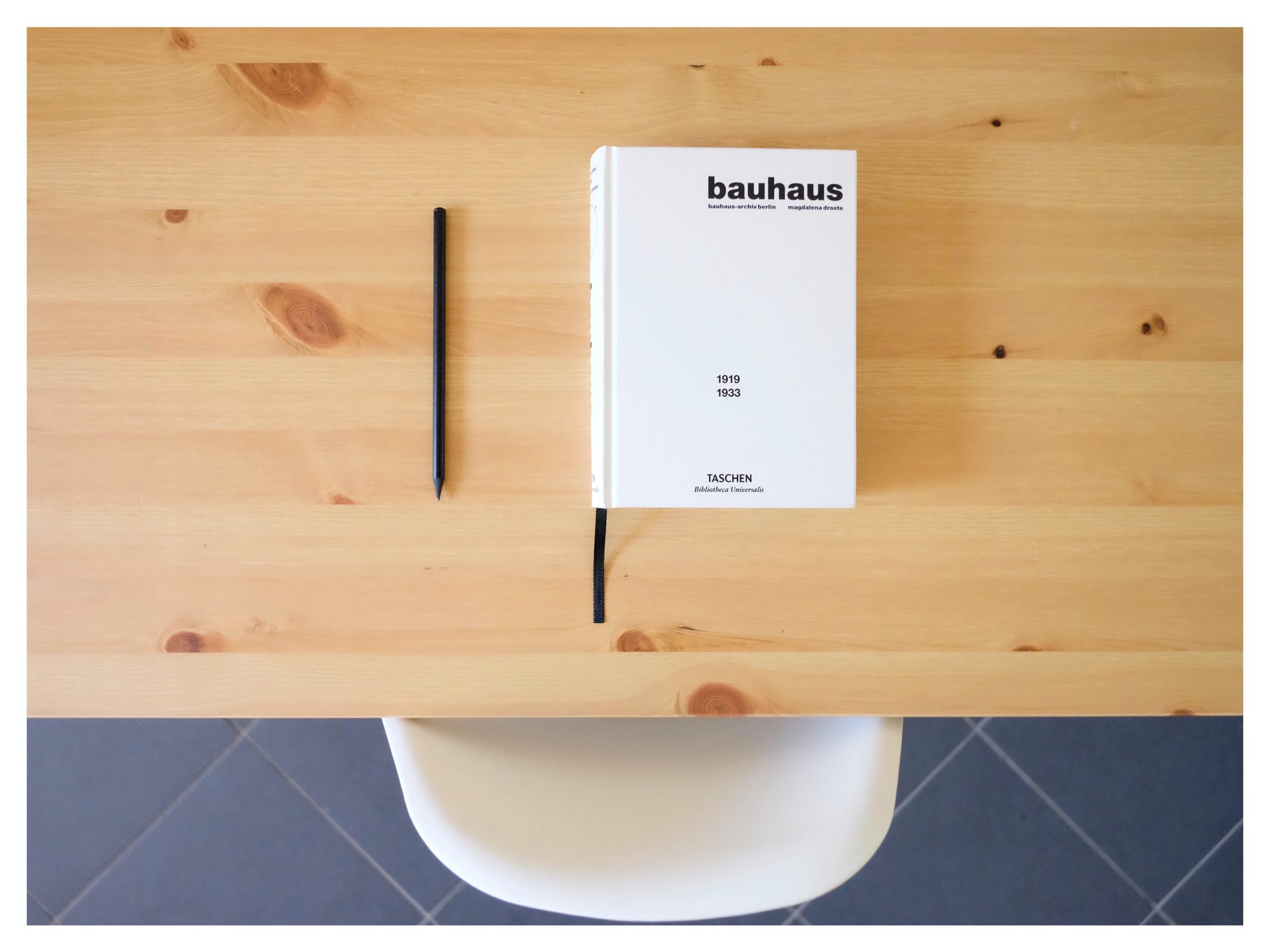
Iconic revelations
An ode to Bauhaus furniture

The Bauhaus school of art, architecture and design was found in 1919 by architect Walter Gropius. The school taught cutting-edge design that became the hallmark of future schools around the world. Students over the years included typographer Herbert Bayer, textile artist Anni Albers and sculptor Marianne Brandt. The teachers in this short-lived institution included artists Wassily Kandinsky, designer Piet Zwart and architect Mies van der Rohe.
Known for developing a distinctive, modern style built on the principle of simplicity, the Bauhaus school was influential in shaping the design concepts that define mid-century trends. As a result, many 20th century pieces of furniture are based off Bauhaus designs. The furnishings are hallmarks of clean, simple styles – often featuring reduced geometric forms or offering much sturdiness given their solid wood construction.
Bauhaus furniture is highly influenced by modernist principles. Modernism is a movement that emerged from an artistic and social response to the industrialized city in Europe at the turn of the early 20th century. Modernist authors and artwork, such as Virginia Woolf and Picasso respectively descended heavily from a reaction to the enormous devastation that World War I also left behind. It was this modernizing moment, pulling artists into 1910s Europe, which influenced a new approach to architecture called Bauhaus style, taking elements of abstraction and purity that are interpreted still today.
Bauhaus furniture may be known for simplicity and its use of new materials, but there are a few things you might not know about the trend. For example, Bauhaus designers wanted to create aesthetically pleasing objects, but also wanted their products to appeal to the desires of the general public – ideas that coincided with those of famous artists like Wassily Kandinsky who promoted the idea of functionalism in relation to art. Key Bauhaus furniture design elements also emphasized functionality and practicality. Modern industrial techniques made certain materials more readily available, such as steel, glass and plastic, etc., which previously were seen as unconventional for use in furniture making at the time, but eventually became closely related to the Bauhaus' core values.
Designers at the Bauhaus pioneered the minimalist, functional furniture that is often associated with the school. As an extension of their principles, many of those designers then produced works created for commercial purposes such as Breuer's Wassily Chair and Josef Hartwig's minimalist chess set. Modern furniture – stripped down to its basic elements - was created specifically to be accessible to the mass public who could not otherwise afford it.
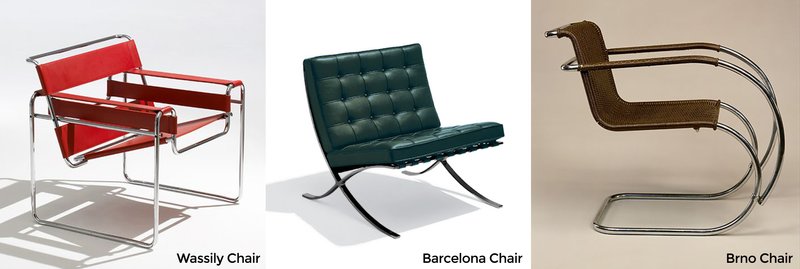
The Bauhaus B3, more commonly known as the Wassily Chair, is one of the most popular pieces of furniture to have been designed by Marcel Breuer. The iconic tubular steel chair was inspired by a variety of things. One inspiration behind it was bicycle frames which lead to many features being incorporated into the design including seat and back make from flat spring wire called arches. By using this technique he helped introduce something that had not yet been broadly utilized at the time making this chair a very popular piece for many decades after its initial release.
As a popular architect of the Bauhaus era, Wassily Kandinsky played an influential role in the German-born designer Marcel Breuer's education. Working on the art school's highly experimental furniture workshop, Breuer was inspired by Kandinsky's paintings and vice versa. He was initially inspired to build the Breuer chair following the completion of his masterpiece painting "Composition V", which is believed to have influenced his designs for the famed piece of furniture. Based on a traditional form of comfortable armchair design, Breuer simplified its overall shape into just a form with padded seat, back and arms. It soon gained fame across Europe as a true classic and was a perfect demonstration of the Bauhaus' ideals of art meeting industry.
The Brno Chair, designed by renowned architect Ludwig Mies van der Rohe between 1929 and 1930, also exemplifies the Bauhaus principle of reducing objects to their basic elements. Based on the principle that it is not necessary for a chair to have four legs when it can be built in a cantilever-style using a single C-shaped bar to support the entire seat.
Bruno's Barcelona chair was founded in 1929 for the International Exposition that happened in Barcelona. The now famous director of the Bauhaus, Ludwig Mies van der Rohe came together with the architect Lilly Reich to make what would resemble one of the most sought-after contemporary furniture pieces on the market today. The chair features two slim, rectangular cushions over a simple and lightweight metal frame. Originally designed to be bolted together, it was later redesigned as a seamless piece of stainless steel, along with changing out bovine leather for ivory-coloured pigskin.
With hanging space, shelf and shoe cupboard, this minimal space-saving design ensures occupants' belongings are compact yet efficient with a simple frame without any complex gadgets. Shelves can also be folded inside, while the wardrobe is mounted on castors wheels making it easy to relocate, ideal for modern urban life style and makes furnishing your home easy at an affordable price. The launch of the Bachelor's Wardrobe was instigated due to the demand for modern living spaces, following World War I.
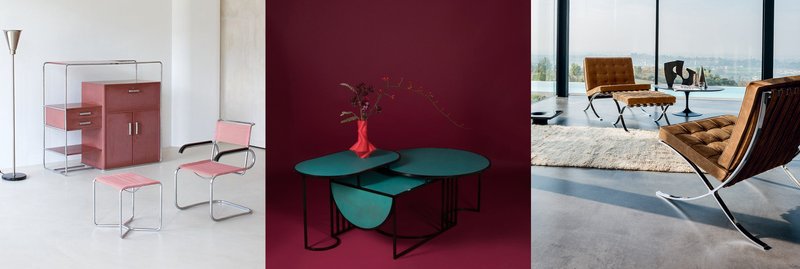
Although the modernist architecture of the Bauhaus, particularly by its founder Walter Gropius, is known for its use of functionality and austere white, black and grey colours in its buildings (which he favoured because of their simplicity), what many people fail to realise is that working with colour was a critical foundation course at the Bauhaus. Its leaders – first Swiss expressionist Johannes Itten, then Paul Klee after him followed by Wassily Kandinsky and then Josef Albers – led the Bauhaus on a quest to decode colour. The theories developed back then at this famous school underpin many intricate rules of contemporary colour theory which we use every day as designers.
Josef Albers, an American artist born in Germany, designed four tables as part of his time as the artistic director of Bauhaus. Each table is made from solid oak and mains acrylic glass and is painted blue, red, yellow or white. Committed to geometric artworks and abstractionism while teaching at the Bauhaus from 1926 to 1927, Albers was inspired by the four primary colours when choosing what colour scheme to apply to each piece. The trend of minimalist design composed of simple shapes like triangles and rectangles and primary colours continued to show up in works of Bauhaus inspired artists.
Schools of design have had a tremendous impact on the home. The Bauhaus style exemplifies this idea. The school sought to redefine the materials world and give people something useful and beautiful. In a sense, it was ahead of its time because many artists who founded this movement were trying to turn back to their roots by making objects that were practical yet beautiful at the same time. Despite the formation of Bauhaus only lasting for 14 years, between 1919 and 1933, its influence amongst artists has lasted even up till today as one can see from how popular mid-century design is now!
References (8)