

Know Thy Neighbor: Rebuilding Social Life Through Urban Regeneration in Dhaka
An architecture of invitation that layers courtyards, porous edges, and shared thresholds into Dhaka's dense neighborhoods to restore everyday encounter.


Streets in Dhaka used to be living rooms. They hosted conversation, play, ritual, and the slow accumulation of neighborly trust. Rapid urbanization compressed those streets into corridors of movement, and with that compression came a quieter crisis: the disappearance of the spaces where community actually forms. Know Thy Neighbor starts from this observation and works backward, asking what architecture can do when the problem isn't a lack of buildings but a surplus of walls between people.
Designed by Sumaita Tahseen and published as a project on uni.xyz, the proposal is an explorative urban regeneration study set within one of the world's densest metropolitan environments. Rather than proposing iconic forms or wholesale demolition, the project reimagines interactive public space as a catalyst for social healing, cultural exchange, and collective belonging. It positions architecture not as an isolated object but as an active framework that reconnects people to place, memory, and each other.
Mapping the Erosion of Shared Space
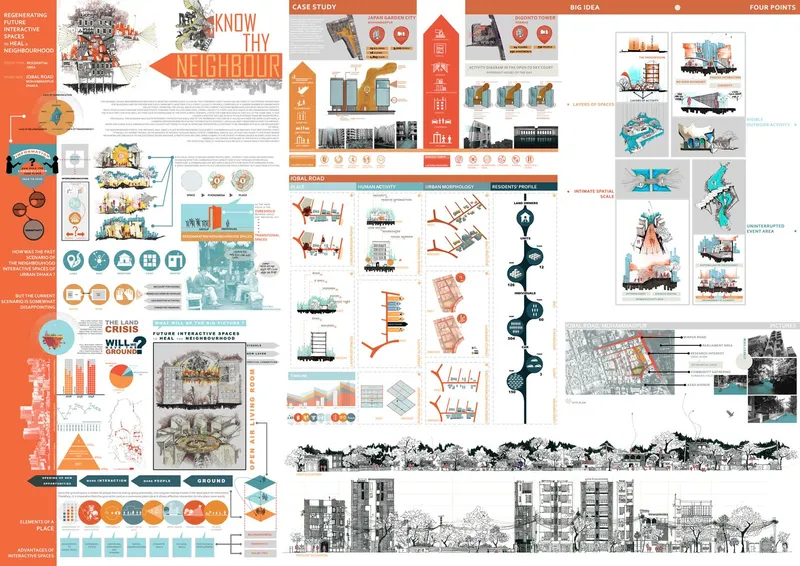
The opening presentation board lays out the analytical foundation in carefully organized infographics, diagrams, elevations, and axonometric drawings. Rendered in an orange-and-teal palette, these mappings trace how Dhaka's socio-cultural practices have shifted over time: how spatial thresholds between public, semi-public, and private zones have blurred or vanished entirely under economic pressure and informal growth. The investigation is forensic, identifying the loss of interactive space as a key contributor to social alienation rather than treating it as an aesthetic shortcoming.
What makes this diagnostic valuable is its specificity. The project doesn't generalize about "urban density." It maps how streets once used for communal rituals were reduced to movement corridors, and how the persistent struggle between private development and public life has reshaped neighborhood identity. Urban regeneration, in this reading, becomes a tool to restore everyday encounters rather than introduce monumental interventions.
Freeing the Ground Plane for People
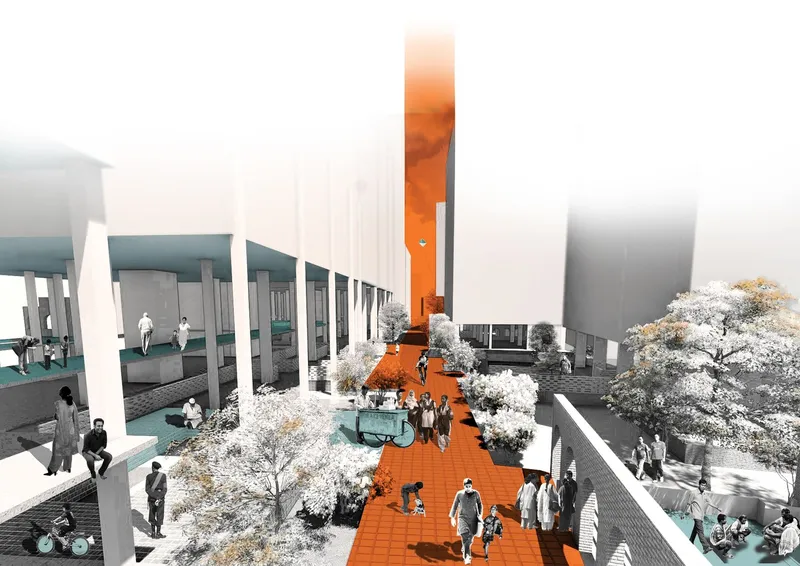
The rendered pedestrian pathway shows the project's most consequential spatial move: pushing vehicular movement to the periphery or basement levels and reclaiming the ground plane for uninterrupted pedestrian activity. Orange paving stretches beneath mature trees while people walk, pause, and gather at the base of a tall tower. The scene is unremarkable in the best sense; it depicts ordinary life happening in a space designed to support it rather than merely tolerate it.
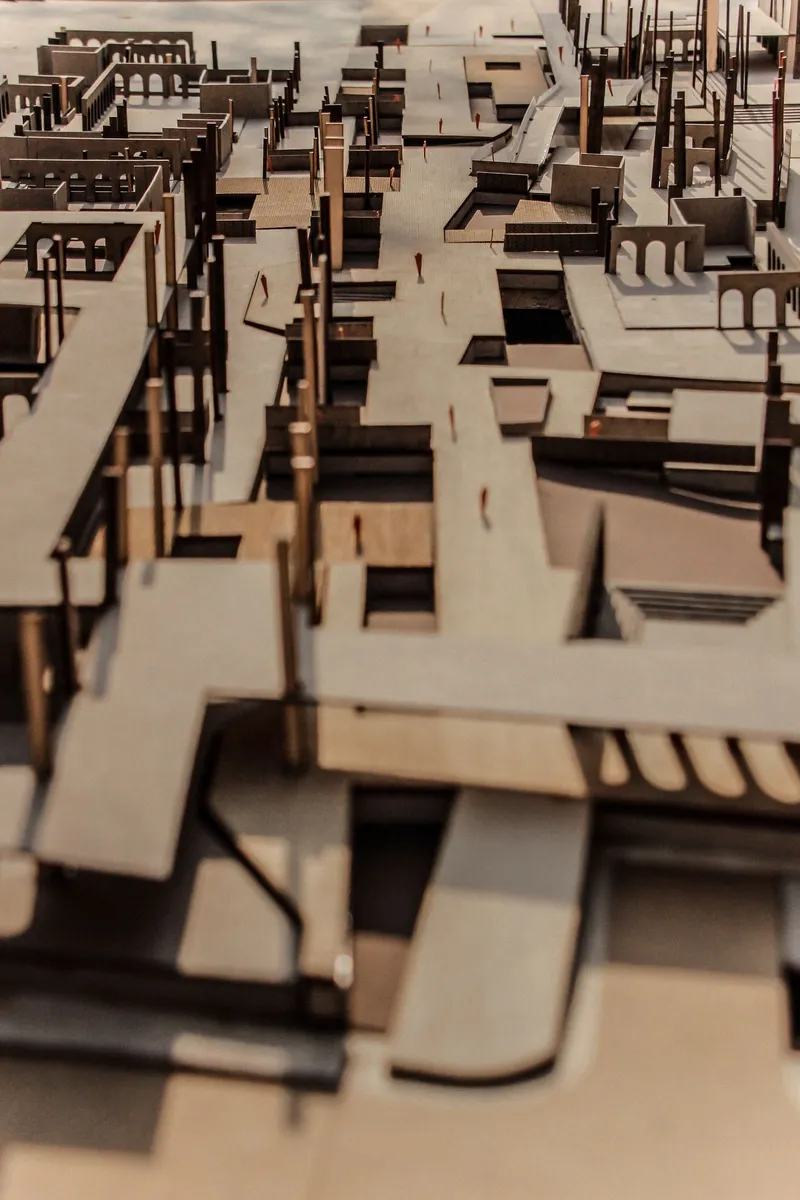
The cardboard physical model reinforces the density of the proposal. A tight cluster of buildings with varied rooflines and openings demonstrates how porous edges, courtyards, verandahs, and shaded walkways are woven into the built fabric. These are not decorative gestures. They create fluid transitions between indoors and outdoors, between private life and neighborhood life, establishing what the designer calls an "architecture of invitation rather than exclusion." The model's materiality, rough cardboard with visible cuts, captures the project's interest in texture and human scale over polished abstraction.
Rooms for Gathering, Thresholds for Pause
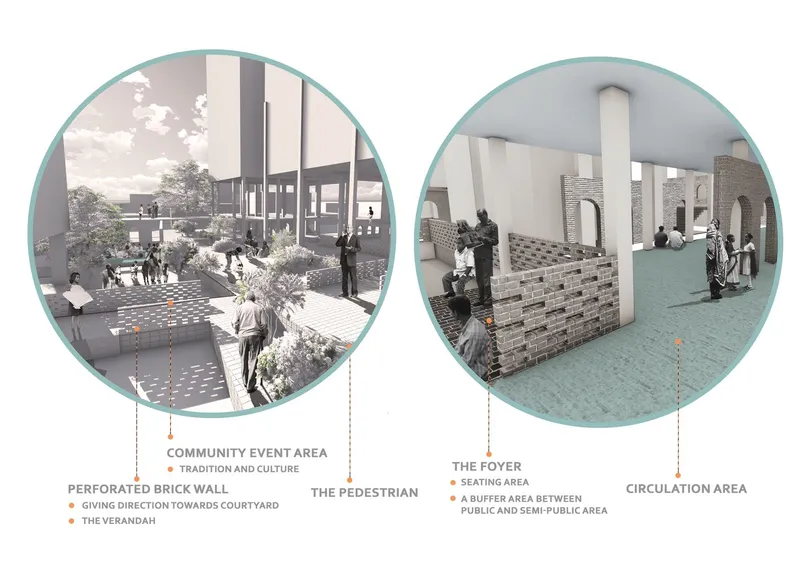
Two circular vignettes zoom into the project's programmatic heart: a community event area and a semi-open foyer with tiled flooring. These spaces represent opposite ends of a carefully modulated intimacy spectrum. Large gathering zones host cultural events, outdoor games, and street vending, while smaller pockets accommodate reading, resting, and quiet conversation. Perforated brick walls, semi-open foyers, and transitional corridors act as filters between public and semi-public realms, controlling visibility and access without hard barriers.
Time-sharing strategies allow these spaces to transform throughout the day. A morning jogging path becomes an afternoon market becomes an evening event ground, responding to different age groups and social needs. The adaptability is what distinguishes this from a conventional masterplan; it treats the neighborhood as a living urban system that shifts with its inhabitants rather than prescribing fixed behaviors.
Circulation as Social Infrastructure
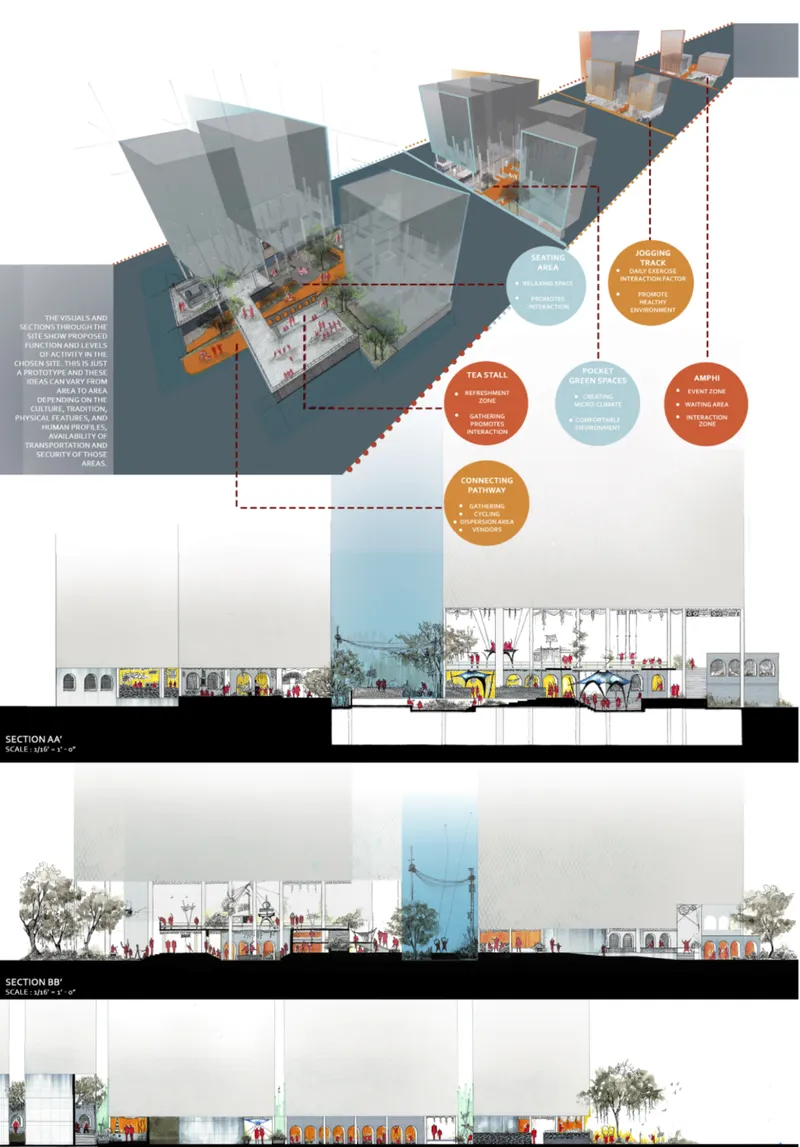
The axonometric and sectional drawings reveal the project's vertical ambition. Color-coded circulation zones and human figures demonstrate how open-to-air interactive rooms operate at multiple levels, not just the ground floor. Sections show a careful orchestration of levels, voids, and connections that maintain visual continuity across the site. You can see a neighbor from a second-floor walkway. You can watch children playing from a shaded balcony. These sightlines are deliberate; passive interaction and collective awareness are the project's core social instruments for rebuilding trust within dense urban neighborhoods.
Material choices reinforce the strategy. Brick and shaded structural grids respond to Dhaka's climate while rooting the proposal in the city's existing architectural language. There is no imported formal vocabulary here. The project draws its legitimacy from familiarity, proposing spaces that feel like they have always belonged to the neighborhood even as they radically restructure how it functions.
Why This Project Matters
Know Thy Neighbor resists the temptation to solve urban alienation with spectacle. There are no landmark towers, no branded public plazas, no gestures aimed at international awards juries. Instead, the project does the harder, less photogenic work of stitching interactive layers into a neighborhood that already exists. Its strength lies in understanding that social healing in dense cities doesn't require demolition and rebuilding; it requires the recovery of spatial generosity at the thresholds where daily life actually happens.
For designers working in contexts of extreme density, this project offers a useful provocation: what if regeneration meant not adding more architecture but opening up the architecture that's already there? Sumaita Tahseen's proposal suggests that the most radical intervention in a city like Dhaka might be a permeable wall, a shared courtyard, or simply a street wide enough to stop and talk.
View the Full Project
About the Designers
Designer: Sumaita Tahseen
Enter a Design Competition on uni.xyz
uni.xyz runs architecture and design competitions year-round that reward proposals with spatial conviction and real site intelligence.
Project credits: Know Thy Neighbor by Sumaita Tahseen.


Popular Articles
Popular articles from the community

Temporary Home for Dogs: A Reversed Zoo Rethinks Animal Shelter Architecture
In Bucharest, a sinuous corridor and freed landscape flip the logic of containment, designing a shelter that works to make itself unnecessary.

Cloaked Colonization: A Mobile Underwater Habitat That Moves Like a Fish
Micah Abaya's shortlisted EHC Pacific entry reimagines ocean settlement as a dispersed network of self-sustaining architectural organisms.
Faces of the Soviet Avant-Garde: Turning Moscow's Street Names into an Open-Air Museum
A network of sculptural installations across a Moscow residential district transforms forgotten architect names into spatial encounters with cultural memor
Opera by the Sea Estonia: Three Shells Dissolving Architecture into Tallinn's Coastline
A winning opera house proposal replaces monumental form with interconnected shells that blur the boundary between building, park and Baltic Sea.

Similar Reads
You might also enjoy these articles
Yenisei Monitoring Center: A Sun-and-Moon Sphere Anchors a Research Campus on Siberia's Great River
In Krasnoyarsk, shifting square blocks, a glazed central sphere and descending window rhythms turn river science into a public spectacle on the Yenisei.
Andretta Artist's Village: A Node-Based Masterplan That Lets the Hills Write the Plan
A cultural landscape strategy for Palampur's artist colony threads studios, residences and stages along a porous spine shaped by the Dhauladhar terrain.
Street Children Rehabilitation Center: A Brick Campus That Eases Children From Street to Safety
A low-rise courtyard campus where learning streets, uthans and shaded verandahs stage a gradual passage from street into protective, family-scale life.

The NEON Culture: A Field of Pavilions Built for the 24-Hour City
Smaran Alva spreads galleries, stages, clubs and markets across a varied site, treating light, sound and ramped movement as the real building materials.

Comments (0)
Please login or sign up to add comments
No comments yet. Be the first to comment!