

Lessons of Travel
An essay about the relationship between Architecture and Travel.

Being an architect is not easy, I believe it was Zaha Hadid who once said “If you want an easy life, don’t be an architect” - and it’s true, being an architect is not easy. You have to know a little about everything and you have to answer complex puzzles every day, 24/7, 365. We work even when we aren’t at work - we have the most brilliant Eureka's at home, or sometimes at 3 am, or sometimes even in the shower. You’re constantly trying to organize that which hates being organized (i.e. schedules, design deadlines, construction problems, etc.) and there’s never enough recognition to go around - and yet we do it anyway. We do it for a various number of reasons, chief among them is the joy and satisfaction of creating. We create and build for the sake of creating and building, at least that’s why I do it - but creating and building comes at a price, good or bad, what we create is added to society. It helps shape the world we live in and influences society to progress forward.
We are fortunate enough to live in an era that promotes good design - nowadays, architecture acts as the chief selling point of travelers worldwide. The connection between architecture and travel is now more evident than ever - much like the books that we architects love to read, travel is essentially the living book of society. Just like what Zaha Hadid said, Architecture is not an easy profession to pursue, but in this day and age, the sheer influence and iconography that our profession holds over society do give an immense sense of satisfaction - and in the context of traveling for architecture’s sake is more prevalent than ever.
Nowadays, tourism has evolved to incorporate iconic architecture in countries - from places like the Tower Bridge in London (alongside the long-running joke of ‘London Bridge’), the Leaning Tower of Pisa in (alongside the famous ‘stop the fall’ pose), the Empire State Building (alongside the lover’s reunion place at the rooftop), the Statue of Liberty, and the Louvre to name a few places - all of these iconic pieces of architecture have been made even more iconic by the history and the use of the tourists in these places. Another great example of this phenomenon is Times Square, at its core, Times Square presents no unique form of architecture. It is simply an iconic convergence of the culture of New York, all in one shot - and that simple place that commands the attention of the world is nothing more than a place made special by culture and subsequently of travel. That’s exactly what makes traveling for architecture pop, it shows us history; not just architectural history mind you, but it showcases the entangled and ethereal dance of society and architecture. We see new cultures, we appreciate the intent of places, whether it was achieved or not, and we see the impact that design has on the lives of the people around us. St. Augustine has a brilliant saying regarding this phenomenon, “The world is a book and those who do not travel, only read one page” - it is precisely because of this that we must explore what is unknown to us and encourage other people to do the same. If the act of travel is reading, then we should act as travel bookworms - the only way to elevate our architecture is by seeing higher forms of it and applying the knowledge we gain from travel.
Architects love to spread ideas and the sheer act of traveling allows us to be both reader and author of this organic book - case in point, in all my travels (both in my homeland and abroad), I’ve always learned something new from all forms of architecture I’ve encountered. In my travels, I learned and appreciated old vernacular architecture up close and have applied that appreciation to synthesizing how society works vis-a-vis their design inclinations. In a region in the Philippines called Banaue, there settles a tribe of indigenous people called the Ifugao. Their iconic piece of vernacular architecture is called the Ivatan House, it’s a precolonial piece that still holds its design ideals to this day - the context of the house is basically that it allows the users to cook in a room that acts as their living room, dining room, and kitchen. The way of life of the people in that region is far from the fast-paced hustle and bustle that we are used to, people there are used to cooking for hours on end just to eat then cook again for hours on end, needless to say, the pace of their life is very slow. While the pace of their life was a bit of a shock, the context of why they did so wasn’t. Their idea of advancement meant a better connection to nature as opposed to the metropolitan definition which is to develop most, if not all, of the spaces that we possibly can. This seemingly simple connection between iconic house and societal context has made me realize that the even vernacular architecture and its societal context varies region per region, and the impact of that realization allows me to think of this factor in my future designs - while it does seem simple, the synthesis of this realization has forever elevated my appreciation and awareness of the context in design.
Furthermore, the best part of it wasn’t just the local travels but the international travels too. Having traveled abroad, I’ve seen designs that I’ve previously only seen in pictures, and having that experience of appreciating these then abstract things that have now come to life sparked a creative passion in me. I knew that if I would be allowed to elevate my designs, that I’d take all those opportunities and create even better designs than I previously thought possible. There were even times when I was doing my thesis that I could help solve the design problems of my classmates because of my travels. I’d see something they’re designing and be reminded of something I saw in a place I went to, or maybe I’ll suddenly remember the beauty of a certain design the first time I see it and suddenly get hit with a lightning bolt eureka that helps smooth their designs along. Having had the experience of travel has made me more open-minded and appreciative of architecture as a whole.
At the end of the day, our profession is very difficult, but it’s also immensely rewarding. Traveling helps us see the bigger picture that we fail to do so sometimes when we’re hyper-focused on our work. Traveling is something that we must love to do and something that we need to do, not only to rest our weary minds but also to remind ourselves of the impact of our profession. Who knows, maybe it’s our designs that will be iconic tourist spots in the future? Maybe it’ll be our architecture and our concepts that make people want to travel, who knows?

Popular Articles
Popular articles from the community


Play: Fragments of Their World
Familiar architecture becomes modular playground design, creating safe spaces where displaced children can learn, connect, imagine and play.

Little Red Riding Hood: Architectural Design as a Journey Through Fear, Light, and Storytelling
Little Red Riding Hood reimagines the fairy tale through architectural design shaped by fear, light, scale, memory, uncertainty, and choice.

Hill & Cross Opera: Sculptural Opera House Architecture Shaped by Tallinn’s Landscape and Identity
Hill & Cross Opera reimagines opera house architecture in Tallinn through its sculptural hill, civic plaza, glass wave and a luminous cross.

Conexión: Biophilic Design Reimagines High-Rise Living in Hong Kong
Conexión reimagines high-rise living in Hong Kong through biophilic design, green facades, shared spaces, daylight, water and nature within.

Similar Reads
You might also enjoy these articles

Day and Night Park: A Time-Based Urban Newsstand in Beijing
A temporary urban newsstand in Beijing blending travel, light, and reading through poetic colors, compact form, and community-focused design.

Modernist Patio Renovation in El Masnou, Barcelona by Oliver Segura Arquitectura + Cebrià Arquitectura
Modernist patio renovation blending tradition and innovation with a movable pool, leveled floors, and Catalan materials in El Masnou.

Alto Residencial Coop: Cooperative Housing Development in Santiago de Compostela by Carbajo Barrios Arquitectos
A linear cooperative housing complex blending white volumes and perforated metal façades, enhancing community living, natural light, privacy, and urban integration.
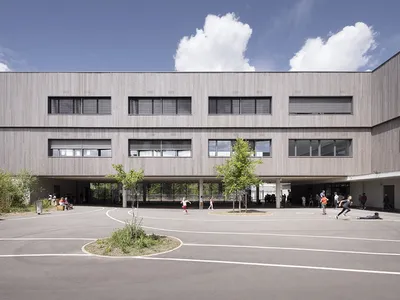
Vil Genis School by BPA ARCHITECTURE – Massy, France
Vil Genis School in Massy, France, features sustainable design, south-facing classrooms, community integration, accessible spaces, and modern educational architecture.

Comments (0)
Please login or sign up to add comments
No comments yet. Be the first to comment!