
Longa-polis: Diagnosing the City as a Body Under Duress
A speculative megastructure treats late-stage capitalism as a spatial pathogen, proposing an immune response built from steel, ritual, and confrontation.


What if a city could be diagnosed like a sick patient? Longa-polis treats the contemporary metropolis not as a machine for living but as an organism in crisis, one riddled with the pathogens of extractive capitalism, spatial inequality, and systemic alienation. The proposal borrows the logic of biological immunity to build a new architectural vocabulary: antigens that isolate urban dysfunction, immune responses that take the form of infrastructural corridors, collective housing, and migratory rituals. The result is a speculative city that refuses comfort, opting instead for confrontation as the precondition for healing.
Designed by Sung Ho Park, Longa-polis was shortlisted in the UnIATA 2019 competition. The project operates at the intersection of political theory, speculative fiction, and radical urbanism, presenting a linear megastructure that slices through fragmented geographies as a politically charged artery. Rather than organizing space by function or class, it recomposes the city through conflict, layering, and intensity.
Processions Beneath Steel: Scale as a Statement of Power
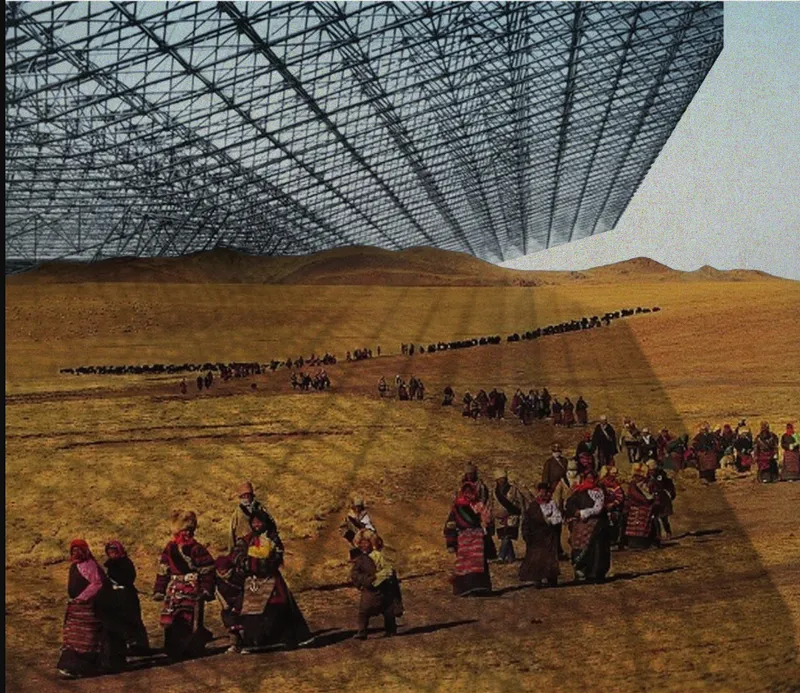
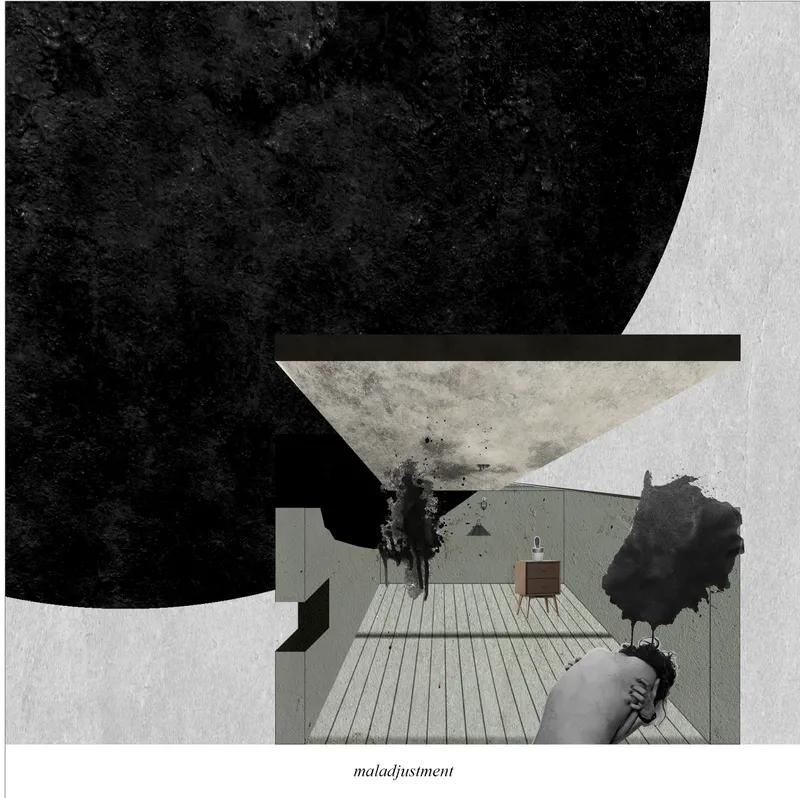
The opening collage sets the project's emotional register immediately. A curved steel lattice canopy hovers above a procession of figures crossing golden desert hills, articulating the simultaneous scale of oppression and human endurance. The juxtaposition is deliberate: monumental infrastructure bears down on collective movement, turning architecture into a theater of confrontation rather than a backdrop for daily life. In the second collage, concrete planes and timber decking collide with dark organic forms, while abstract figures occupy a space that feels both sheltering and menacing. These images do not aim to comfort. They expose the condition Park diagnoses: cities shaped by systemic weight, where human presence persists beneath forces it did not choose.
The visual language across both collages is visceral and layered, drawing on techniques that recall both Archigram's speculative provocations and the gritty photomontages of Superstudio. Monolithic black masses appear simultaneously ancient and futuristic. The human figure is never heroic here; it is present, enduring, and in motion. That motion, the symbolic exodus beneath vast trusses, becomes the project's central spatial ritual.
The Sketchbook as Diagnostic Tool
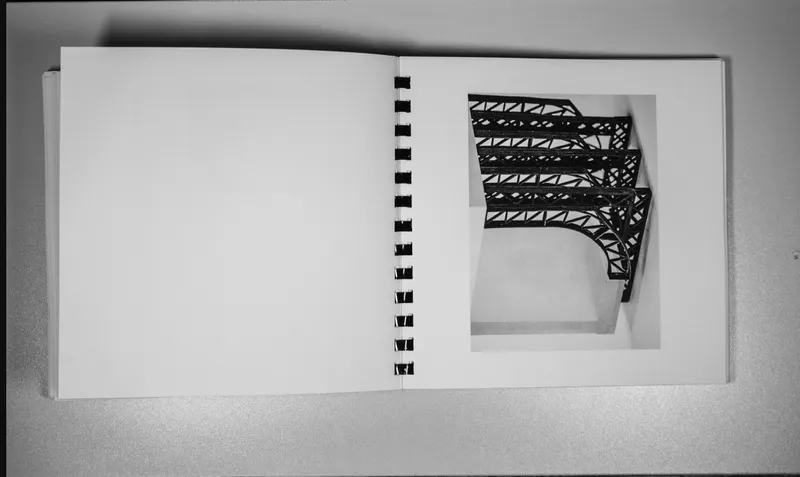
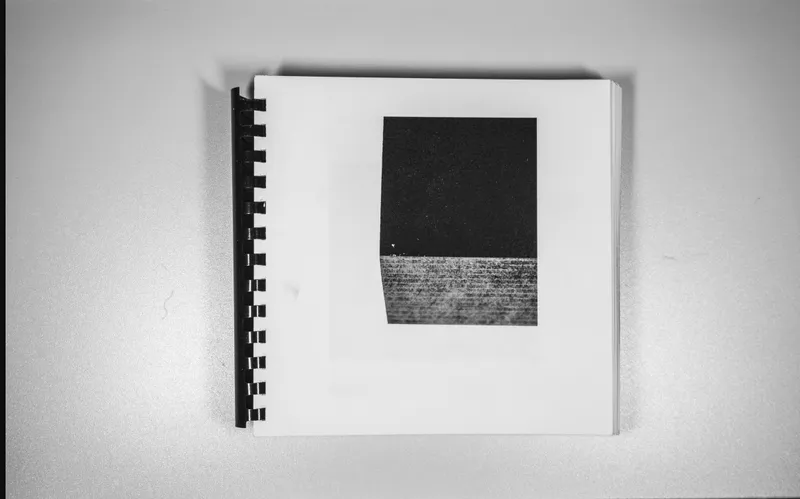
Two photographs of an open spiral-bound sketchbook reveal the project's working method. On one spread, a truss structure model sits on white pages, its skeletal form stripped to pure structural logic. On the next, a textured black square hovers above a striated band, evoking the psychological weight Park assigns to what he calls "maladjustment." These are not polished presentation boards; they are diagnostic artifacts, evidence of a designer thinking through material and metaphor at the same time. The truss reads as both engineered spine and oppressive lattice. The black square suggests both a spatial void and a psychological wound.
The inclusion of process material matters here because Longa-polis is a project that foregrounds thinking over resolution. Park does not offer a singular solution, a finished typology, or an optimized plan. Instead, the sketchbook pages function as fragments of an ongoing immune response: tentative, iterative, and deliberately incomplete.
A Linear Megastructure That Refuses Neutral Planning
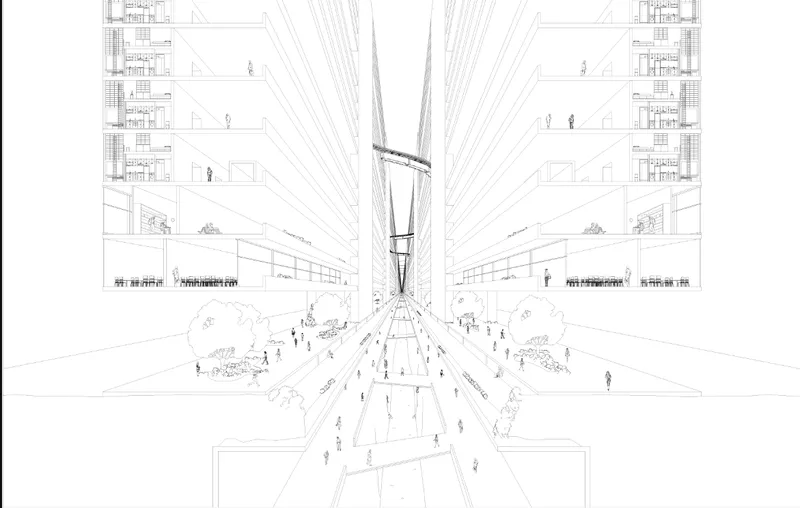
The perspective section drawing exposes the megastructure's internal anatomy. A linear plaza stretches between residential blocks, populated by figures and trees that give human scale to an otherwise relentless horizontal form. This is the project's infrastructural spine: not a neutral connector linking neighborhoods, but a provocative insertion into the landscape. It weaves together shelter, surveillance, habitation, and provocation in equal measure. The drawing reveals an ecology of flows, with people, goods, energy, and information coursing through a spatial immune system that resists normative zoning and hierarchical ordering.
What distinguishes this section from conventional urban proposals is its refusal to segregate program by class or function. Residential blocks sit alongside collective spaces without the buffer zones and grade separations that typically enforce social hierarchy in planned developments. The linear form itself becomes an argument: that cities organized by conflict and intensity might be more honest, and ultimately more livable, than those organized by the false neutrality of master planning.
Structure as Resistance: The Louvred Facade Model
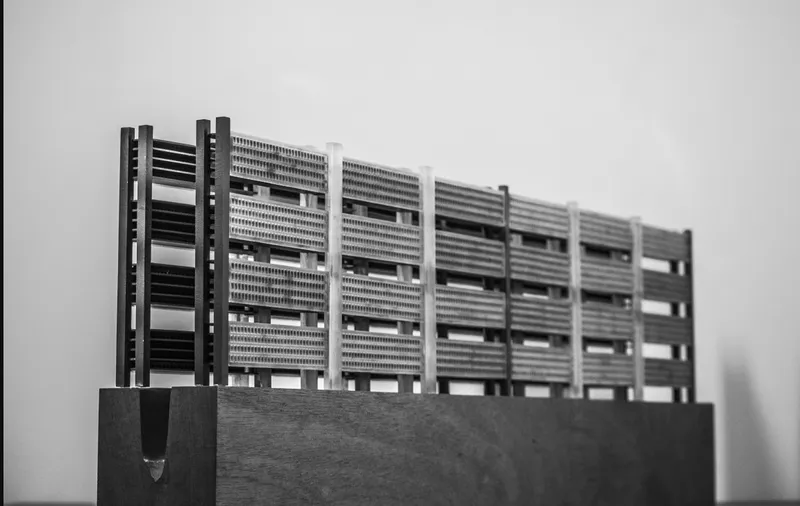
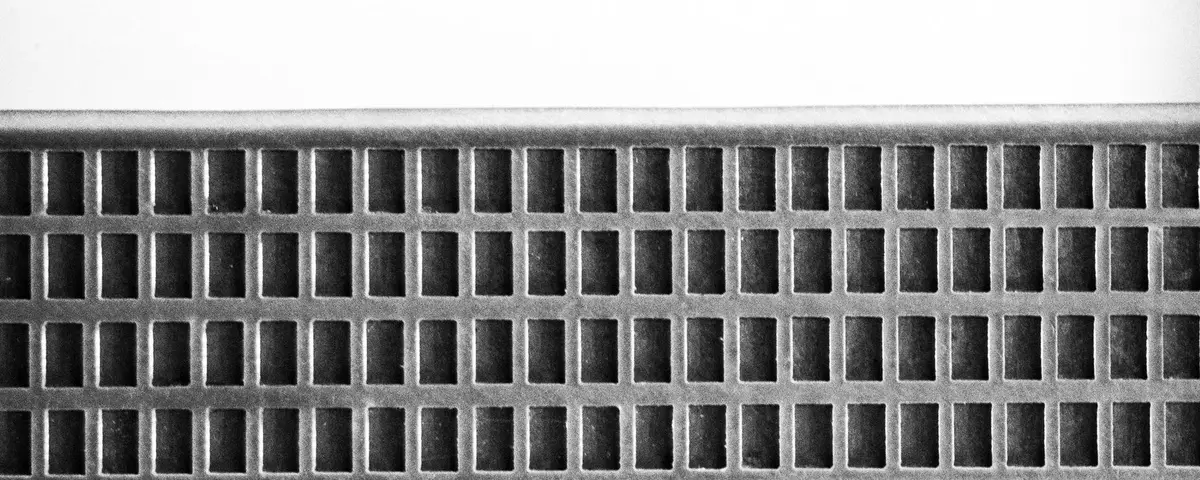
A physical model of a horizontal louvred facade with protruding structural piers, mounted on a dark base, brings the project's material logic into three dimensions. The louvres suggest control over light, air, and visibility, while the piers push aggressively outward, claiming territory beyond the building's envelope. This is architecture that does not recede politely into its context. It asserts, it interrupts, it takes up space in ways that mirror the project's broader political stance. The model's material rawness, with no decorative finish or contextual camouflage, reinforces Park's argument that authentic urban form must confront rather than conceal.
Why This Project Matters
Longa-polis operates in a tradition of speculative urbanism that includes Constant's New Babylon and Archizoom's No-Stop City, but it updates that lineage for a moment when the crises of capitalism are no longer theoretical. Park's contribution is to reframe the city not as a failed utopia in need of repair, but as a sick organism in need of diagnosis. The biological metaphor is not decorative; it structures the entire proposal, from the identification of spatial antigens to the design of immune responses that take the form of collective housing, contemplative chambers, and migratory rituals.
The project's strength lies in its refusal to offer easy resolution. There is no single typology, no optimized floor plan, no reassuring render of happy residents in sunlit courtyards. Instead, there is an uncomfortable honesty about the conditions architecture inherits, and a provocation to imagine design not as aesthetic production but as a form of care administered to a body under duress. For a competition entry, that is a rare and valuable commitment.
View the Full Project
About the Designers
Designer: Sung Ho Park
Enter a Design Competition on uni.xyz
uni.xyz runs architecture and design competitions year-round that reward proposals with spatial conviction and real site intelligence.
Project credits: Longa-polis by Sung Ho Park UnIATA 2019 (uni.xyz).


Popular Articles
Popular articles from the community


ETEH Reworks the Shared Spaces of São Domingos School in Brazil Around Timber, Color and Hanging Plants
At São Domingos School in Brazil, 436 m² of hall, refectory and library are recast with timber joinery, a yellow and blue code and trailing greenery.


Singing Woman: An Opera House That Performs Before the Curtain Rises
Ovidiu Cristian Pavel's conceptual opera house translates Estonia's choral identity into a sculpted waterfront landmark facing the Baltic Sea.

The Amber Palace Opera: A Geological Fiction Surfaces on Tallinn's Baltic Waterfront
Pierre Brillard reimagines a Baltic legend as a public landscape, opera house, and waterfront promenade rooted in Tallinn's coastal identity.

David Ortega Stacks a Two-Story Mexico City Penthouse Around a Steel Stair and a Pergola-Shaded Roof Terrace
In Colonia Roma, a 300 m² penthouse uses oak joinery, a planted steel stair and a slatted roof pergola to make a new-build apartment feel like a house.

Similar Reads
You might also enjoy these articles

Cube Design Draws an Ecological Corridor Between Two Shenzhen Hills with the Nankai Building
Beside Shenzhen's container docks, the Nankai Building pairs stacked balconies with a climbing green screen to connect two hillsides across its height.

Praksis A and Studio Sted Bend a Red Timber Cabin Across the Granite of Norway's Southern Coast
On the southern Norwegian coast, a 105 m² cabin follows the rock on slender posts, pairing red cladding outside with pine, brick and plywood within.
David Ortega Stacks a Two-Story Mexico City Penthouse Around a Steel Stair and a Pergola-Shaded Roof Terrace
In Colonia Roma, a 300 m² penthouse uses oak joinery, a planted steel stair and a slatted roof pergola to make a new-build apartment feel like a house.

PARALELA and LB2 Thread a Public Walkway Through the Base of a Las Condes Residential Tower
In Las Condes, Santiago, the Hamlet Building gives its fenceless ground floor to a 70-metre wooded passage linking two streets and the metro.

Explore Dystopian Architecture Competitions
Discover active competitions in this discipline

Design a brochure to showcase the effects of the technosphere

Challenge to illustrate ‘A tale of Two Cities’

Deconstructivism - Illustration Design Challenge

Challenge to illustrate a Contemporary Castle
Comments (0)
Please login or sign up to add comments
No comments yet. Be the first to comment!