

Plug-In Housing: Hexagonal Capsules That Let Dhaka's Micro Homes Grow Cell by Cell
Tahmina Tonni and Rafiul Khan stack interlocking hexagonal pods into a plug-in housing system for Dhaka's students and young professionals.


Most micro housing proposals treat small space as a problem to be apologised for. Plug-In Housing, Minimum Space Maximum Uses takes the opposite position: it borrows the geometry of the honeycomb, a structure in which nothing is wasted, and argues that compactness can be a generator of form, community and growth. The result is a building conceived as a living system of hexagonal capsules that can be inserted, removed and recombined as the city demands.
Designed by Tahmina Tonni and Rafiul Khan, the proposal is rooted in Dhaka, one of the fastest-growing megacities in the world. Rural migration, climate displacement and a booming population of students and young professionals have pushed land prices and rents beyond reach for many. The designers studied the city's educational hubs, transport networks, migration patterns and growth trends to locate sites close to institutions and workplaces, framing their users clearly: young residents who need affordable, compact homes within reach of where they study and work.
The Honeycomb as Structure, Not Decoration
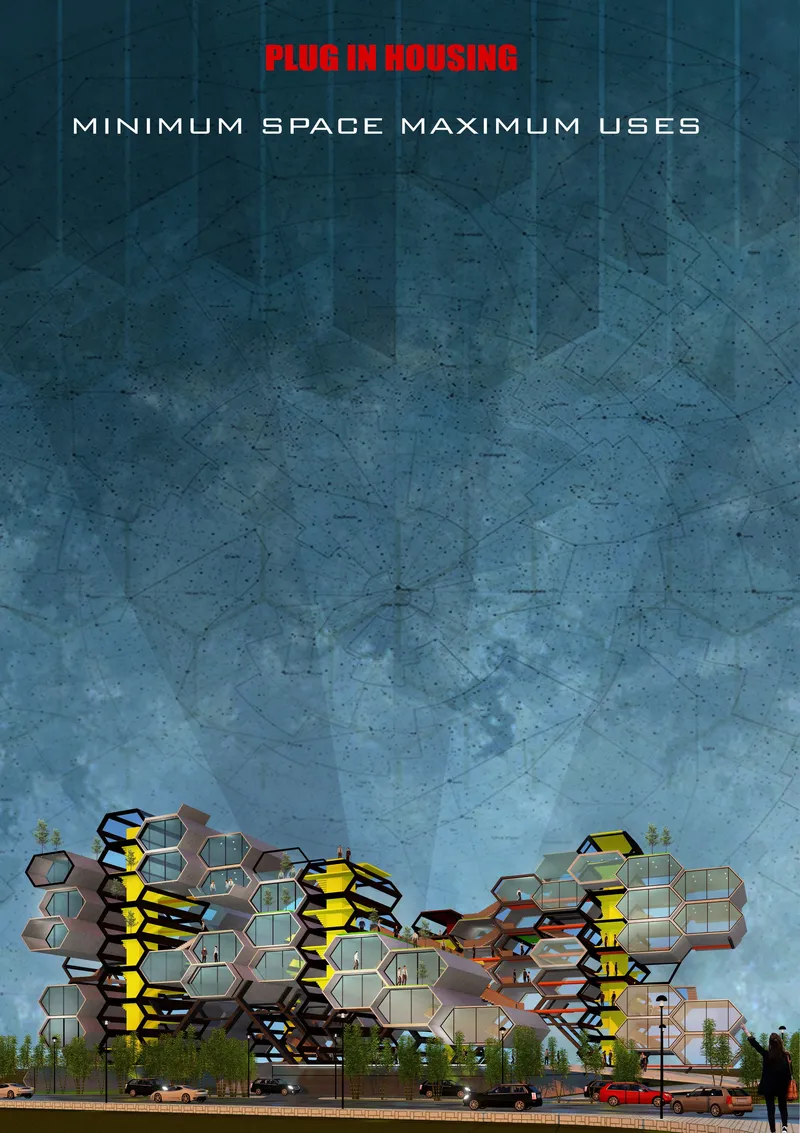
The poster rendering sets out the core idea with clarity: hexagonal pods stacked into a dense, irregular cluster, each one marked by a yellow core that reads almost like a cell nucleus against the dark star-chart sky. The figure standing at the edge gives a sense of scale and hints at the intimacy of each unit. This is the honeycomb taken literally, but the designers push it beyond image. Interlocking hexagons share walls and edges, which reduces redundant circulation and lets volumes pack tightly without collapsing into a monotonous slab.
The more interesting claim is that the geometry carries both privacy and collectivity at once. Each hexagon is a discrete dwelling, yet the way the cells bond produces a continuous field of shared edges, terraces and connections. The honeycomb becomes a spatial system rather than a façade motif, and that distinction is what gives the project its conviction.
Removing Cells to Let Light, Air and People In
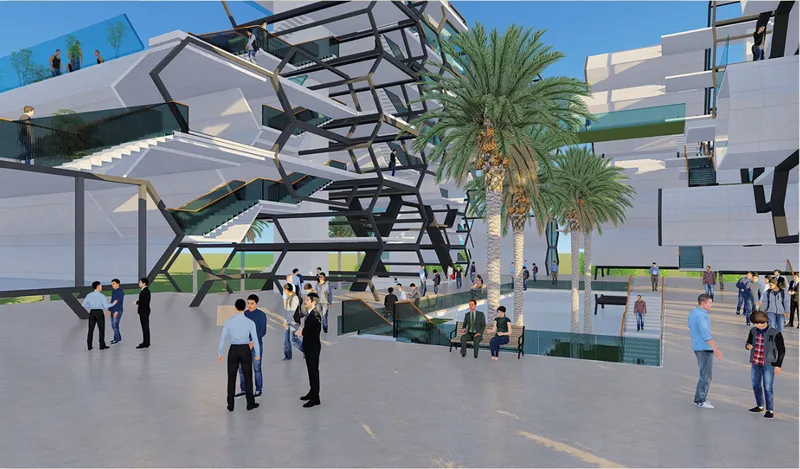
The design develops through a clear five-step sequence: basic composition of stacked hexagons, shape transformation to improve daylight and ventilation, module bonding into clusters, deconstruction and circulation, and finally the plug-in strategy. The fourth step is where the scheme earns its spatial richness. By selectively removing and shifting modules, the designers carve out terraces, voids and communal corridors from what would otherwise be a solid mass.
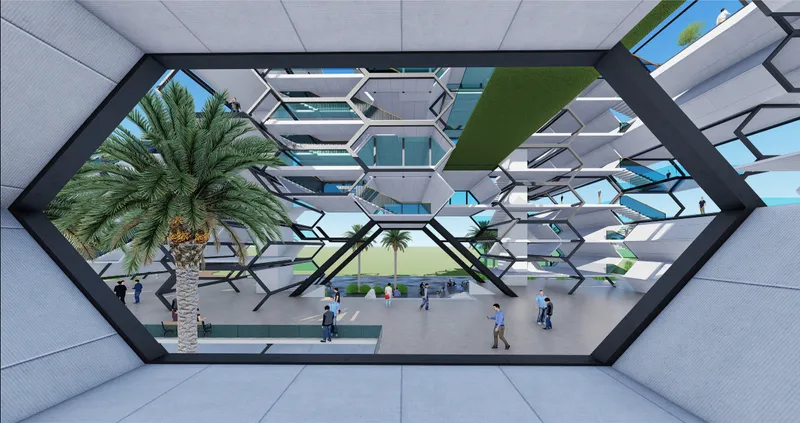
The views from the plaza show what that subtraction delivers. Hexagonal steel framing and stair landings hover above a palm-planted public space where groups gather in the afternoon sun. Seen through a hexagonal window frame, the stacked terraces step back and open to the sky, confirming that the voids are not leftover gaps but deliberate rooms for light, breeze and social life. In a humid climate like Dhaka's, that porosity matters as much environmentally as it does socially.
Capsules That Shift Between Day and Night
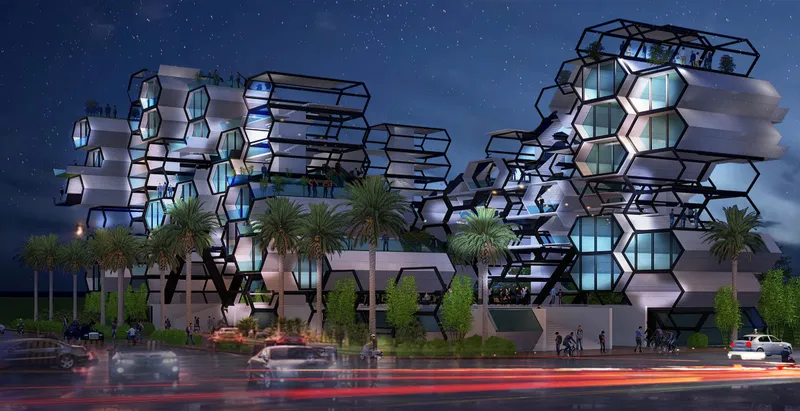
At night, the cluster reads as a constellation of lit glazing above palms and the red light trails of the road, and each glowing hexagon becomes legible as an individual home. That legibility underlines the plug-in logic: every unit is an independent living capsule that can be inserted or removed as required, allowing the block to expand vertically or horizontally without disrupting the overall system. Growth becomes incremental rather than a single act of construction.
Inside, the philosophy of minimum space and maximum uses is carried by movable walls and furniture. The designers describe units that open up during the day into collaborative, flexible space and fold back into private retreats at night. For a resident population of students and young workers whose routines shift constantly, this adaptability is not a luxury; it is the condition that makes a very small home liveable.
A Ground Floor Handed Back to the Community

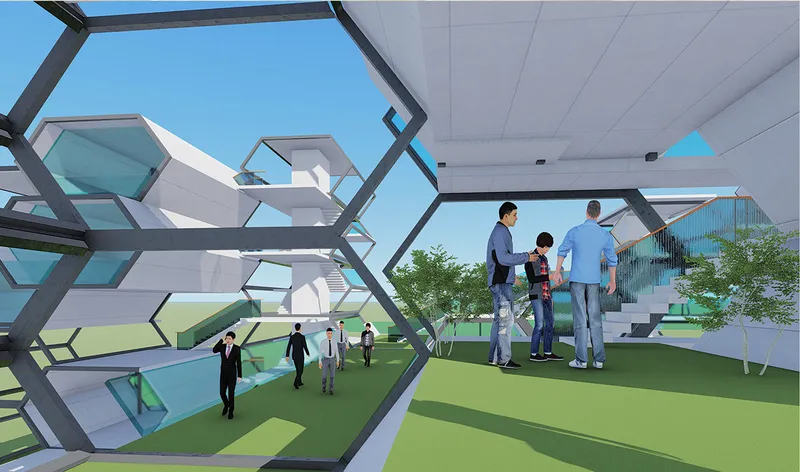
Where conventional apartment blocks seal their ground floors behind gates and parking, this proposal gives the base over to shared amenities and public space. The renderings show a plaza beneath hexagonal steel framing and open stairs, with palms, a group of benches and pedestrians moving through in warm daylight. The structure overhead acts like a canopy, shading the plaza while keeping it visually connected to the homes above.
The final view, through an open hexagonal frame onto a grass terrace where residents stand and talk, captures the project's social ambition. The designers deliberately blur the line between circulation and activity, so that corridors become social terraces and vertical connections become places to pause. In a dense environment where private rooms are small, these in-between spaces carry the weight of everyday encounter.
Why This Project Matters
Plug-In Housing is valuable because it ties a strong geometric idea to a specific urban condition. The honeycomb metaphor could easily have remained a graphic gesture, but Tonni and Khan use it to organise structure, reduce circulation, generate terraces through subtraction and enable incremental growth. Their site research into Dhaka's educational and employment hubs grounds the proposal in real patterns of demand rather than abstract density.
The project also reframes what micro housing can offer a younger generation. Instead of the isolated cubicle, it proposes a small private capsule embedded in a generous shared landscape of plazas, terraces and social corridors. Questions of construction, cost and long-term maintenance of a plug-in system remain open, as they should for a conceptual proposal, but the core argument is persuasive: in a city running out of land, the smallest unit can still belong to a larger, more sociable whole.
View the Full Project
About the Designers
Designers: Tahmina Tonni, Rafiul Khan
Enter a Design Competition on uni.xyz
uni.xyz runs architecture and design competitions year-round that reward proposals with spatial conviction and real site intelligence.
Project credits: Micro housing is in-fact a honeycomb to uplift the living pattern for younger generation by Tahmina Tonni, Rafiul Khan.


Popular Articles
Popular articles from the community


The Amber Palace Opera: A Geological Fiction Surfaces on Tallinn's Baltic Waterfront
Pierre Brillard reimagines a Baltic legend as a public landscape, opera house, and waterfront promenade rooted in Tallinn's coastal identity.


ETEH Reworks the Shared Spaces of São Domingos School in Brazil Around Timber, Color and Hanging Plants
At São Domingos School in Brazil, 436 m² of hall, refectory and library are recast with timber joinery, a yellow and blue code and trailing greenery.

David Ortega Stacks a Two-Story Mexico City Penthouse Around a Steel Stair and a Pergola-Shaded Roof Terrace
In Colonia Roma, a 300 m² penthouse uses oak joinery, a planted steel stair and a slatted roof pergola to make a new-build apartment feel like a house.

FCC Arquitectura Expands a Portuguese Granite House with a Board-Marked Concrete Wing
In Portugal, JV House pairs a cleaned-up whitewashed and granite dwelling with a timber-shuttered concrete extension, courtyards and a garden pool.

Similar Reads
You might also enjoy these articles
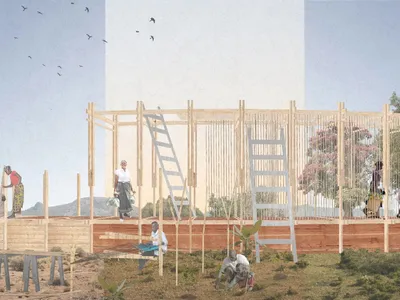
Healing Façade: A Modular Chapel System That Restores Ethiopia's Sacred Forests
Winner of the Eco-Chapel competition, this circular timber façade collects water from air to rebuild soil and reforest degraded Ethiopian landscapes.
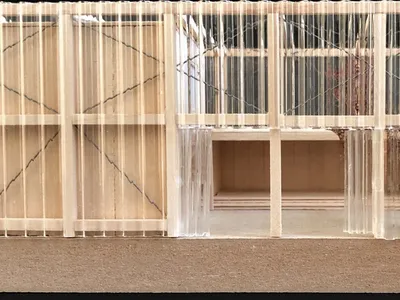
Kaffeebühnen: Where Coffee Shop Architecture Becomes a Civic Stage in Vienna
A linear sequence of timber boxes, transparent shells, and open yards turns the Viennese café tradition into a public performance space.
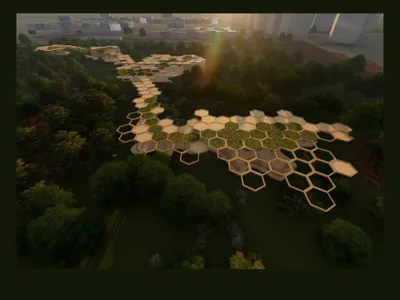
Eco Chapel: A Modular Forest Pavilion That Grows Like the Landscape It Protects
Hexagonal timber modules weave through existing trees, turning a chapel into a living system for prayer, education, and reforestation.


Urban Forest: A Vertical Ecosystem for 5,000 Workers in Singapore's Changi Business Park
Radially stacked pods and layered green decks turn a 7-acre plot into 47 acres of ecological workspace projected for 2040.


Comments (0)
Please login or sign up to add comments
No comments yet. Be the first to comment!