

Muslim Space: A Self-Sustaining Settlement Shaped by Prayer and Desert Logic
Lee Bomin designs a complete Saharan community where compressed earth, vaulted roofs, and Islamic ritual structure every spatial decision.


What happens when the five daily prayers of Islam become the literal organizing principle of an entire settlement? In Muslim Space, architecture stops being a container for religious life and starts functioning as its infrastructure. Every courtyard, every vaulted room, every shaded pathway is calibrated to the rhythms of devotion, communal gathering, and modest desert living. The result is not a mosque surrounded by housing but something more ambitious: a self-sustaining community in the Sahara where faith, climate, and construction technique are inseparable.
Designed by Lee Bomin and published on uni.xyz, the project imagines a settlement that serves three distinct populations: long-term Islamic residents who practice daily religious life, travelers visiting for three to seven days to experience desert culture, and missionaries and students who stay for several months of focused study. Rather than treating these groups as separate programs, Lee weaves them into a single clustered urban fabric of compressed earth buildings, shared bathhouses, schools, and open-air prayer spaces.
Four Quadrants Around a Central Core
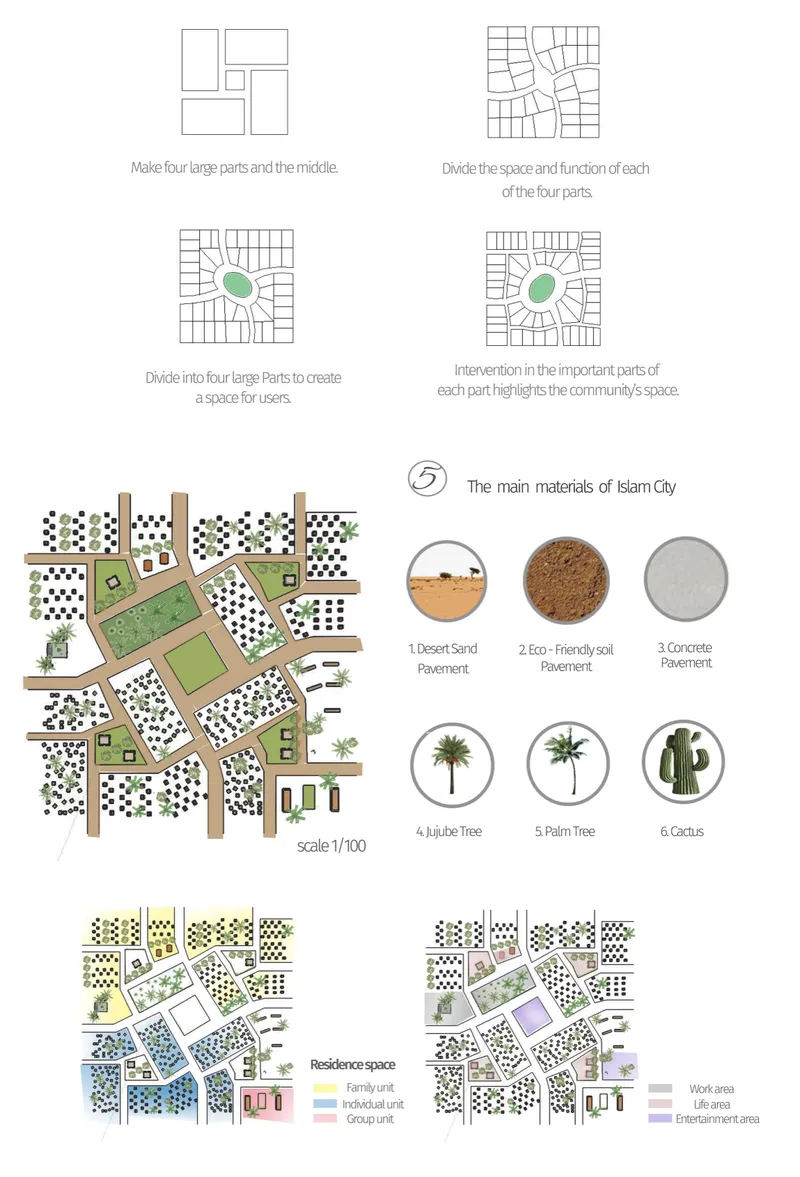
The masterplan follows a four-step logic: establish four major zones around a central core, divide each zone by function and circulation, allow quadrants to develop unique communal uses, and then reinforce the interaction nodes between them. The diagram above lays this out alongside the material palette, which includes desert sand pavement, eco-friendly soil pavement, limited concrete, and native plantings of jujube trees, palm trees, and cactus. What reads as an organic, almost informal settlement pattern is actually a deliberate strategy to minimize sun exposure through clustered massing and shaded courtyards, borrowing directly from the spatial DNA of traditional Saharan towns.
The walkable urban fabric prioritizes pedestrian circulation over vehicular movement. Organic pathways connect residential clusters to community buildings, bathhouses (separated by gender, essential before prayer), and a school divided into elementary, middle, and high school sections. An employee building anchors organizational life. The settlement is not a single landmark but a distributed network of small, thermally resilient structures that collectively form a complete civic infrastructure.
Vaulted Rooms and Compressed Earth Walls
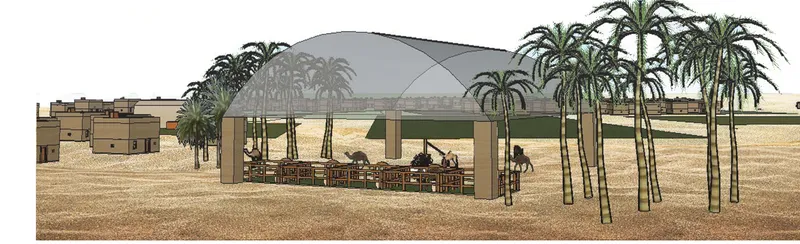
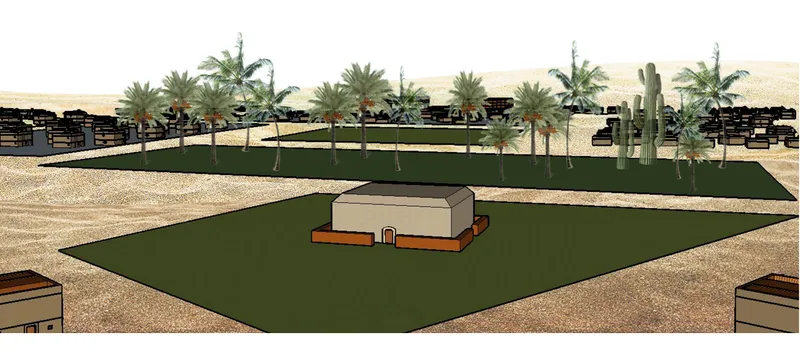
The section rendering shows a covered gathering space framed by palm trees, its heavy earth roof providing shade while the open sides invite cross-ventilation. Next to it, an axonometric view reveals the anatomy of a vault-roofed dwelling: compressed earth brick walls sit on lime-concrete foundations, topped with clay-lime roof finishing. The construction is deeply local. Rammed earth, compressed earth brick, lime plaster, and flat or vaulted roofs are chosen not for aesthetics alone but for their proven performance in hot, arid climates where temperature swings between day and night are extreme.
The two-story house development places kitchens, living areas, and bathrooms on the ground floor, with bedrooms and a dedicated prayer zone above. The roof itself becomes an open-air prayer space and thermal buffer, a layer that serves both spiritual and environmental purposes simultaneously. This stacking of program reflects the project's refusal to separate the sacred from the domestic. Prayer is not relegated to a single building; it permeates every dwelling.
Housing Clusters Dispersed Across Sand and Green Zones
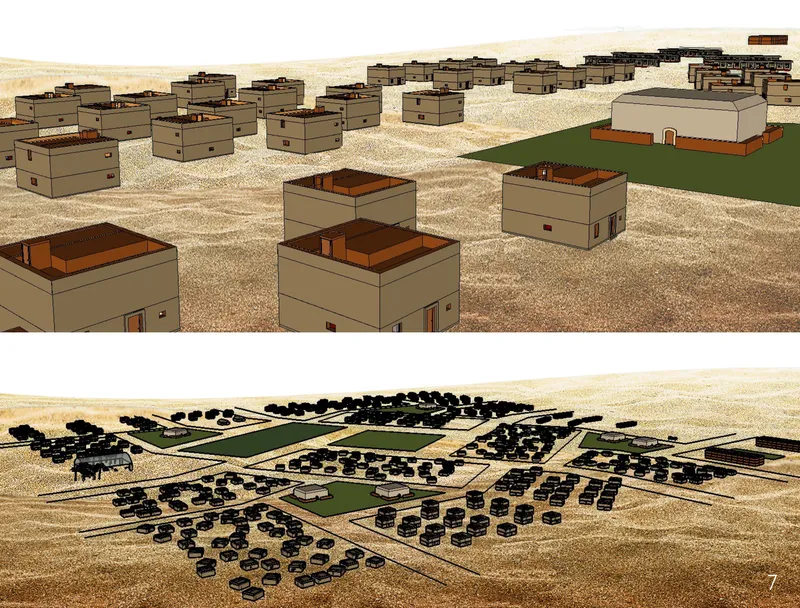
Seen from above, the settlement reads as a constellation of flat-roofed units punctuated by planted green zones. The dispersal is intentional. By breaking the building mass into smaller clusters rather than continuous blocks, the plan creates pockets of shade and breeze between structures. Vegetation, primarily palm trees and hardy desert species, serves double duty as microclimate modifier and spatial marker, softening the boundary between built form and open sand.
Residential units scale from the individual to the communal. The smallest is a single-room layout combining a living and prayer room, kitchen, bedroom, and toilet, designed for personal devotion and simple living. Family units aggregate multiple private spaces around a shared center, emphasizing privacy between genders while enabling communal outdoor activity and natural ventilation. The progression from solitary to collective mirrors the social structure of the community itself: individual faith practiced within a network of mutual support.
Barrel Vaults and Arched Entries at Human Scale
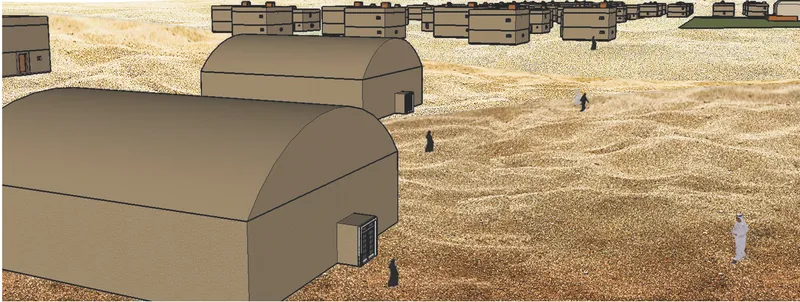
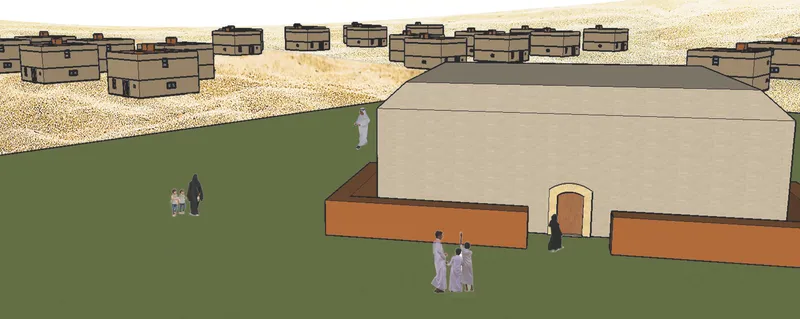
At eye level, the barrel-vaulted structures reveal their most compelling quality: they feel approachable. Figures walk through sandy corridors between buildings whose proportions remain modest, never monumental. The orange-base dwelling with its arched entry, where small groups gather in the shade, captures the social life the project seeks to foster. These are not grand civic gestures but quiet, repeated acts of spatial hospitality. The arch, a form with deep roots in Islamic architecture, recurs not as decoration but as structure, spanning compressed earth walls to create cool, shaded interiors.
The materiality is consistent across scales. Whether viewed as a single dwelling or an entire settlement, the palette remains grounded in earth tones, rough-textured walls, and the vertical accents of palm trunks. This coherence gives the project a visual unity that reinforces its conceptual premise: that a community built around shared faith and shared construction methods will naturally achieve formal harmony without requiring a rigid stylistic framework.
Why This Project Matters
Muslim Space pushes back against the tendency to treat religious architecture as a singular, iconic object. Instead of designing a spectacular mosque and filling in the rest, Lee Bomin distributes prayer, study, and communal life across an entire settlement. The architecture does not point to one sacred center; it makes the whole environment sacred. That is a fundamentally different proposition, and it demands a different kind of design thinking, one rooted in program sequence, thermal performance, and social ritual rather than formal spectacle.
The project also serves as a compelling case study in vernacular intelligence. Compressed earth, rammed earth, lime plaster, barrel vaults, and clustered massing are not nostalgic choices. They are performance-driven responses to extreme heat, scarce resources, and the need for durable, replicable construction. By grounding a contemporary settlement in these techniques while organizing it around the lived practices of Islam, Lee demonstrates that tradition and sustainability are not parallel concerns but the same concern, expressed through different vocabularies.
View the Full Project
About the Designers
Designer: Lee Bomin
Enter a Design Competition on uni.xyz
uni.xyz runs architecture and design competitions year-round that reward proposals with spatial conviction and real site intelligence.
Project credits: Muslim Space by Lee Bomin.


Popular Articles
Popular articles from the community


Manzana Morphosis: Stretching Barcelona's Grid into a Living Landscape for 2050
A radical reworking of the Eixample manzana turns density into a tool for generous public space, vertical ecology, and environmental performance.


ETEH Reworks the Shared Spaces of São Domingos School in Brazil Around Timber, Color and Hanging Plants
At São Domingos School in Brazil, 436 m² of hall, refectory and library are recast with timber joinery, a yellow and blue code and trailing greenery.

David Ortega Stacks a Two-Story Mexico City Penthouse Around a Steel Stair and a Pergola-Shaded Roof Terrace
In Colonia Roma, a 300 m² penthouse uses oak joinery, a planted steel stair and a slatted roof pergola to make a new-build apartment feel like a house.

Singing Woman: An Opera House That Performs Before the Curtain Rises
Ovidiu Cristian Pavel's conceptual opera house translates Estonia's choral identity into a sculpted waterfront landmark facing the Baltic Sea.

Similar Reads
You might also enjoy these articles

Aquadapt: An Underwater Habitat That Rewrites Its Rooms by the Hour
Curved modules ring the seabed while one shell shifts from breakfast room to cinema, farm and football pitch as residents' needs change.

Play: Fragments of Their World: Remembered Architecture Rebuilt as a Modular Playground for Refugee Camps
Tom Gardner abstracts domes, arches and towers from the homelands of displaced families into a kit of child-scaled play parts for camp settlements.
REBIRTH: A Circular Settlement Where Afghan Widows and Their Children Rebuild Life Together
A shortlisted Resile entry turns the circle into a protective ring of timber and brick, gathering homes, classrooms and gardens around a shared landscape.
The Main Dream: A Recycled Plastic Kit That Lets Refugee Children Build Their Own Playground
Thirty-centimetre interlocking cubes that connect on three axes turn play into construction, letting children author the spaces they occupy.

Comments (0)
Please login or sign up to add comments
No comments yet. Be the first to comment!