

Obsidian Quest
Research

The Obsidian Quest is a project that seeks to adapt to the extreme environment and harvest the potential that the volcanic site, Olympus Mons, can offer. The intent was to select a location iconic to Mars, well-known, researched, and proper for landing space shuttles. One of the fascinating facts about Olympus Mons is that it behaves differently than volcanoes on Earth, with an oozing, slow-flowing nature instead of an explosive one. With that in mind, the main objective was to create a research facility for the growth of food by studying the volcanic site, soil, lava, and atmosphere, which could provide vital information for the future possibility of humans living on Mars.
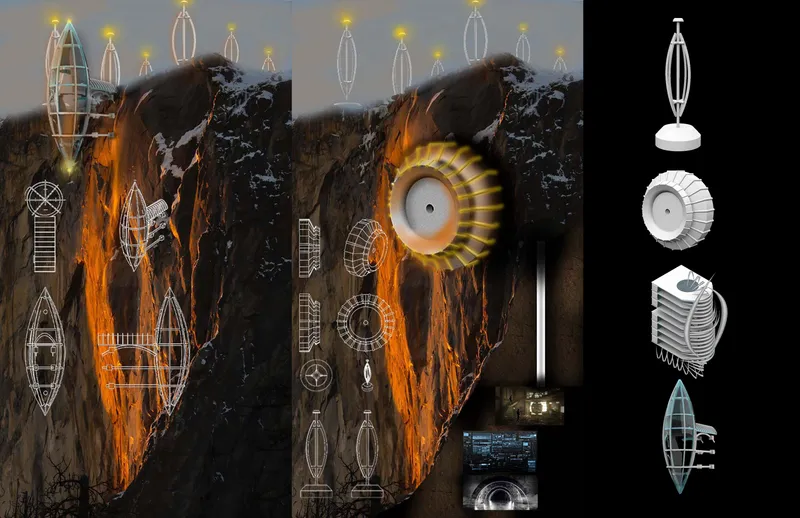
After establishing the site and its objectives, the project's conceptualization began its early stages of development. The first attempts sought to address the extremity of cohabiting with an active volcano by creating forms that would allow the oozing lava flow to pass by the facility with minimal damage to the structure by hanging off the mountain wall and creating hollow space between structural elements. The second of two possibilities was to develop a strong exterior shell that could handle the extreme heat of the lava and hide the facility into the mountain itself for protection. The second of those possibilities was to make a solid, heavier structure that would redirect the lava. An issue seen is the lack of spatial conditions and excessive solidness of both iterations, which focused on form instead of the creation of space.
For the subsequent iterations, the focus switched from creating solid form into creating lighter novel tectonic components and a dynamic assembly that would result in a much more spatial model. This concept would then run through all iterations from here to the final take. A prominent "bow" component was created, and different models built on vacuum explored the creation of space through shifting, stretching, and positioning those elements. Along with the bow component, grids were created and used as structural parts.
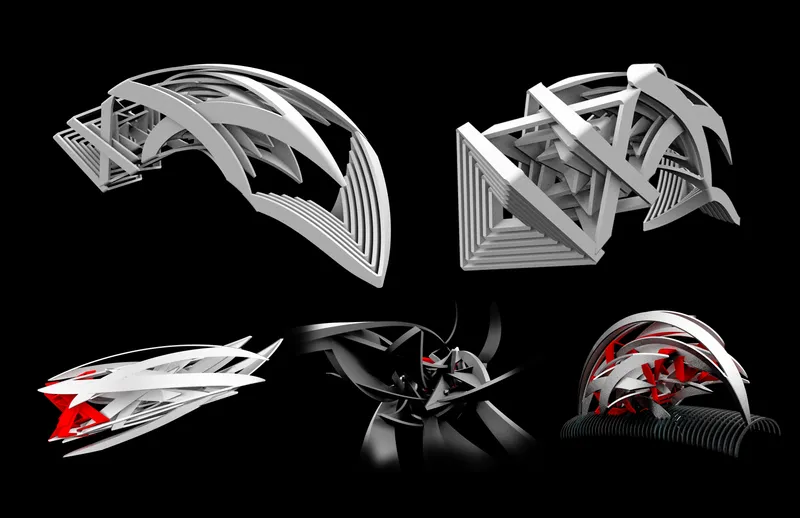
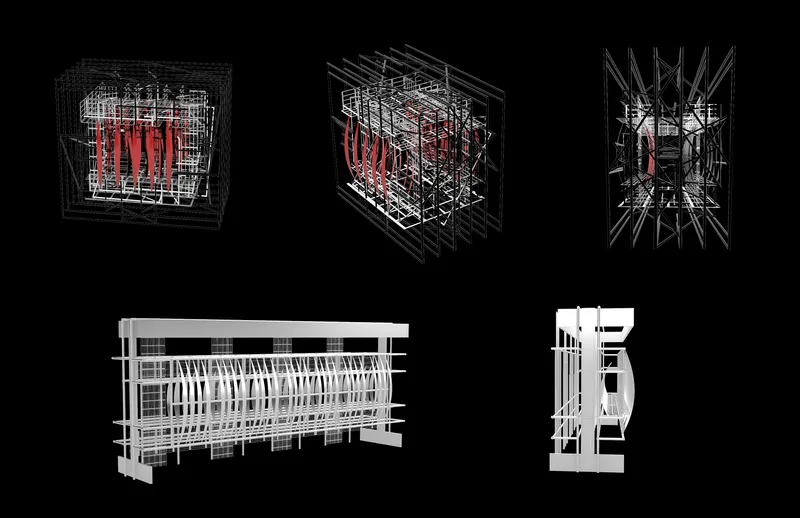
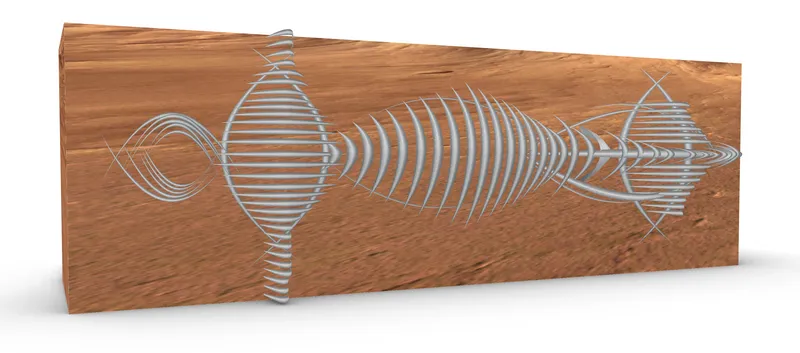
The following developmental phase focused on grids as a registration device, structural element, and the bow novel tectonic component hanging off the grids and creating spaces. Some of the previously faced issues had been the difficulty of connecting the site with the facility and giving a proper scale since Olympus Mons is roughly the size of France. The subsequent iterations focused on solving these issues while deploying the instances that worked well on models built on vacuum. To do that, the model then moved to hang at the edge of the mountain. Hanging at the edge helped engage the site, avoid lava spew, provide the most accessible landing spot for aircraft and shuttles, and be an optimal area for dispatch of any scientific excursions since the top of Olympus is mostly a flat surface.
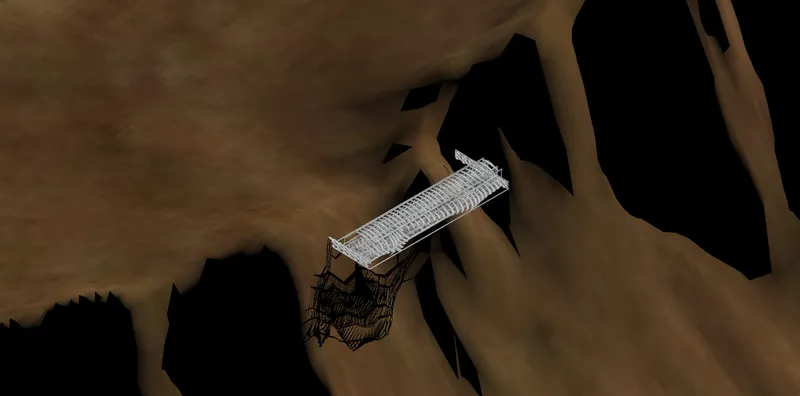
For the programme, a lab was established as the main hub space of the research facility, which is the largest open centralized space in the model. The lab would then serve as a space where growing plants in a greenhouse environment and using volcanic soil nutrients would be researched. Along with the lab, modular housing units were created using the bow component along the façade of the model, which allowed for expansion and the creation of more rooms as the facility grew. In order to connect the private areas (housing) to the main hub (lab), large hallway spaces were created, where programmes such as entertainment, cooking, and meeting rooms would be located and serve as a bridge between private and public space. Finally, besides avoiding the lava spew by hanging off the mountain, the facility also has piping systems that harvest lava and run it throughout the interior of the building to provide heating for both the greenhouse lab and the private rooms.
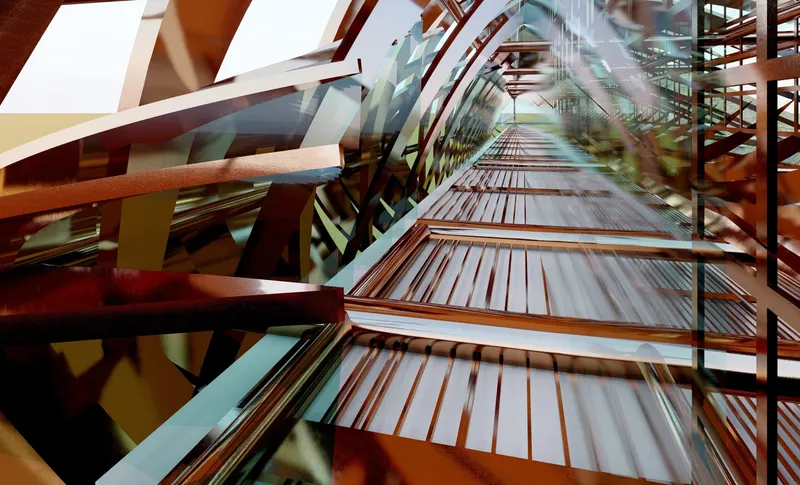
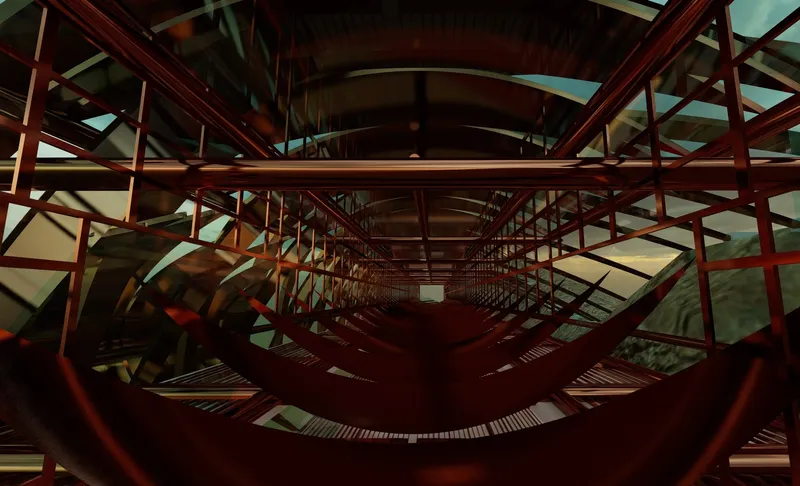
For the materials, it was essential to consider what might already be available on Mars or locally at the site chosen. For that reason, aluminum was one of the leading choices, as it is light and thin and therefore easy to bend and work with to create the arched bow components. Still, it is also one of the most abundant materials found on the planet and can age beautifully. The second most used material was glass; due to the volcanic nature of the site, obsidian, or volcanic glass, could possibly be made there and be abundant. The other advantage is that, due to the atmospheric nature of Mars, with most of it being composed of Nitrogen and a very low percentage of Oxygen, humans can't breathe outside without protective equipment. With that in mind, the use of glass throughout the facility helps the completely enclosed space feel more open to the exterior and provides views of the planet and connection to the site without compromising the safety of the workers.
To finalize, the future plan of expansion considers the modularity of the housing units and the modular nature of the components created. Due to the facility being built with few material types that are all abundant on-site and only three different main components, it is made easy to expand by simply adding more "pieces" to the structure and building along the edge of the mountain. If any maintenance is needed can also be done on-site.

Popular Articles
Popular articles from the community


The Amber Palace Opera: A Geological Fiction Surfaces on Tallinn's Baltic Waterfront
Pierre Brillard reimagines a Baltic legend as a public landscape, opera house, and waterfront promenade rooted in Tallinn's coastal identity.

Opera on the Sea: Driftwood Logic Shapes a Timber Opera House on Estonia's Coast
Trevor Orgill's opera house translates the entangled drift of floating timber into a civic building where wood, water, and music converge.
Opera by the Sea Estonia: Three Shells Dissolving Architecture into Tallinn's Coastline
A winning opera house proposal replaces monumental form with interconnected shells that blur the boundary between building, park and Baltic Sea.

Extended Shell: Retrofitting Kolkata's Balconies as Living Urban Thresholds
A modular retrofit system recovers the social and environmental intelligence of Kolkata's historic verandas for contemporary Park Street residents.

Similar Reads
You might also enjoy these articles
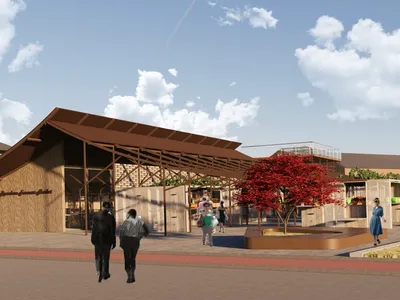
The Rhythm of Seasons
A Farmers' Market Connecting Nature and the City
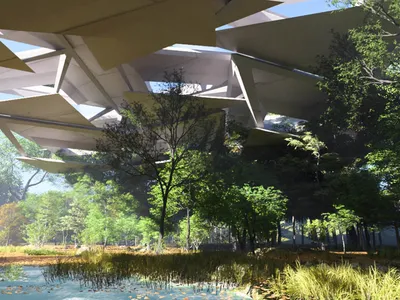

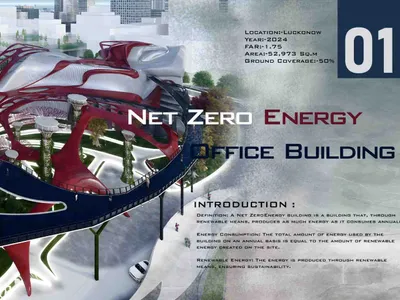
More Than a Building-Designing a Living System
More Than a Building-Designing a Living System
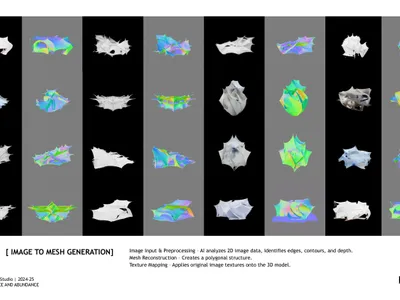
Base Beyond
DESERT COMPOUND ARID: TOURISM OF ABSENCE AND ABUNDANCE

Comments (0)
Please login or sign up to add comments
No comments yet. Be the first to comment!