
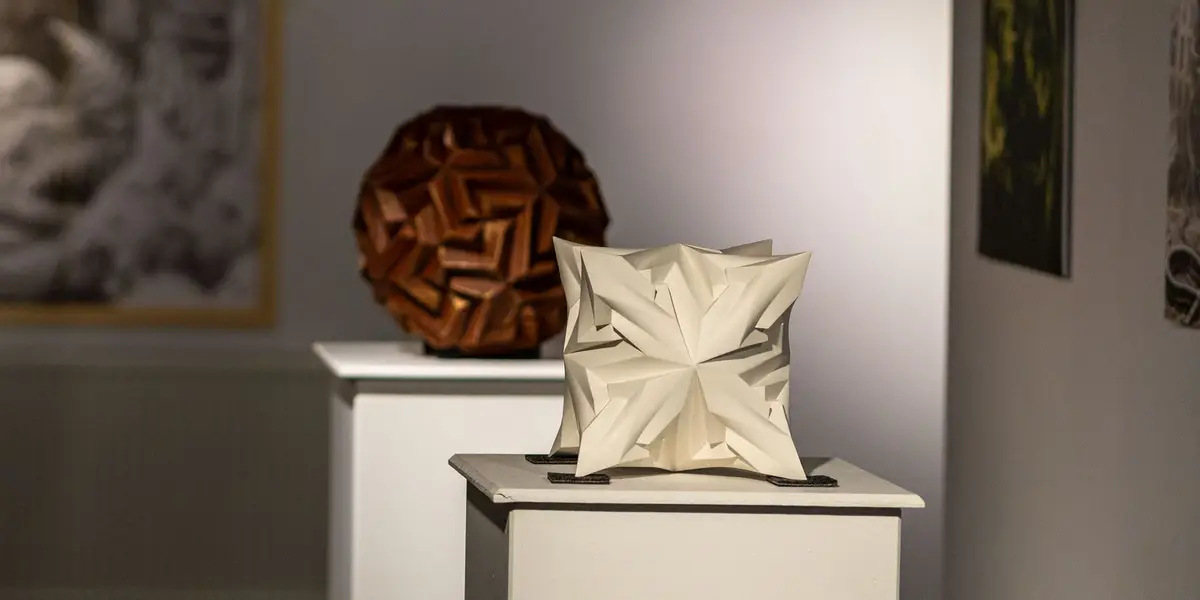
Polyhedra Sculpture: Algorithmic Geometry Cast in Plaster and Wood
Lars Renklint turns parametric subdivision logic into tactile sculptures, bridging cloud-based computation with physical casting and 3D printing.


Start with a cube. Subdivide each face into smaller surfaces. Then make those surfaces morph, wrap, and fold around their neighbors until the original geometry dissolves into something that looks both organic and impossibly precise. That is the core move behind the Polyhedra Sculpture, a project that treats algorithmic subdivision not as an end in itself but as a gateway to physical craft: plaster casts, 3D prints, and a faceted wooden sphere that glows under gallery lighting.
Designed by Lars Renklint, the project won the Best in Category award at the Beegraphy Design Awards. Renklint used Beegraphy's cloud-based parametric editor as the primary design environment, developing a custom plugin to generate polyhedra beyond the platform's default cube. The dodecahedron became a key starting geometry, and the plugin was eventually published online so that others could generate and modify their own models. The work sits at the intersection of computational design scripting, digital fabrication, and participatory exhibition.
A Workshop Full of White Geometry
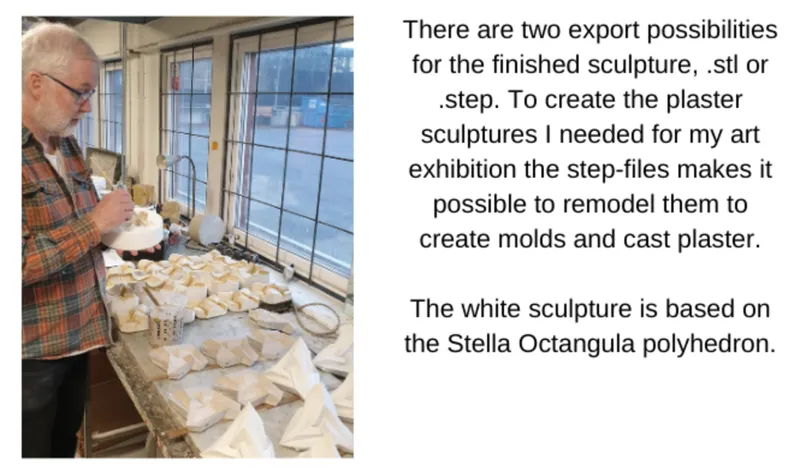
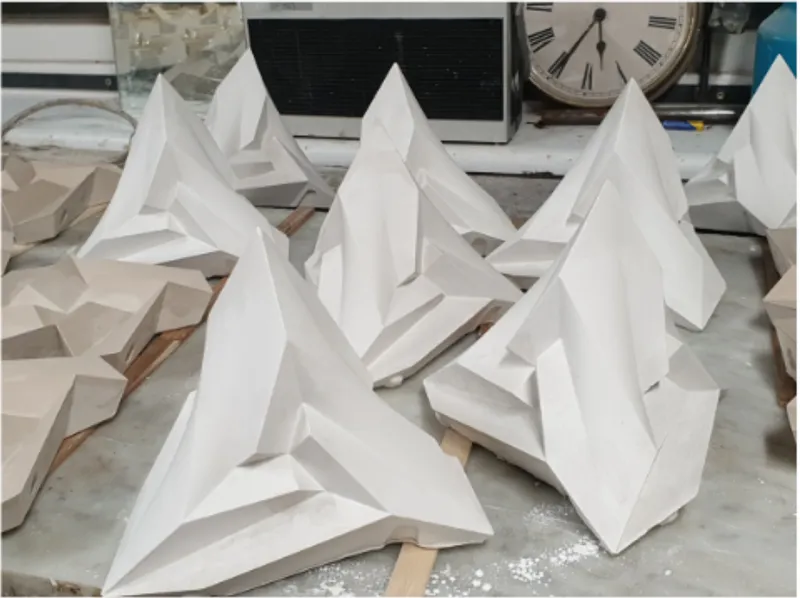
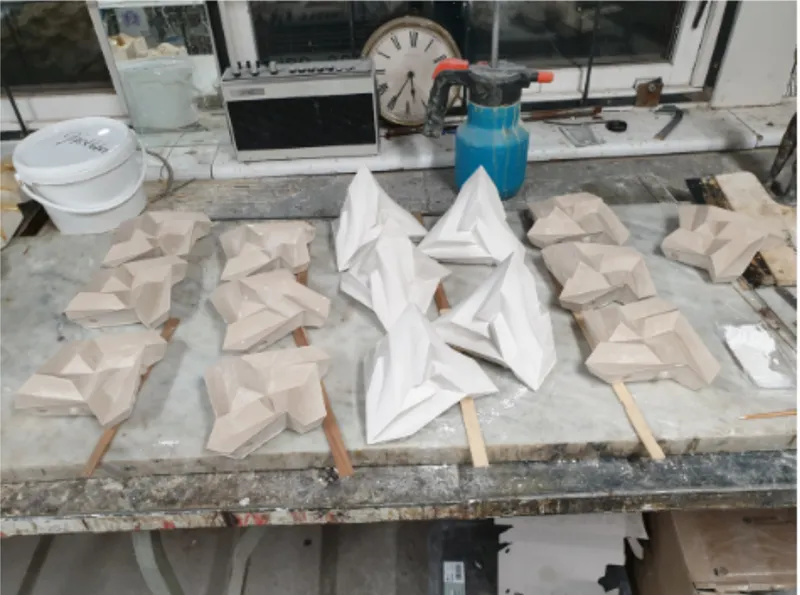
The workshop photographs reveal the project's material reality. Beneath gridded industrial windows, a table is scattered with white plaster molds and geometric forms in various stages of completion. Close-up shots show faceted plaster sculptures dusted with residue, their crisp edges catching raking light. These are not pristine gallery objects yet; they are iterations, prototypes that accumulate the marks of a casting process still being refined. The surfaces read as both mathematical and geological, with each subdivision plane meeting its neighbor at angles that feel simultaneously calculated and intuitive.
Renklint's parametric logic network subdivides, manipulates, and reassembles faces through rule-based operations. Each iteration exposed new relationships between geometry and form, and the plaster casts serve as physical records of that search. The translation from digital model to plaster mold is where the project gains its weight: computation alone produces screen geometry, but casting turns that geometry into something you can hold, rotate, and read with your hands.
From Pedestal Object to Fabrication Dialogue
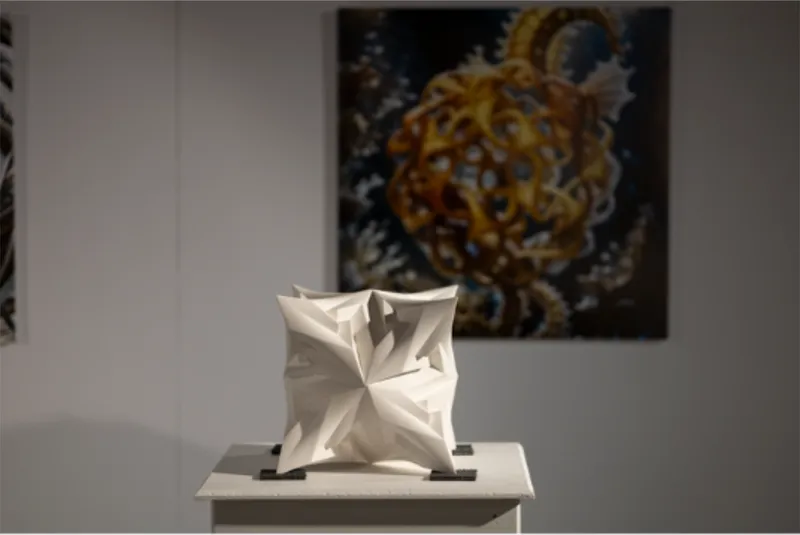
A single white polyhedral sculpture mounted on a pedestal against a gallery wall offers the clearest reading of the project's formal ambition. Soft shadows pool in the concave facets while crisp edges stand in sharp relief, producing a depth that flat-screen renderings cannot replicate. Behind it, framed artwork provides an almost incidental backdrop, reinforcing that the sculpture holds its own as a spatial object rather than a decorative accessory.
Back on the workbench, a messier picture emerges. Multiple plaster prototypes in white and tan sit beside power tools and a computer monitor, collapsing the distance between digital model and physical artifact into a single frame. The tan pieces suggest experiments with different plaster mixes or curing conditions, while the tools confirm that post-processing, sanding, and trimming were essential steps. The computer screen, likely running Beegraphy or Grasshopper, closes the loop: parametric rules generate form, fabrication tests it, and observations feed back into the next iteration.
Wood, Light, and a Spherical Logic
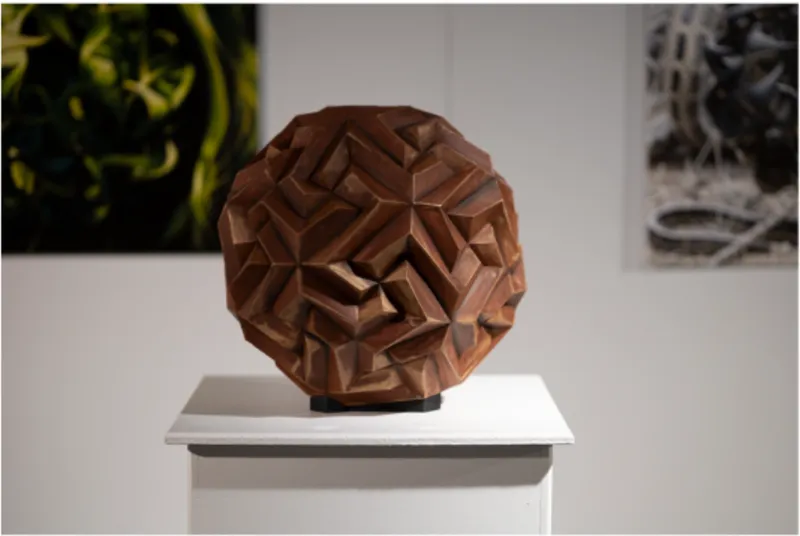
The faceted wooden sphere is the project's most resolved object. Displayed on a white pedestal under focused gallery lighting, its warm timber grain contrasts sharply with the plaster pieces, proving that the same subdivision logic can migrate across materials without losing coherence. Each facet catches light at a slightly different angle, producing a subtle gradient across the surface that shifts as the viewer moves. It reads as a polyhedron that has been inflated into a sphere, its planar origins still legible in every edge.
The material shift matters. Plaster is fast and forgiving, ideal for iterative prototyping. Wood demands more commitment: each cut is deliberate, each joint permanent. By pushing the parametric geometry into timber, Renklint demonstrates that the algorithmic process is not locked to a single fabrication method but can scale in precision and material ambition.
An Exhibition That Invited Everyone to Design
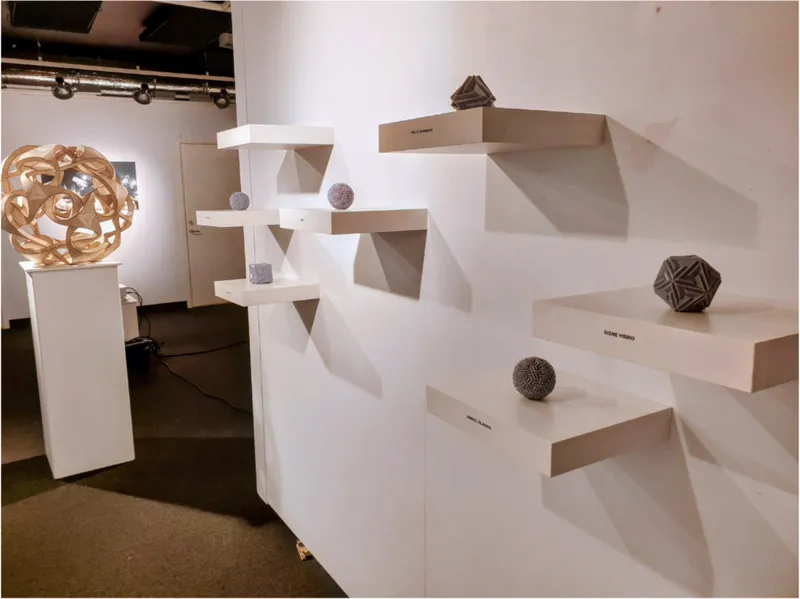
The final exhibition view gathers multiple sculptures on tiered white pedestals under track lighting, presenting the collection as a family of related forms rather than isolated experiments. Each piece shares the same parametric DNA but expresses it differently depending on the base polyhedron, the subdivision depth, and the fabrication material. The tiered display creates a visual taxonomy, inviting visitors to compare and trace the variations.
Crucially, visitors were not just spectators. As part of the Beegraphy Design Awards exhibition, attendees could use Renklint's published plugin to design their own polyhedra and have them 3D-printed on site. The result was a growing collection of unique sculptures, each shaped by individual choices within the parametric framework. The exhibition became an open system: the designer set the rules, and the audience populated the space with outcomes no single author could have predicted.
Why This Project Matters
Parametric design tools are everywhere now, but the gap between screen geometry and physical presence remains wide. Renklint closes that gap methodically, moving from a custom Beegraphy plugin through plaster casting and 3D printing to a hand-finished wooden sphere. Each step tests whether the algorithmic logic survives contact with gravity, material grain, and human touch. The answer, convincingly, is yes.
The participatory exhibition model adds another layer. By publishing the plugin and inviting visitors to generate their own forms, Renklint reframes the designer's role from sole author to system architect. The polyhedron becomes a shared language, and the exhibition becomes a living proof that computational design can be both rigorous and genuinely accessible. For a competition entry, that is a rare combination of technical depth and public generosity.
View the Full Project
About the Designers
Designer: Lars Renklint
Enter a Design Competition on uni.xyz
uni.xyz runs architecture and design competitions year-round that reward proposals with spatial conviction and real site intelligence.
Project credits: Polyhedra Sculpture by Lars Renklint Beegraphy Design Awards (uni.xyz).


Popular Articles
Popular articles from the community


Manzana Morphosis: Stretching Barcelona's Grid into a Living Landscape for 2050
A radical reworking of the Eixample manzana turns density into a tool for generous public space, vertical ecology, and environmental performance.


Cube Design Draws an Ecological Corridor Between Two Shenzhen Hills with the Nankai Building
Beside Shenzhen's container docks, the Nankai Building pairs stacked balconies with a climbing green screen to connect two hillsides across its height.

The Amber Palace Opera: A Geological Fiction Surfaces on Tallinn's Baltic Waterfront
Pierre Brillard reimagines a Baltic legend as a public landscape, opera house, and waterfront promenade rooted in Tallinn's coastal identity.

Singing Woman: An Opera House That Performs Before the Curtain Rises
Ovidiu Cristian Pavel's conceptual opera house translates Estonia's choral identity into a sculpted waterfront landmark facing the Baltic Sea.

Similar Reads
You might also enjoy these articles

Aquadapt: An Underwater Habitat That Rewrites Its Rooms by the Hour
Curved modules ring the seabed while one shell shifts from breakfast room to cinema, farm and football pitch as residents' needs change.

Play: Fragments of Their World: Remembered Architecture Rebuilt as a Modular Playground for Refugee Camps
Tom Gardner abstracts domes, arches and towers from the homelands of displaced families into a kit of child-scaled play parts for camp settlements.
REBIRTH: A Circular Settlement Where Afghan Widows and Their Children Rebuild Life Together
A shortlisted Resile entry turns the circle into a protective ring of timber and brick, gathering homes, classrooms and gardens around a shared landscape.
The Main Dream: A Recycled Plastic Kit That Lets Refugee Children Build Their Own Playground
Thirty-centimetre interlocking cubes that connect on three axes turn play into construction, letting children author the spaces they occupy.


Comments (0)
Please login or sign up to add comments
No comments yet. Be the first to comment!