
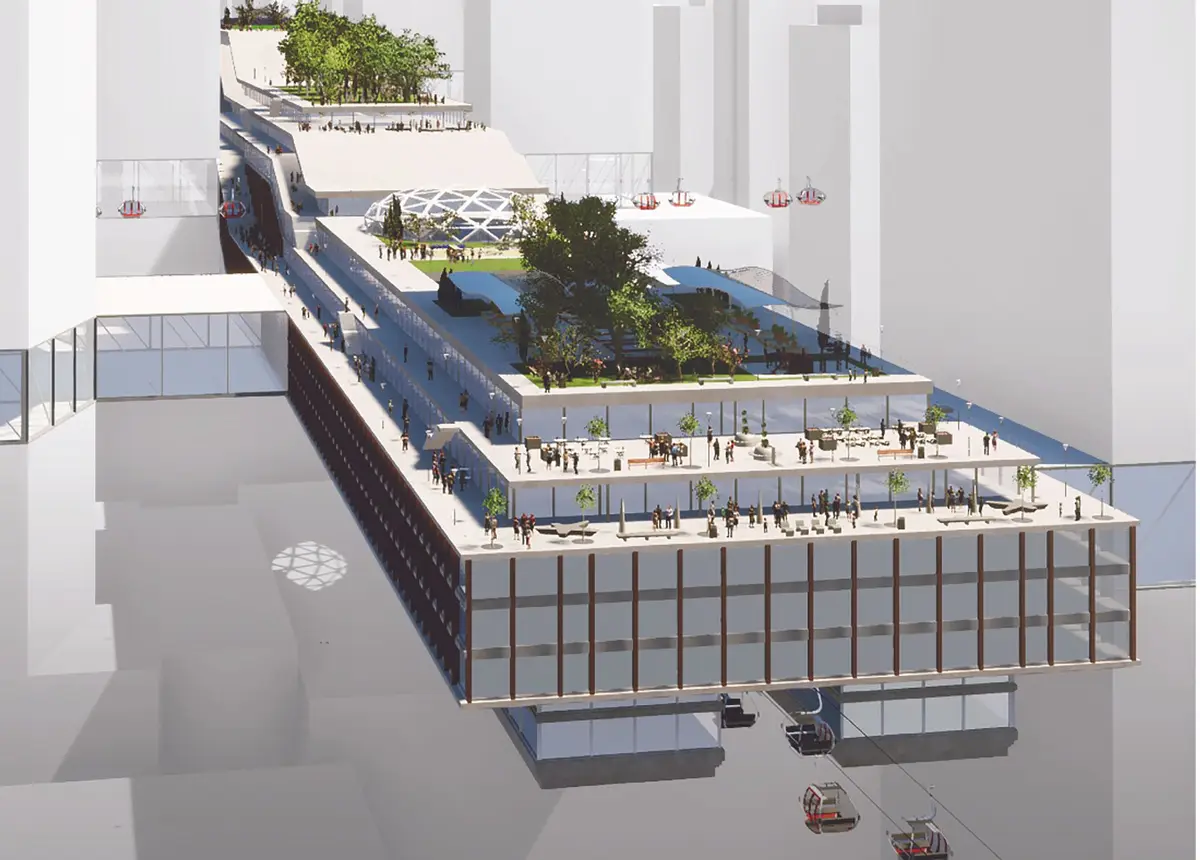
AGORA Platform: Horizontal Infrastructure as a New Urban Stratum
An elevated, city-spanning platform reconnects fragmented neighborhoods through layered mobility corridors and suspended public space.


What if the next great piece of urban infrastructure didn't rise into the sky but stretched across it? The AGORA Platform proposes exactly that: a horizontally oriented, elevated megastructure that layers new mobility, workspace, and public parkland above existing city fabric without consuming a single additional square meter of ground. It is a direct challenge to the vertical reflex that has dominated urban densification for over a century, replacing tower logic with corridor logic.
Designed by Mickael Papi and shortlisted in the Hybrid Futures '19 - Work x Fly competition, the project positions itself as a universally adaptable system rather than a site-specific proposal. It can align with any urban grid, bridge disjointed neighborhoods, and activate underutilized air rights to deliver equitable access to services, transit, and open space in land-scarce city centers.
A Terraced Waterfront Where Cable Cars Replace Congestion
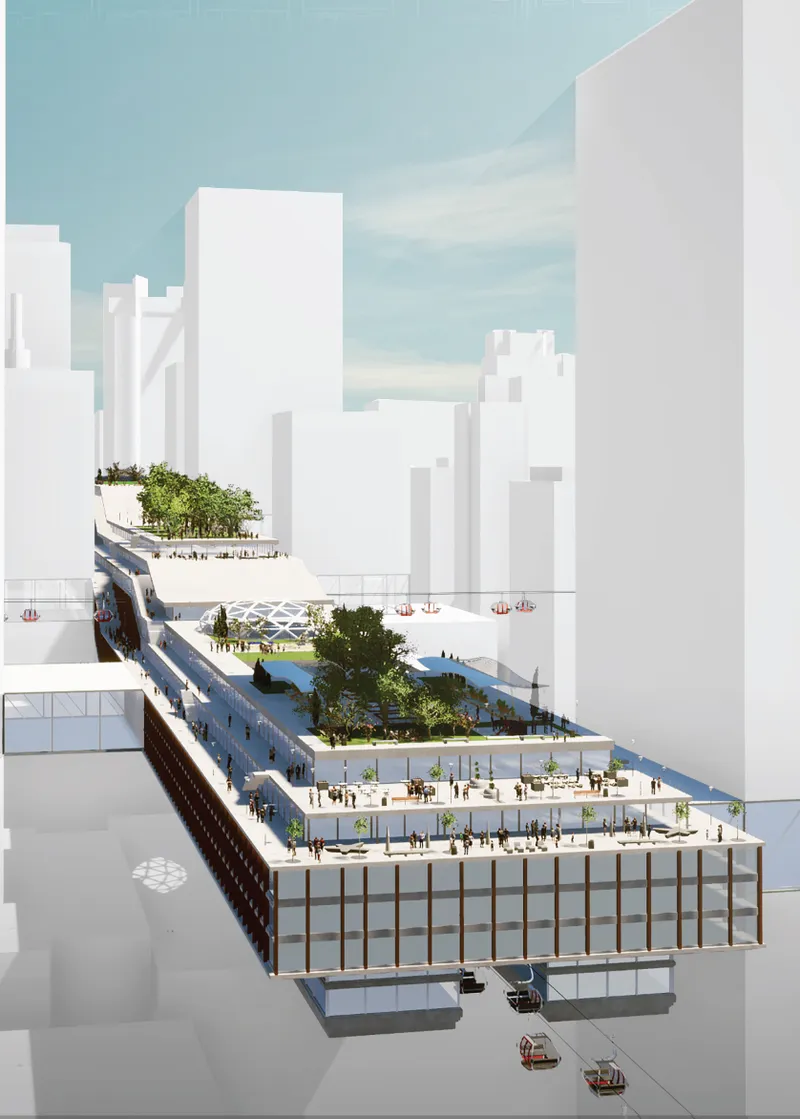
The rendering reveals the platform's most striking proposition: a terraced waterfront pier cascading toward the water, populated with planted green terraces and crowned by red cable cars gliding overhead. The aerial transit system is not decorative. It is integral to the platform's mobility thesis, connecting elevated pathways with subways, roads, ports, and pedestrian zones to create a seamless flow between what Papi calls the city's various "urban strata." The planted tiers beneath the cables double as public parks, offering rest and social interaction against the skyline while liberating the ground level for pedestrian use and green space.
By suspending transit above and distributing landscape across the deck, the platform sidesteps the congestion that typically accompanies waterfront development. Shared mobility routes, bike paths, and light transit lanes run underneath, sustaining multiple sustainable travel modes simultaneously without spatial conflict.
A Gridded Skin That Breathes With the Rooftop Forest
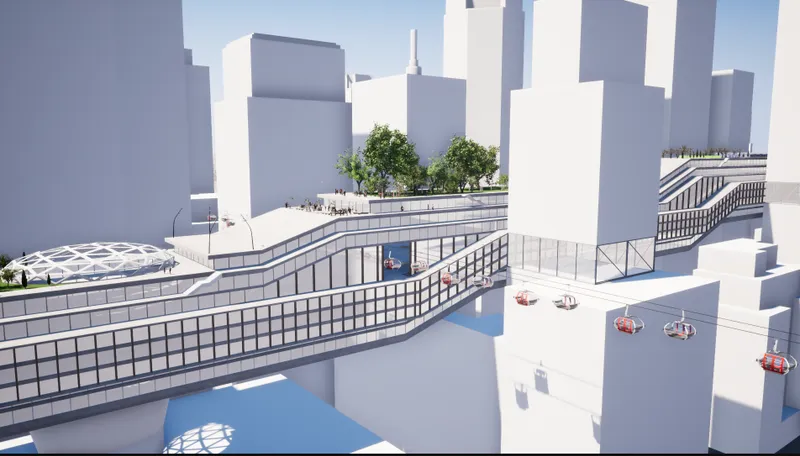
Zooming into the facade, the platform's structural language comes into focus: a tightly gridded screen curves along rooftop terraces dense with mature trees. The grid is doing double duty. Structurally, it provides the repetitive, modular framework that makes the platform exportable to different urban contexts and amenable to phased implementation. Environmentally, the perforated surface regulates solar gain while framing views outward, softening the boundary between interior corridor and open-air park.
The trees are not afterthought garnish. Positioned at the uppermost deck, they form a continuous canopy that absorbs heat, filters air, and signals from a distance that this is occupied public territory, not sealed-off private infrastructure. It is an architectural argument that climate resilience and urban intensity can coexist on the same slab.
Bridging Tower Blocks With a Multi-Level Glazed Corridor
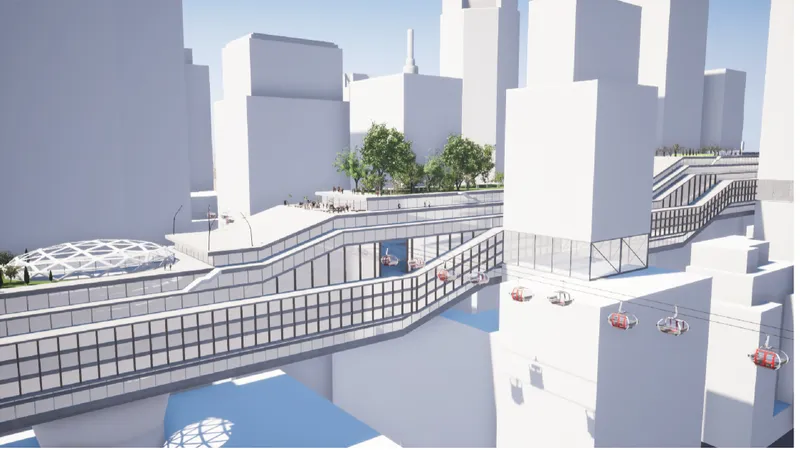
The angled perspective clarifies the platform's relationship to its vertical neighbors. A multi-level structure with a transparent glazed facade spans between white tower blocks, physically suturing what would otherwise be isolated buildings into a single interconnected system. Elevators, ramps, and escalators visible within ensure full accessibility across levels, a critical detail that separates this from the many elevated walkway proposals that privilege the able-bodied.
The glazing choice is deliberate. By making the bridge volume transparent, Papi avoids the oppressive shadow-casting that plagued earlier megastructure visions. Light reaches the ground plane, pedestrian sightlines remain unobstructed, and occupants of the corridor retain visual contact with the city below. The platform becomes a lens rather than a lid.
Why This Project Matters
Horizontal megastructures carry historical baggage. From the Metabolists to the Plug-In City, elevated platforms have often collapsed under their own ambition, dismissed as totalizing visions that ignore the messy reality of existing cities. What distinguishes the AGORA Platform is its insistence on adaptability: it aligns with existing urban grids, activates air rights above already-built fabric, and allows phased rollout tailored to local needs. It does not erase the city below; it supplements it with a second datum of public life.
Papi's contribution is a reminder that the mobility crisis in global cities is fundamentally a spatial crisis. When ground-level real estate is exhausted, the choice is not simply between taller towers and wider roads. A third option exists: to build across, creating new public arteries that redistribute access, reconnect neighborhoods, and prove that infrastructure can enrich urban life rather than merely sustain it.
View the Full Project
About the Designers
Designer: Mickael Papi
Enter a Design Competition on uni.xyz
uni.xyz runs architecture and design competitions year-round that reward proposals with spatial conviction and real site intelligence.
Project credits: AGORA Platform by Mickael Papi Hybrid Futures '19 - Work x Fly (uni.xyz).


Popular Articles
Popular articles from the community


longwave studio Reorganizes a 112 m² Tainan Apartment Around the Daily Routines of a Family and Two Cats
In Tainan, Taiwan, birch plywood, rust-red furniture and a freestanding plaster wall link arrival, storage, work and family life in one apartment.

David Ortega Stacks a Two-Story Mexico City Penthouse Around a Steel Stair and a Pergola-Shaded Roof Terrace
In Colonia Roma, a 300 m² penthouse uses oak joinery, a planted steel stair and a slatted roof pergola to make a new-build apartment feel like a house.

U.GA Architects Wraps an Oval Rooftop Pool in Curved Board-Formed Concrete on Busan's Jeollidan-gil
In Busan's Jeonpo-dong, a 454 m² mixed-use block stacks a neighborhood facility, guest rooms and an oval rooftop pool inside spiraling concrete walls.

Jaramillo Van Sluys Arquitectura and Urbanismo Turn a Demolished Registry Lot in Quito into an Orchard Plaza
In Quito's Centro Histórico, a 2,800 m² plaza exposes the San Agustín convent wall and redraws its lost Augustinian orchard in volcanic stone.

Similar Reads
You might also enjoy these articles


Vereda Arquitetos Renovates a 40-Square-Meter Apartment Inside Niemeyer's Copan Building
A compact unit in São Paulo's most iconic residential tower gets a material overhaul that pairs exposed concrete with bold blue Formica.

Shakur's House: Exposed Brick as an Interior Organiser in a 168 m² Mashhad Residence
Brick moves indoors in this Mashhad residence, where masonry walls, glass partitions and teal planes sequence a compact home without closing it off.

Day and Night Park: A Time-Based Urban Newsstand in Beijing
A temporary urban newsstand in Beijing blending travel, light, and reading through poetic colors, compact form, and community-focused design.

Modernist Patio Renovation in El Masnou, Barcelona by Oliver Segura Arquitectura + Cebrià Arquitectura
Modernist patio renovation blending tradition and innovation with a movable pool, leveled floors, and Catalan materials in El Masnou.

Comments (0)
Please login or sign up to add comments
No comments yet. Be the first to comment!