
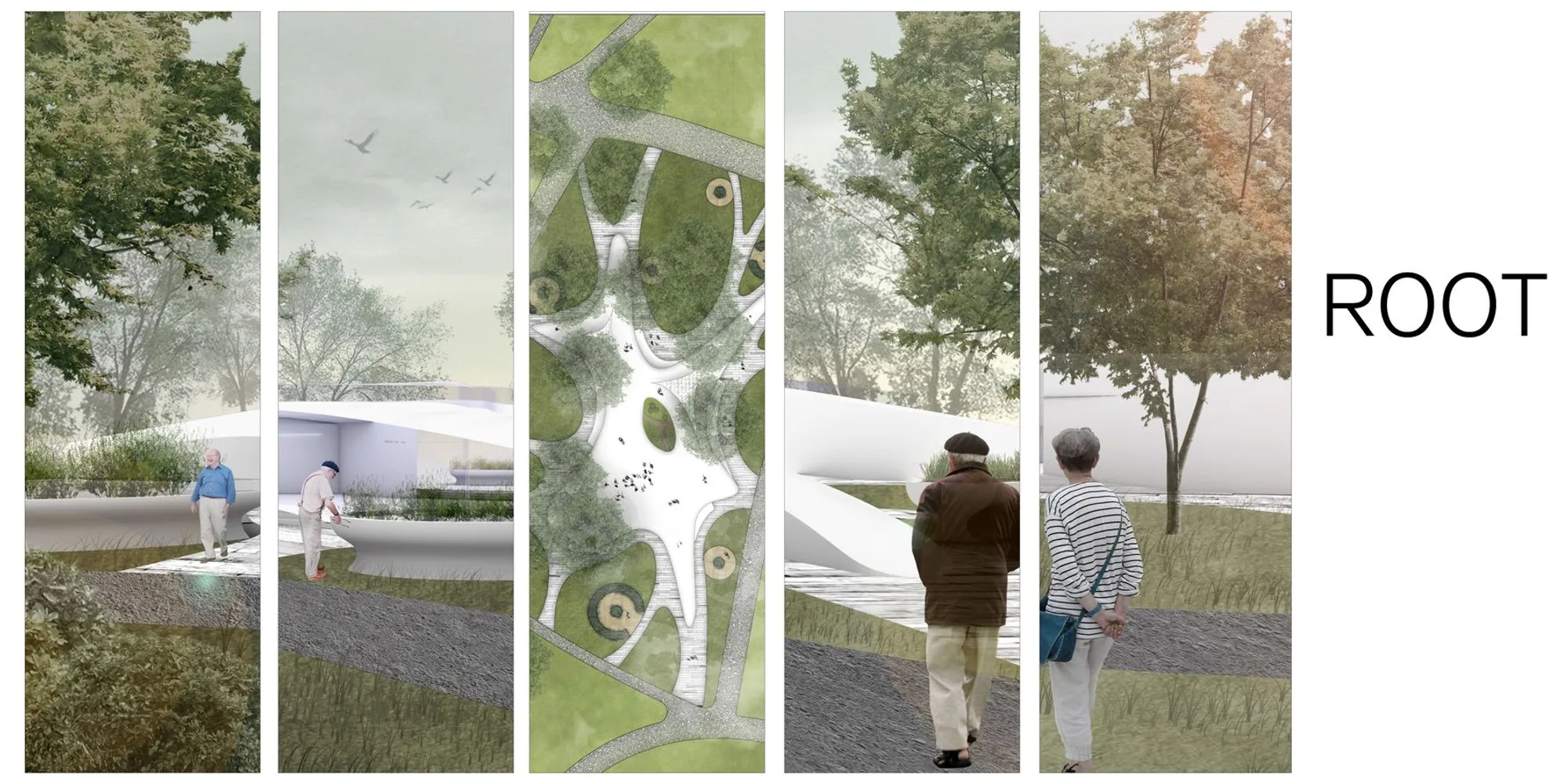
ROOT: Landscape Architecture as a Living Metaphor for Aging Societies
A biomorphic park design uses the branching logic of tree roots to reconnect generations through shared gardens, stages, and rest zones.


What if the shape of a park could argue for the dignity of its oldest visitors? ROOT begins with a deceptively simple analogy: a society without its elders is a tree without roots. From that idea, the entire site plan unfolds in branching, petal-shaped volumes that radiate outward from a central plaza, mimicking the organic geometry of a root system. The metaphor is not decorative. It drives every spatial decision, from the concentric rings of program that surround the core to the radial pathways that thread through preserved existing flora. The result is a landscape architecture project that functions simultaneously as public park, intergenerational community center, and quiet provocation about who our cities are actually designed for.
Designed by Liu Yiming, Yangfan Lee, and Bibo Tian, ROOT was shortlisted in the Huddle competition. The project proposes a biomorphic central structure surrounded by concentric circular zones, each representing a different "ring" of engagement, much like the annual rings of a tree trunk. These rings segment the site into diverse functional areas: vibrant activity hubs and open-air stages sit alongside quiet meditative gardens and shaded rest zones. The design team treats landscape architecture not only as a physical practice but as a narrative tool, one aimed at promoting inclusivity, horticultural therapy, and spontaneous intergenerational dialogue.
An Undulating Canopy That Invites Rather Than Encloses
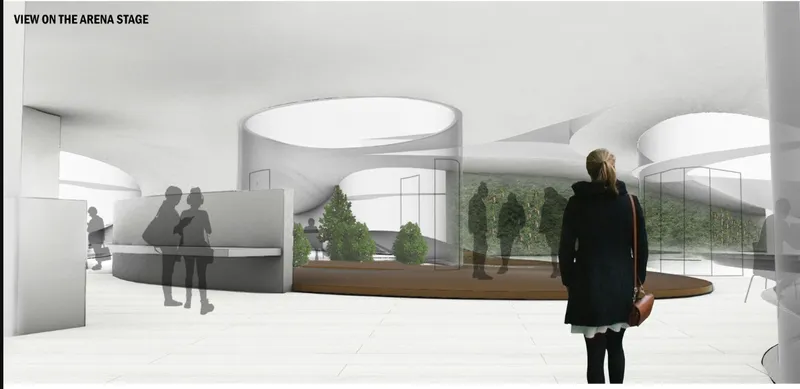
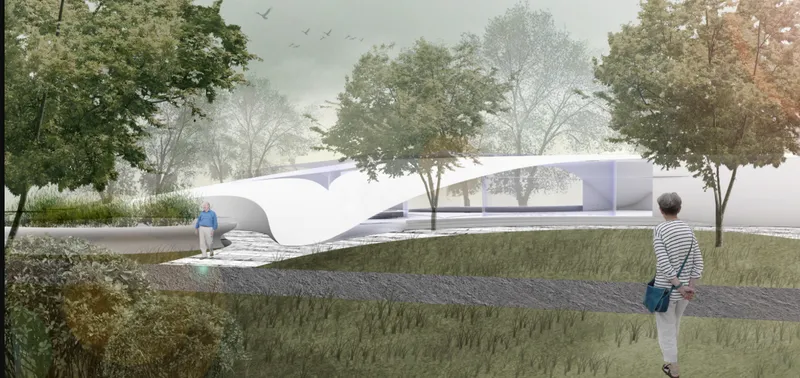
The interior rendering of the arena stage foyer reveals the project's material and spatial character in a single frame. An undulating white ceiling flows overhead like a continuous canopy, its smooth curves directing visitors toward planted areas integrated directly into the floor plane. There is no hard threshold between indoors and out; the greenery simply appears, blurring the boundary between built form and landscape. Visitors of varying ages move through the space casually, suggesting the kind of low-friction encounter the designers are after. The exterior view confirms this reading at a larger scale: a low, curving white canopy structure nestles into a landscaped park dense with mature trees, its profile barely rising above the existing tree line. The building does not impose itself on the site. It defers to the topography and the canopy already present, a move that embodies the project's core principle of continuity and ecological respect.
Sculptural Seating and the Space Between Activity and Rest
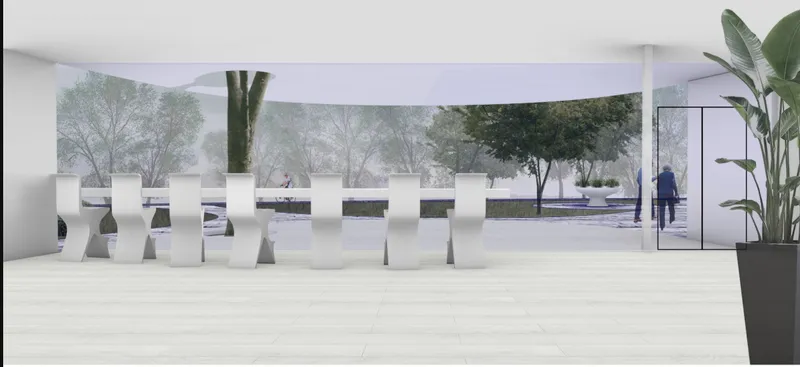
One of ROOT's most considered details is the way it handles the transition between energy and stillness. The interior view of white sculptural seating elements beneath the continuous curved ceiling captures this precisely. The forms are generous and organic, shaped for lingering rather than perching. They overlook a winter landscape through floor-to-ceiling glazing, collapsing the distance between inside warmth and outside season. For elderly users, this kind of space is critical: it offers rest without isolation, views without exposure, and social proximity without obligation. The age-friendly ambition is legible in every contour, from the absence of sharp edges to the gentle ramp-like transitions between surface levels.
Radial Geometry Reads as Both Plan and Program
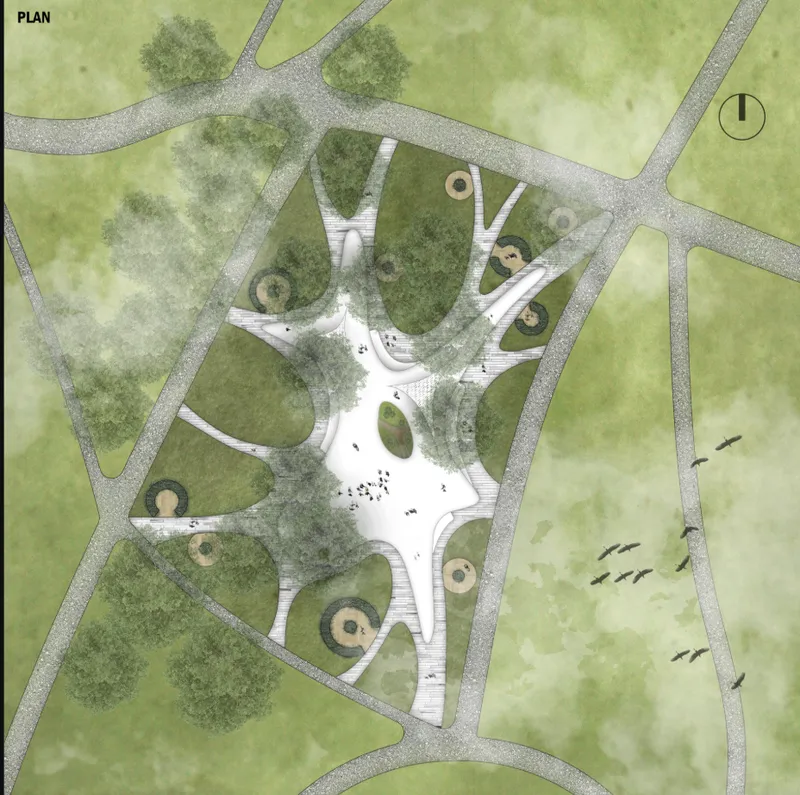
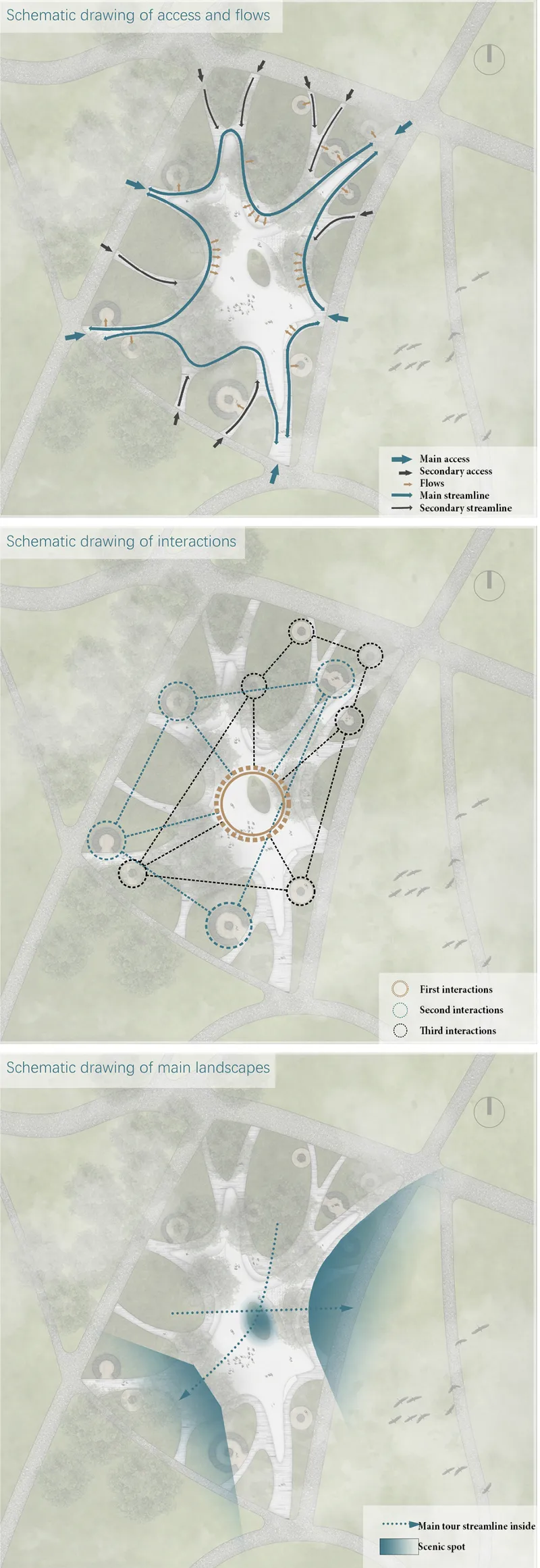
The site plan drawing makes the root metaphor structurally legible. Petal-shaped volumes radiate from a central plaza, connected by pathways that branch and reconnect through generous greenspace. The concentric ring logic is clear: the innermost zones are the most communal, hosting multipurpose rooms for storytelling, cooking classes, and music sessions, while the outer rings dissolve into garden pockets designed for horticultural therapy and quiet contemplation. The schematic diagram set reinforces this reading by mapping access routes, circulation patterns, and landscape zones across the radiating plan. Radial pathways ensure intuitive navigation, an important consideration for users with reduced mobility or cognitive challenges. What stands out is that the geometry does not feel imposed; it emerges from the program's social ambitions, giving physical form to the idea that different generations need different proximities to activity and solitude, and that a single landscape can accommodate both.
The spatial programming is notably specific about the kinds of interaction it wants to produce. Shared activities like planting, reading, performing, and relaxing are distributed across both indoor and outdoor spaces, each equipped with seating, ramps, and sensory gardens. Rather than creating a facility that segregates the elderly from younger visitors, the designers distribute intergenerational contact points throughout the entire root network. The effect is a site where a grandparent tending a garden bed is naturally adjacent to a child on a performance stage, and where a caregiver resting on one of the sculptural benches can observe both.
Why This Project Matters
ROOT takes on a problem that most public space projects acknowledge in their briefs but rarely address in their plans: the physical and social marginalization of elderly populations within increasingly youth-oriented urban environments. As cities worldwide contend with the dual pressures of rapid urbanization and aging demographics, projects like this offer a concrete spatial strategy rather than a vague aspiration. The concentric ring plan, the biomorphic canopy, and the distributed program all serve the same argument: that the elderly are not passive recipients of care but active participants in community life, and that design can make that participation legible and comfortable.
What distinguishes the work of Liu Yiming, Yangfan Lee, and Bibo Tian is their refusal to let the metaphor remain merely symbolic. The tree root analogy could easily have produced a pretty diagram and nothing more. Instead, it generates a legible spatial hierarchy, a clear circulation strategy, and a program that places horticultural therapy, intergenerational storytelling, and sensory gardens on equal footing with performance spaces and communal halls. ROOT demonstrates that landscape architecture, when it commits to a social position, can transcend aesthetics and become a genuine instrument of inclusion.
View the Full Project
About the Designers
Designers: Liu Yiming, Yangfan Lee, Bibo Tian
Enter a Design Competition on uni.xyz
uni.xyz runs architecture and design competitions year-round that reward proposals with spatial conviction and real site intelligence.
Project credits: ROOT by Liu Yiming, Yangfan Lee, Bibo Tian Huddle (uni.xyz).



Popular Articles
Popular articles from the community


Co-life: Sustainable Architecture for Age-Friendly Community Living
Co-life reimagines sustainable architecture for seniors through courtyards, rammed earth, shared gardens, and spaces designed for belonging.

Riyadh For All: Intergenerational Urban Design for Active Aging in Rabat
Riyadh For All reimagines urban design in Rabat with intergenerational co-living, adaptive courtyards, and Moroccan cultural exchange today.

Hill & Cross Opera: Sculptural Opera House Architecture Shaped by Tallinn’s Landscape and Identity
Hill & Cross Opera reimagines opera house architecture in Tallinn through its sculptural hill, civic plaza, glass wave and a luminous cross.

Co-Life: Senior Housing Design That Reconnects Older Adults With the City
Co-Life reimagines senior housing design through healing gardens, shared streets, workshops, and a sustainable community across generations.


Similar Reads
You might also enjoy these articles

Day and Night Park: A Time-Based Urban Newsstand in Beijing
A temporary urban newsstand in Beijing blending travel, light, and reading through poetic colors, compact form, and community-focused design.

Modernist Patio Renovation in El Masnou, Barcelona by Oliver Segura Arquitectura + Cebrià Arquitectura
Modernist patio renovation blending tradition and innovation with a movable pool, leveled floors, and Catalan materials in El Masnou.

Alto Residencial Coop: Cooperative Housing Development in Santiago de Compostela by Carbajo Barrios Arquitectos
A linear cooperative housing complex blending white volumes and perforated metal façades, enhancing community living, natural light, privacy, and urban integration.

Vil Genis School by BPA ARCHITECTURE – Massy, France
Vil Genis School in Massy, France, features sustainable design, south-facing classrooms, community integration, accessible spaces, and modern educational architecture.




Comments (0)
Please login or sign up to add comments
No comments yet. Be the first to comment!