
Sake House Firewater
Never forget the origin.

1. What is the concept behind your design idea?
The design idea was to create a place where sake can be experienced and tasted in different ways. The Sake House should not only be the focus for sake lovers, but also attract the younger generation with different events. The design components are derived from elements of sake making, patterns and materials from Japanese culture. The historical background and contemporary architectural language combine tradition and modernity. The Sake House stands for the promotion of sake culture and the preservation of a rich cultural treasure in the heart of Osaka.
2. What special programmatic features are included in your design?
The special programmatic functions of the design are firstly the dynamic form language, secondly the different usage zones and thirdly the atmospheric aura of the spatiality. The dynamic design language is based on cultural backgrounds of Japanese rice and sake culture. The different usage zones are intended to appeal to young and old. Not every visitor has to be an active sake drinker. In the premises can be eaten among other things, one can participate in events or simply drink good sake. The spirit of sake is to be conveyed through exterior, interior and the resulting mood of the visitors. The goal of the Sake House is to create an all-encompassing experience for all generations.
3. From what idea was the floor plan developed?
Since sake is based on the basic ingredient rice, the idea of finding the shape of the floor plan was based on that of an old Japanese family coat of arms. It shows a rice plant wound clockwise. In the course of the preliminary design, it was decided to use this variant of the coat of arms, as it brings tension to the design through its dynamic course and the different division of the ears.

The basic usage areas such as washrooms, kitchen, staff areas and storage were placed where the rice plant has its beginning. In the floor plan, the stylized rice stalks become walkways or connecting links such as sake tasting bar or tatami seating areas. Also in these zones are slats to visually separate certain areas. The spikes indicate the main areas, which are complemented by the connecting links.
4. What areas of use and offerings can be found at Sake House?
Upper floor
The stage is located in the center of the room. This is intended to provide space for smaller concerts, karaoke nights and lectures. It is visible from every other area of the space and is meant to connect guests in the different areas. Another main area is the bar counter where guests sit at a long counter with a view out the window. Even though it is a high counter, not only drinks but also food can be taken there. The last large area is that of the restaurant, which is equipped with tables, chairs and a bench. Through the different seating options, guests have the choice to enjoy an evening in different ways. This not only rounds out events, but in this way can provide access to sake in different ways. Thus, the concept of the Sake House should stand as a kind of mediator for today's sake culture.
Between the main areas are the so-called links. These include, firstly, a semicircular seating area made of tatami, which nestles in front of the stage. It allows the guests to enjoy the event in a special way with a good glass of sake. Secondly, the sake tasting bar where either larger quantities of sake can be prepared for the guests or can be used for sake training and tasting courses. At the back of the bar, which is slightly lower than the front, food from the adjacent kitchen is prepared for service. The third link is the large bar, which is used by staff to prepare drinks and for other service procedures.
First floor
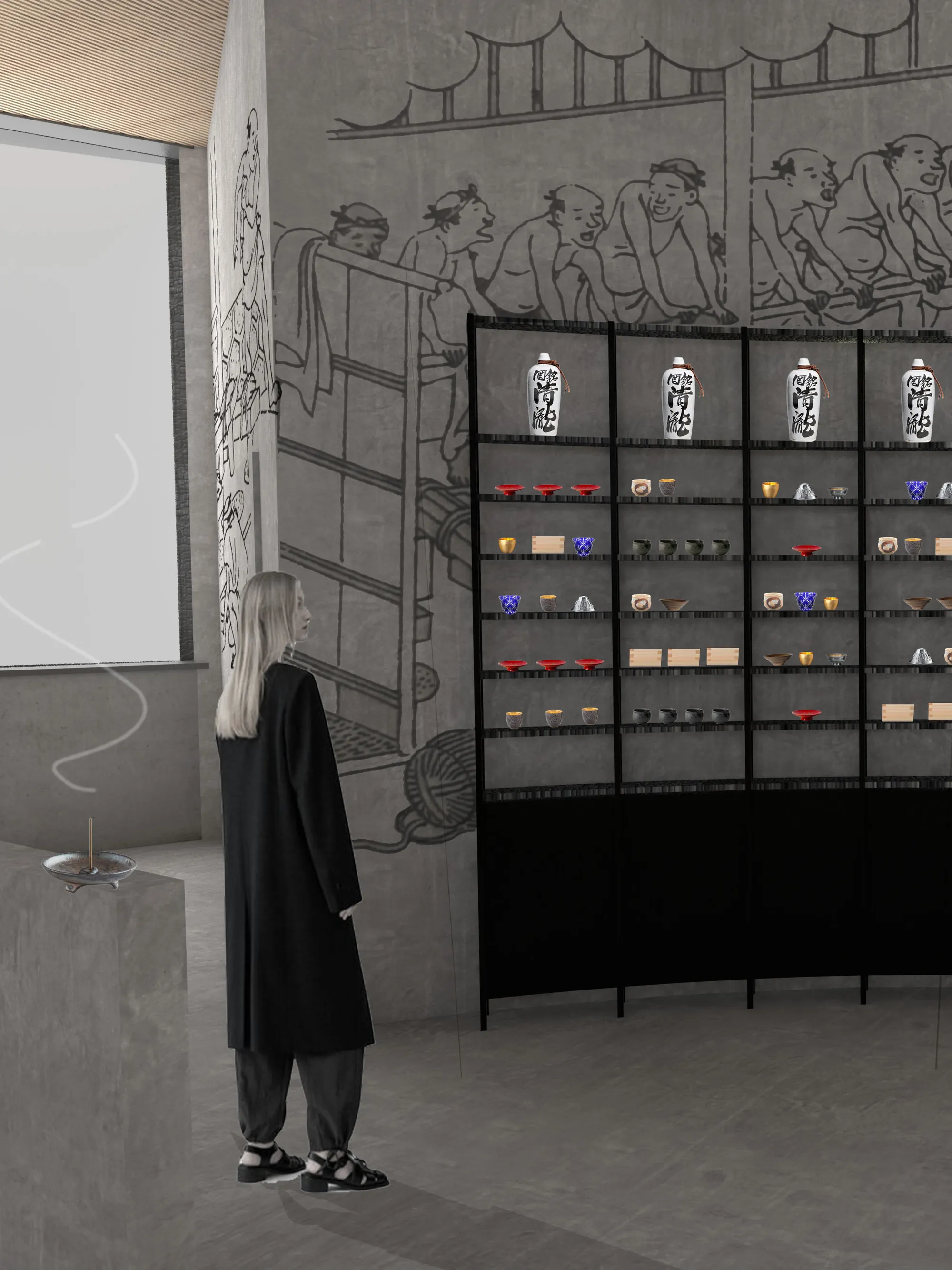
The room with the flowing water is a place of remembrance and offers an opportunity to pause. Water is one of the three most important ingredients of sake, along with rice. For this reason, the center is marked by a fountain. Around it are places to sit down. Here visitors can rest, reflect and enjoy the moment. The sake warehouse has space for all sizes of traditional sake barrels and modern bottles. Visitors can see into the warehouse from the outside through two windows on the north side. Likewise, the warehouse can be visited as part of a guided tour. Next to the main entrance is a small store to allow visitors to purchase hostess gifts and sake to take home.
Between the main areas, as on the upper floor, are the so-called links. Here these are a staff room, circulation areas, as well as niches in the architecture for viewing the different areas.
5. What materials do you use to enhance your design?
The basic structure of the Sake House consists of rounded reinforced concrete walls combined with wood from local cultivation. The cladding of the exterior facade is treated with the Yakusugi technique. The flamed cedar wood makes the facade more weather resistant and is a natural wood preservative. The shape of the building with its boarding is reminiscent of sake barrels, which are used for the production of sake. Light pine wood is used for the interior fittings, which contrasts strongly with the minimalist but rather cool appearance of the concrete. Materials such as tatami (rice straw mats), straight dark steel shelving and soft upholstered furniture are also used, as are natural stone slabs for the monolithic sake-tasting bar and round dining tables.




Popular Articles
Popular articles from the community


The Ocean Hive: Sustainable Architecture for a Self-Sufficient Civilization at Sea
The Ocean Hive imagines sustainable architecture at sea, where modular habitats, algae, wave power and ocean waste sustain a growing colony.

Lunar Spiral: Space Architecture Shaped by the Mathematics of the Universe
Lunar Spiral reimagines space architecture through Fibonacci geometry, lunar regolith, levitating habitats, and self-sustaining Moon living.

The Earth Pod: 3D Printed Homes for Resilient Refugee Communities
The Earth Pod reimagines refugee housing through 3D printed homes made from clay, combining resilience, self-sufficiency, and rapid shelter.

Conexión: Biophilic Design Reimagines High-Rise Living in Hong Kong
Conexión reimagines high-rise living in Hong Kong through biophilic design, green facades, shared spaces, daylight, water and nature within.


Similar Reads
You might also enjoy these articles

Day and Night Park: A Time-Based Urban Newsstand in Beijing
A temporary urban newsstand in Beijing blending travel, light, and reading through poetic colors, compact form, and community-focused design.

Modernist Patio Renovation in El Masnou, Barcelona by Oliver Segura Arquitectura + Cebrià Arquitectura
Modernist patio renovation blending tradition and innovation with a movable pool, leveled floors, and Catalan materials in El Masnou.

Alto Residencial Coop: Cooperative Housing Development in Santiago de Compostela by Carbajo Barrios Arquitectos
A linear cooperative housing complex blending white volumes and perforated metal façades, enhancing community living, natural light, privacy, and urban integration.

Vil Genis School by BPA ARCHITECTURE – Massy, France
Vil Genis School in Massy, France, features sustainable design, south-facing classrooms, community integration, accessible spaces, and modern educational architecture.


Explore Traditional Japanese Competitions
Discover active competitions in this discipline


Challenge to design luxury tourism on rails


VR headsets Storefront design competition


Bring back Drive In's


Designing a staircase for a client
Comments (0)
Please login or sign up to add comments
No comments yet. Be the first to comment!