
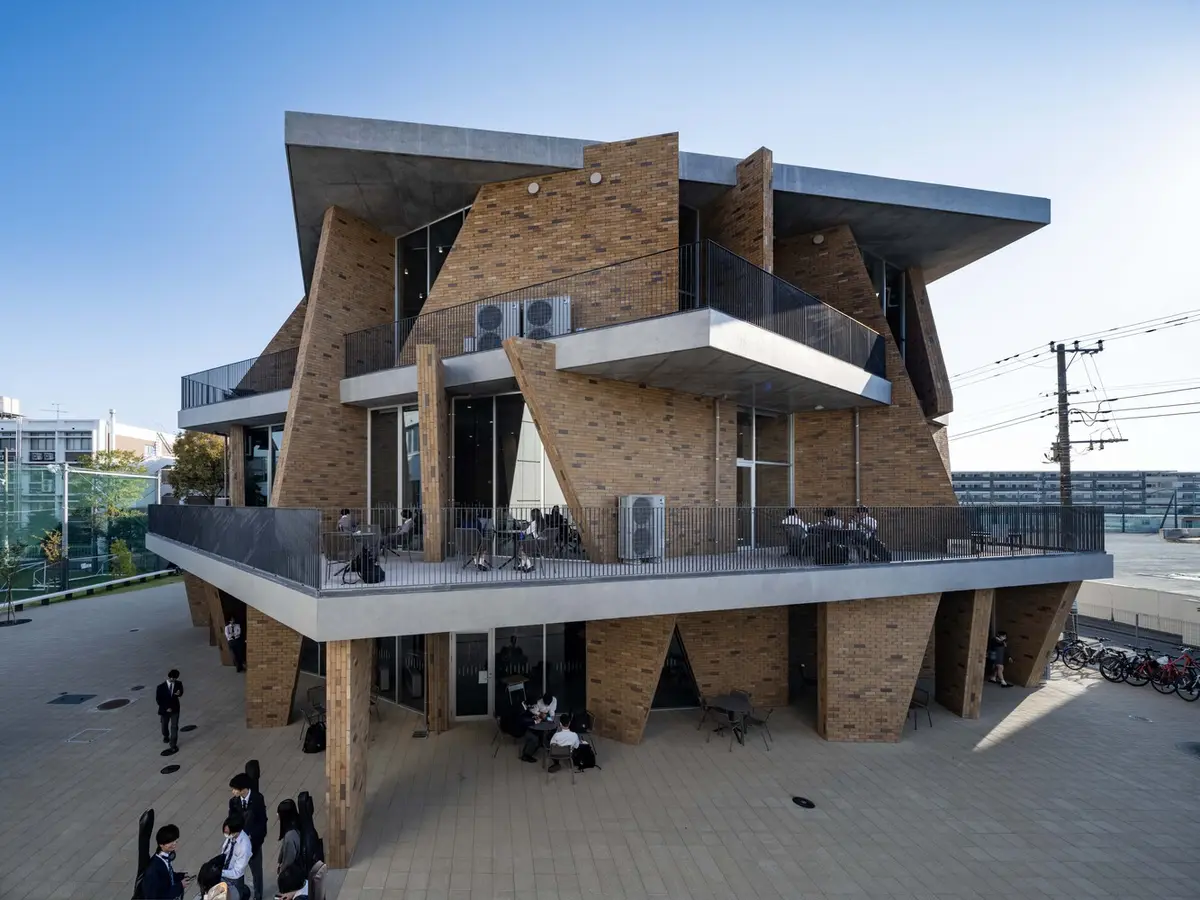
kousou and Fukei Co. Build a High School Library in Shonan Where Every Wall Leans into Learning
Angled brick pilasters and stacked terraces dissolve the boundary between corridor and reading room on a compact campus in Kanagawa.


A school library rarely gets this kind of architectural commitment. At Shonan Institute High School, kousou and Fukei Co. have produced a building that treats the act of studying not as something confined to a room but as something that happens between rooms, across half-levels, on terraces, and alongside casual circulation. The tan brick volumes, canted at deliberate angles, break the massing into a sequence of interlocking wedges rather than stacked floors. The result is a building that reads as both monolithic and porous, solid from the street yet deeply open once you step inside.
What makes the project genuinely interesting is the way it refuses the standard educational diagram of corridor plus classroom. Instead, cantilevered concrete slabs create outdoor terraces at each level, angled brick pilasters define semi-enclosed zones without closing them off, and the section is organized so that sightlines connect students across double-height voids. It is a building designed around peripheral awareness: you are always conscious of other people reading, talking, or passing through. That social density, held in a framework of heavy materials handled with real precision, is the engine of the whole scheme.
A Facade That Tilts and Stacks
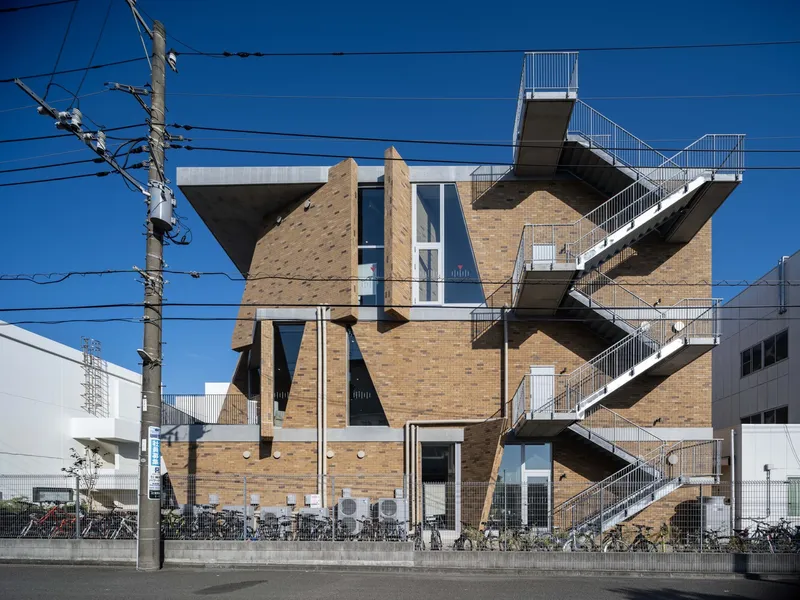
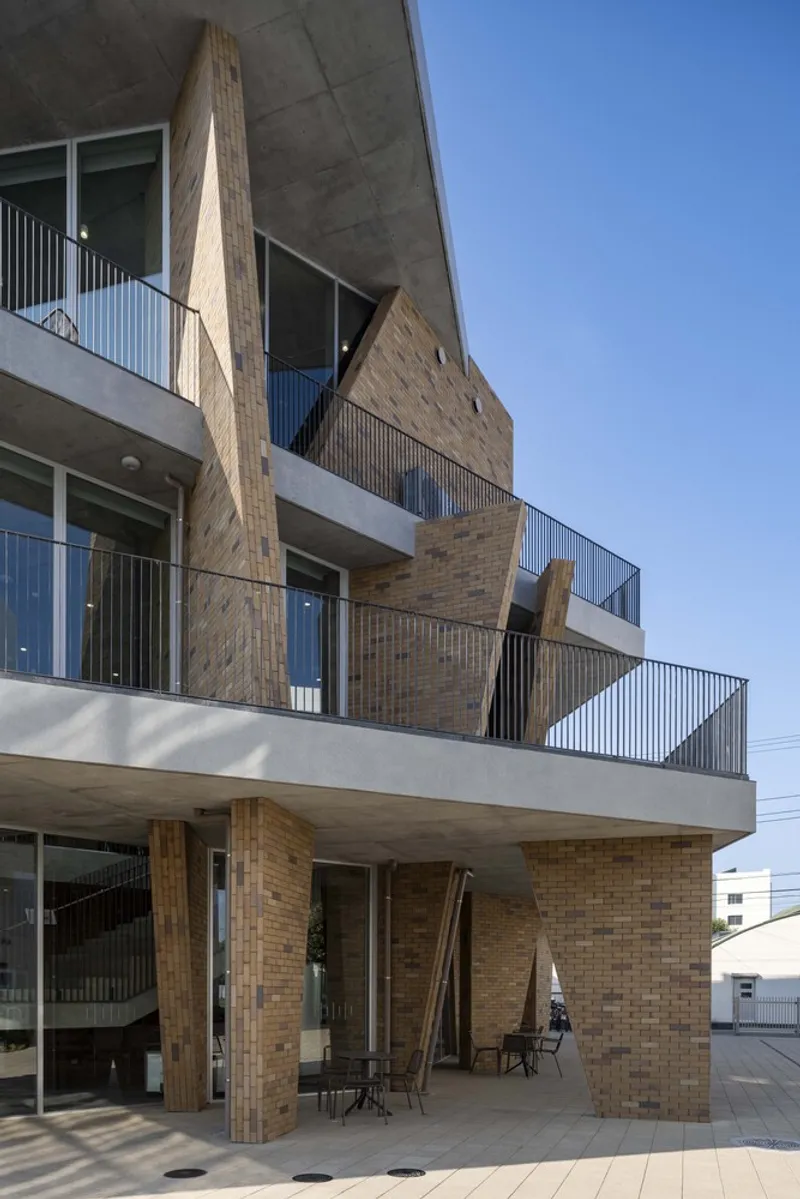
From the street, the building presents a collection of cantilevered slabs and angled brick walls that step in and out of a rough vertical plane. The geometry is not ornamental. Each inclined surface corresponds to an interior partition or structural pilaster, so the exterior is a direct expression of the plan's angular logic. The external steel staircase on the front facade introduces an industrial counterpoint to the warm brick, and its open-air landings double as informal gathering spots between floors.
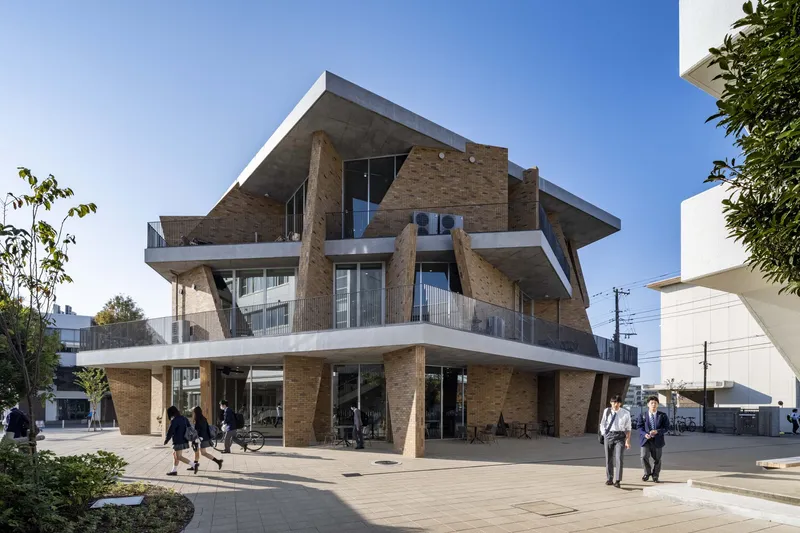
Viewed from the corner, the building's mass seems to hover over a ground-level plaza. Pilotis lift the upper volumes clear of the pedestrian zone, creating shaded passages that pull foot traffic through the site rather than around it. It is a move borrowed from civic architecture, applied here to a secondary school with welcome conviction.
The Atrium as Social Engine
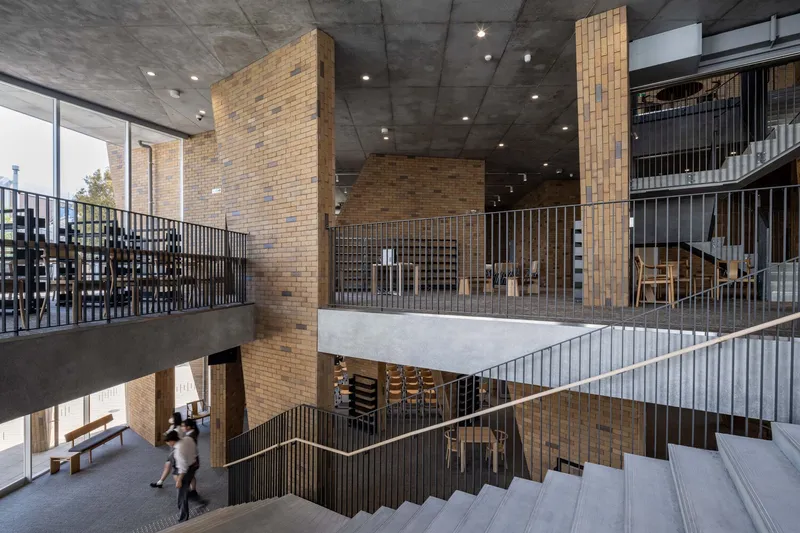
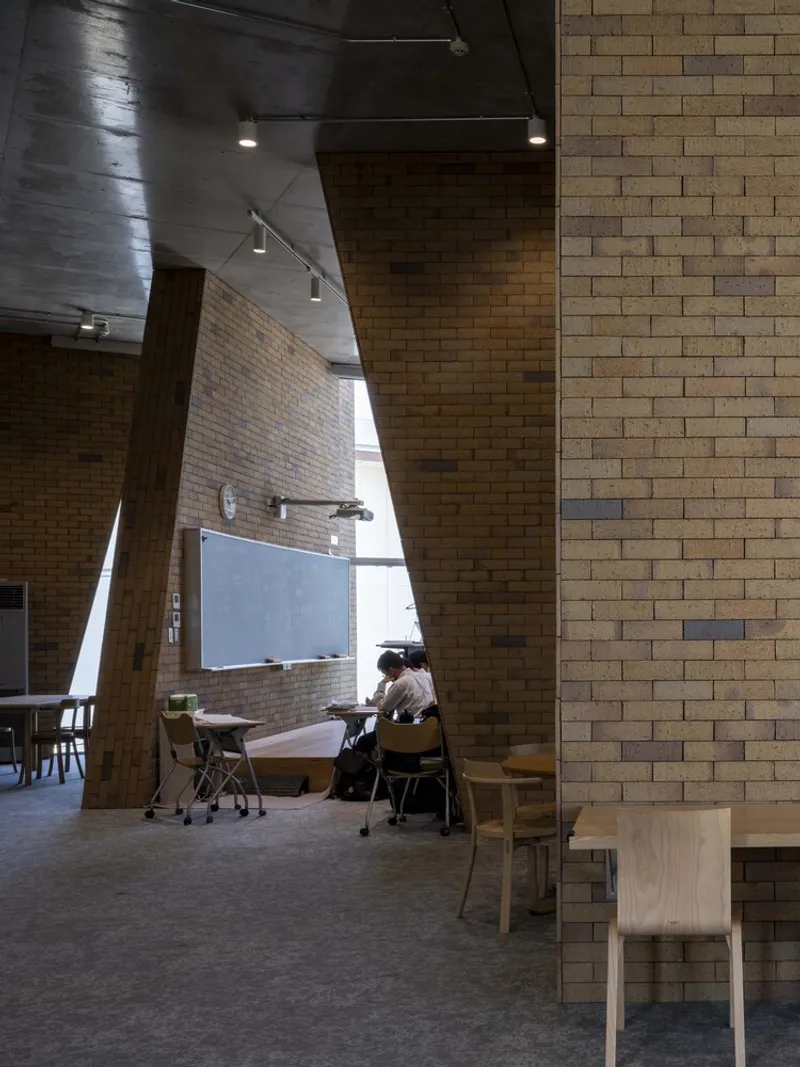
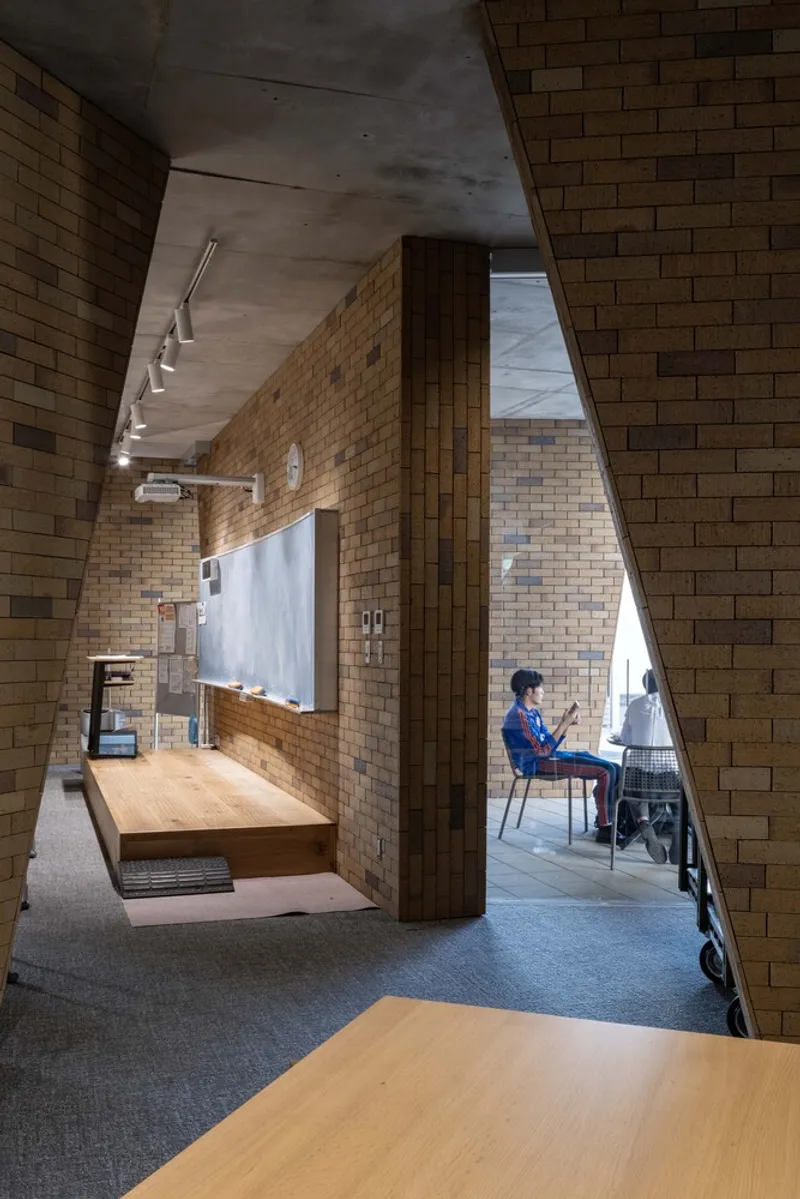
The multi-level atrium is the spatial heart of the building. Exposed concrete ceilings span above, brick columns rise through several floors, and bridges connect offset levels across the void. Natural light enters from above, washing the upper walls and filtering down to the lower reading areas. The effect is not unlike a small urban canyon, scaled for teenagers rather than office workers.
What distinguishes this atrium from a typical school commons is the quality of its edges. Rather than a single large room ringed by balconies, the space is carved into overlapping volumes separated by angled brick partitions. A student seated at a desk near a balcony railing can look across to someone on a bridge or down to someone on the floor below. The architecture cultivates visibility without surveillance, a subtle but important distinction in a school setting.
Brick, Concrete, and the Craft of the In-Between
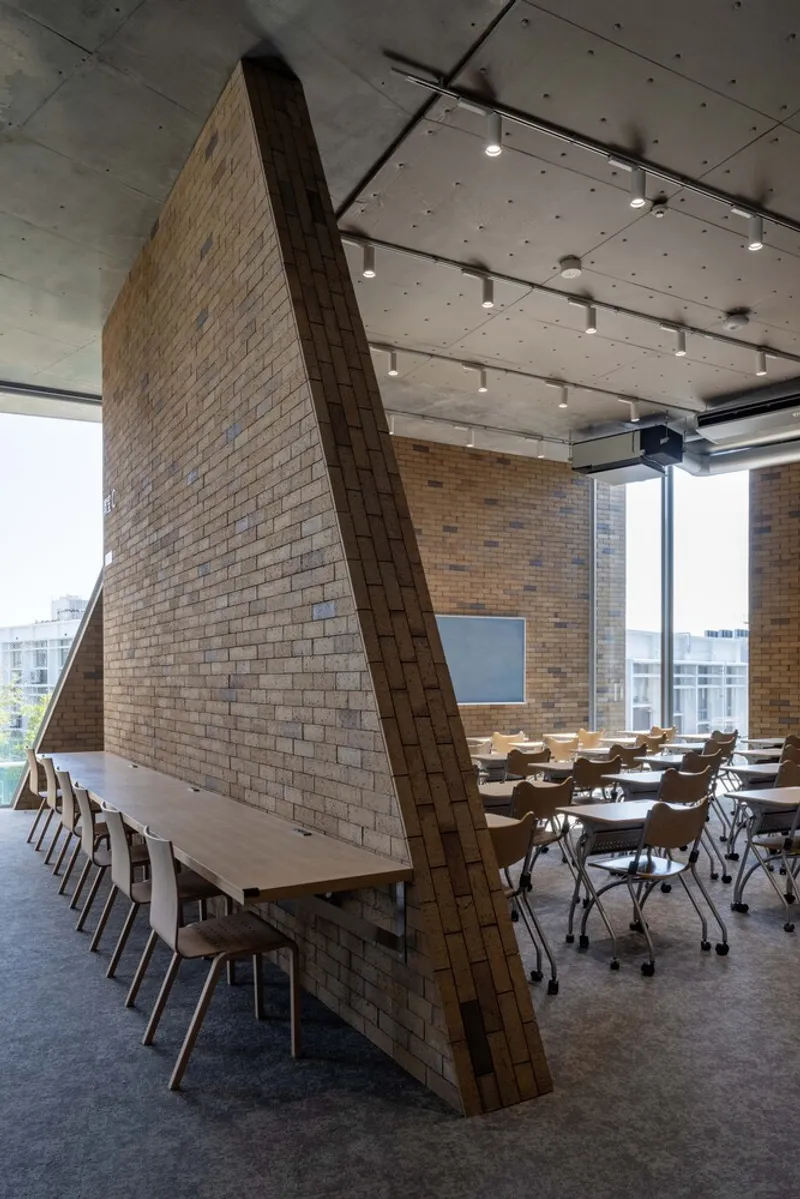
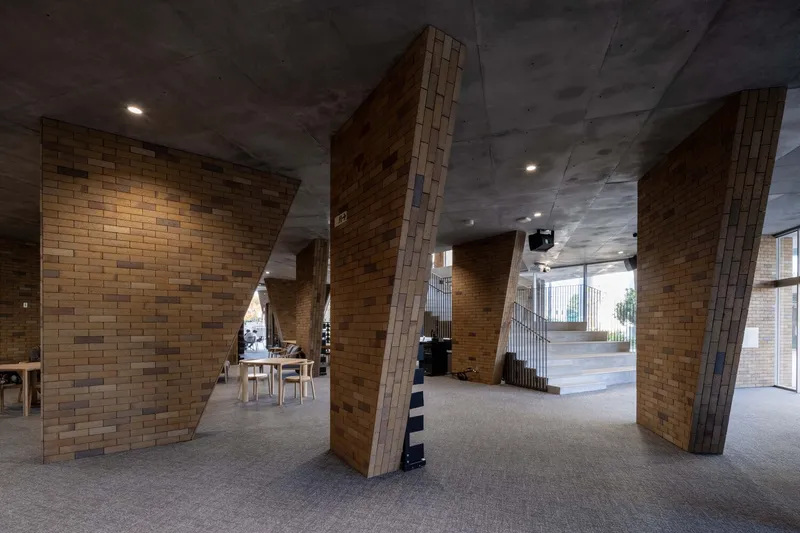
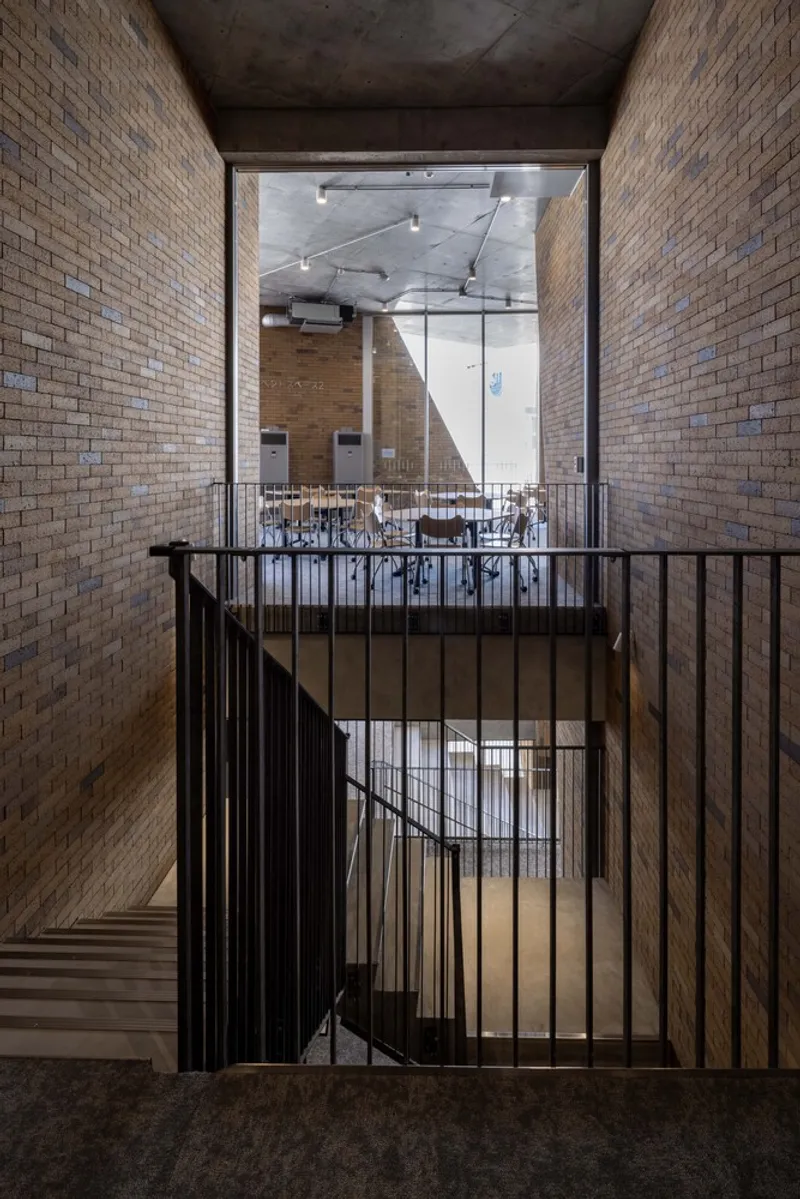
The material palette is deliberately restrained: tan brick, board-formed concrete, black steel, and timber. Each material does a specific job. The brick carries warmth and texture at human scale. The concrete ceilings provide acoustic mass and visual weight overhead. Steel railings and balustrades keep the circulation legible without adding bulk. Timber appears at furniture scale, on tables and chairs, anchoring the spaces where people sit for extended periods.
The angled brick walls deserve particular attention. Their triangular profiles create deep shadow lines under track lighting, and their inclined surfaces compress and expand the passages they define. Walking through the ground-floor colonnade feels tighter than the plan would suggest because the pilasters lean inward, then releases into a broader volume beyond. It is a trick of spatial sequence that the architects deploy consistently and well.
Study Spaces That Resist Uniformity
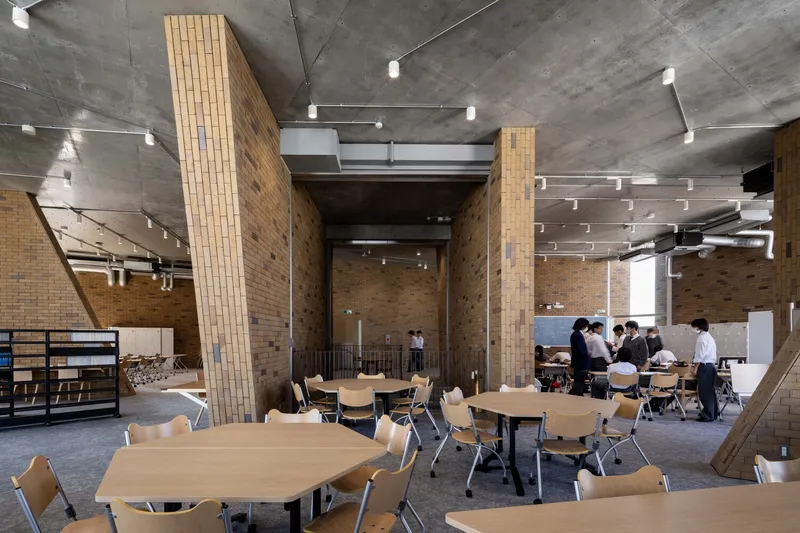
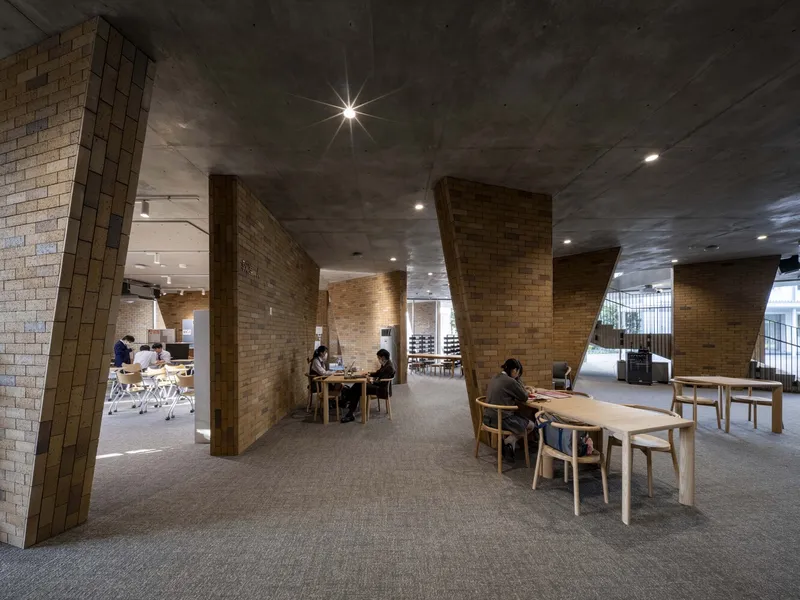
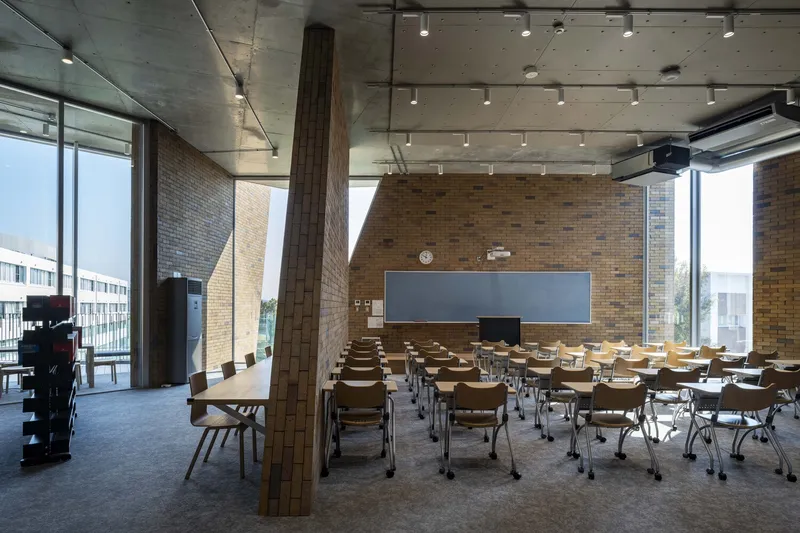
The library and classroom areas share the same structural and material language but vary in enclosure and light. One study area offers long wooden tables under a low board-formed concrete ceiling, flanked by brick pilasters that give the room a vaulted rhythm. Another is wide open, its angled walls framing views outward while students sit at timber desks. A more conventional classroom collects tablet-arm chairs in rows beneath track lighting, but even here the variegated brick columns and exposed soffits refuse to let the room feel generic.
The range of spatial conditions, from intimate and low to open and tall, gives students real choice about where and how they work. That variety is not just a functional amenity; it teaches spatial literacy, something an architecture school might appreciate in its own students, offered here to high schoolers.
Terraces and the Dusk Effect
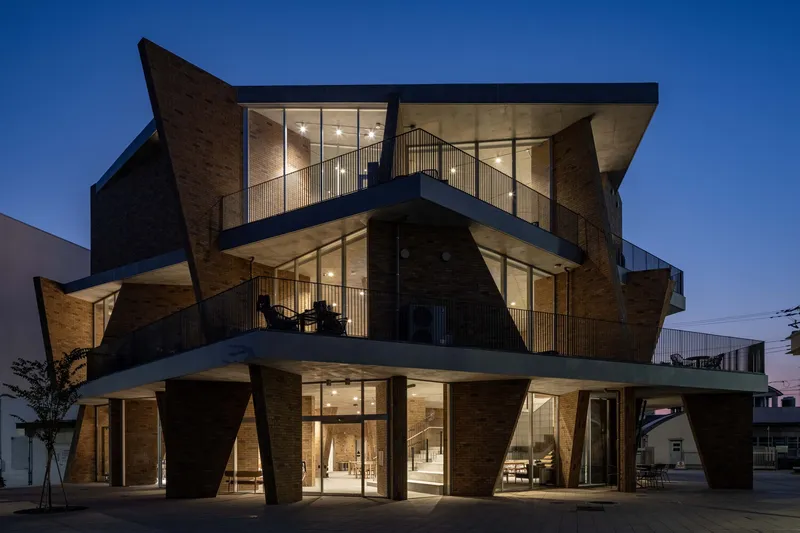
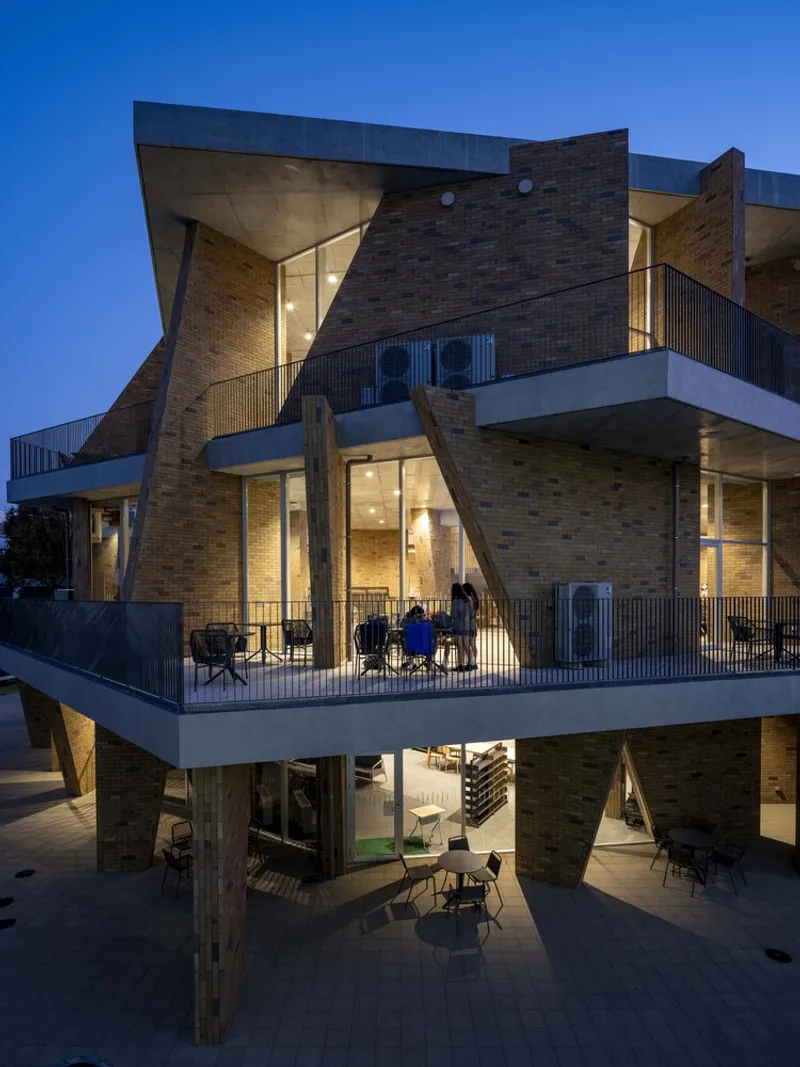
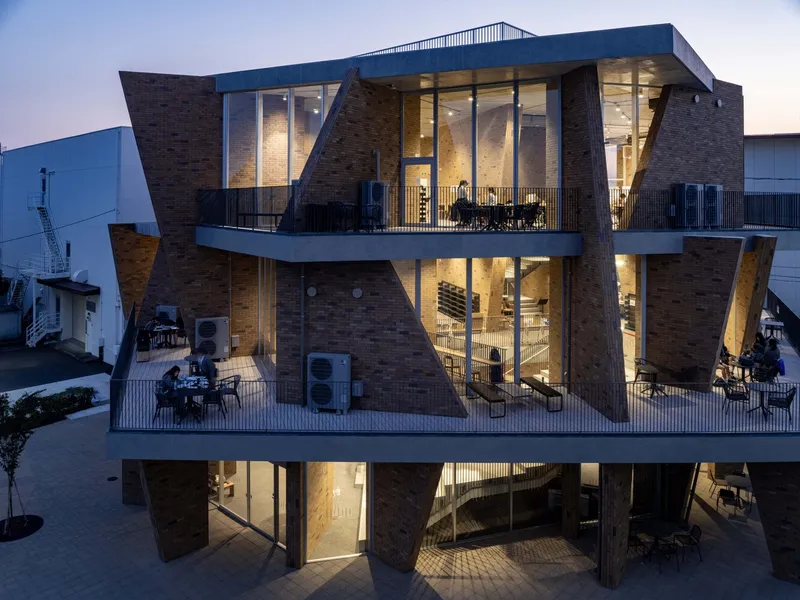
At twilight the building transforms. Interior lighting pours through glazed openings, and the stacked terraces glow against the darkening sky. The cantilevered balconies with their timber columns become inhabited silhouettes, students lingering at the edges as the day ends. The dusk photographs reveal something the daytime images only hint at: the building is designed to be occupied late, its terraces and open floors encouraging extended use rather than a sharp end-of-day evacuation.
The rear elevation, with its brick-clad pilotis and stacked terraces, reads almost like a sectional model at full scale. You can trace the floor plates, count the half-levels, and understand the logic of the offset massing in a single glance. It is a rare case where the back of a building is as legible and compositionally resolved as the front.
Vertical Circulation as Architecture
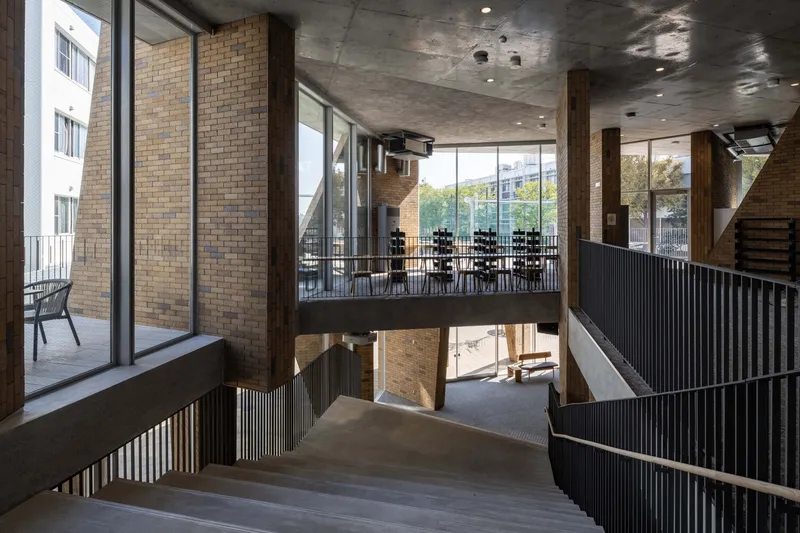
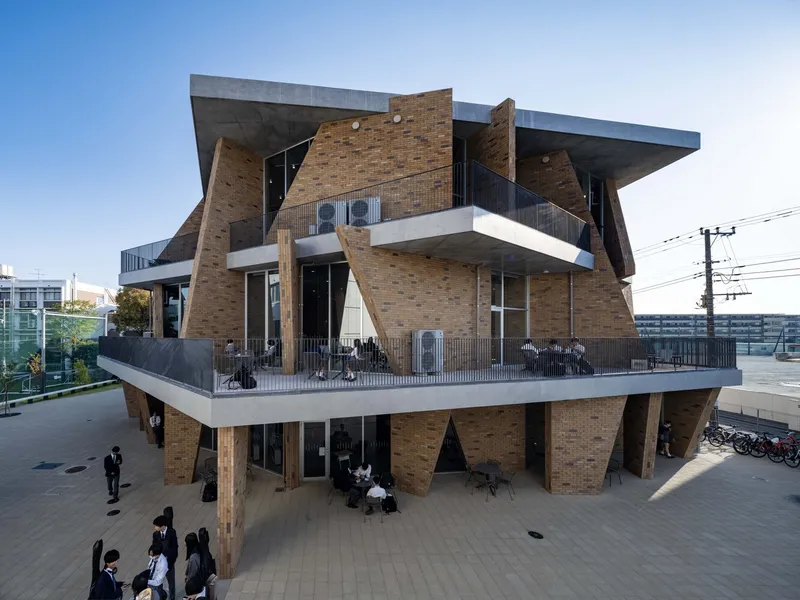
The stairwells and landings are not afterthoughts. Corrugated metal railings, black steel balustrades, and glazed openings overlooking double-height spaces turn every change of level into a moment of spatial awareness. From an elevated vantage point, the offset floor plates and canted pilasters form a complex topography of brick and concrete, populated by students at different heights and orientations. The stairs slow you down just enough to notice.
Classrooms Within the Language
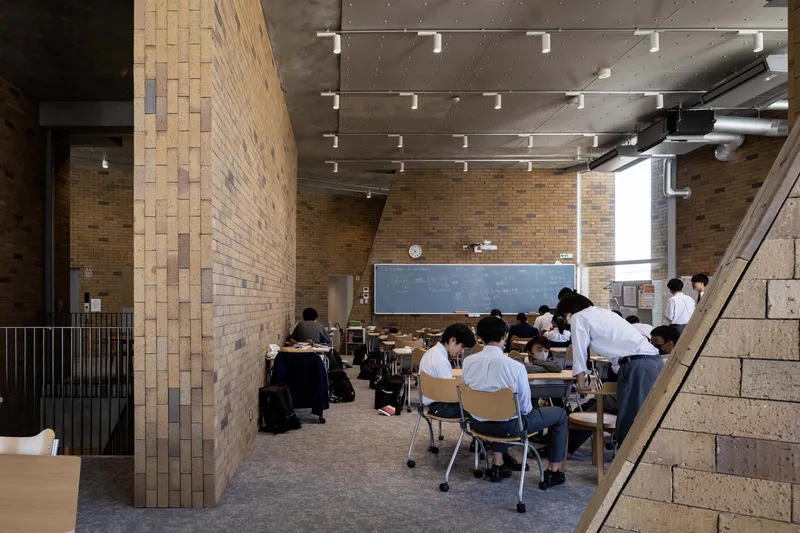
Even the most conventional rooms in the building carry the project's DNA. The classrooms shown here maintain the exposed concrete ceilings, the variegated brick columns, and the track lighting that run throughout the scheme. These are not neutral boxes dressed up with a feature wall. The structural and material logic of the whole building is present in every room, which means that moving from library to classroom to terrace feels like navigating a single continuous environment rather than stepping between disconnected zones.
Plans and Drawings
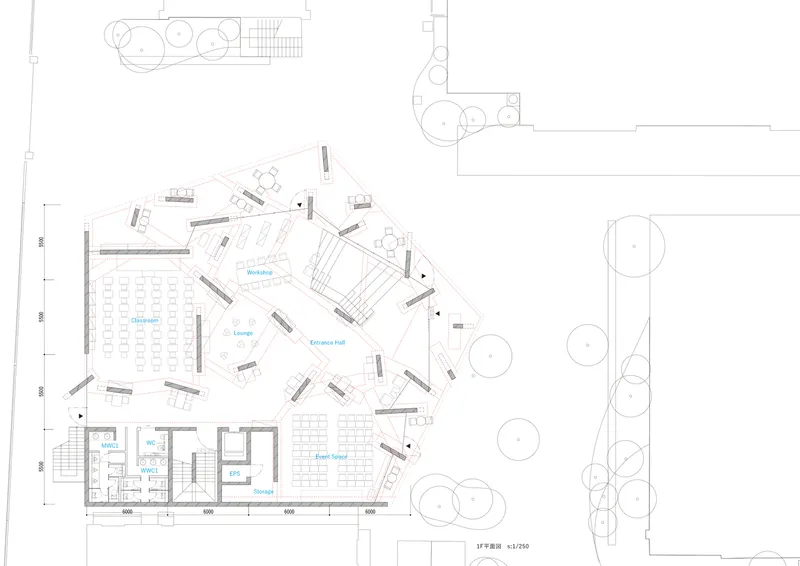
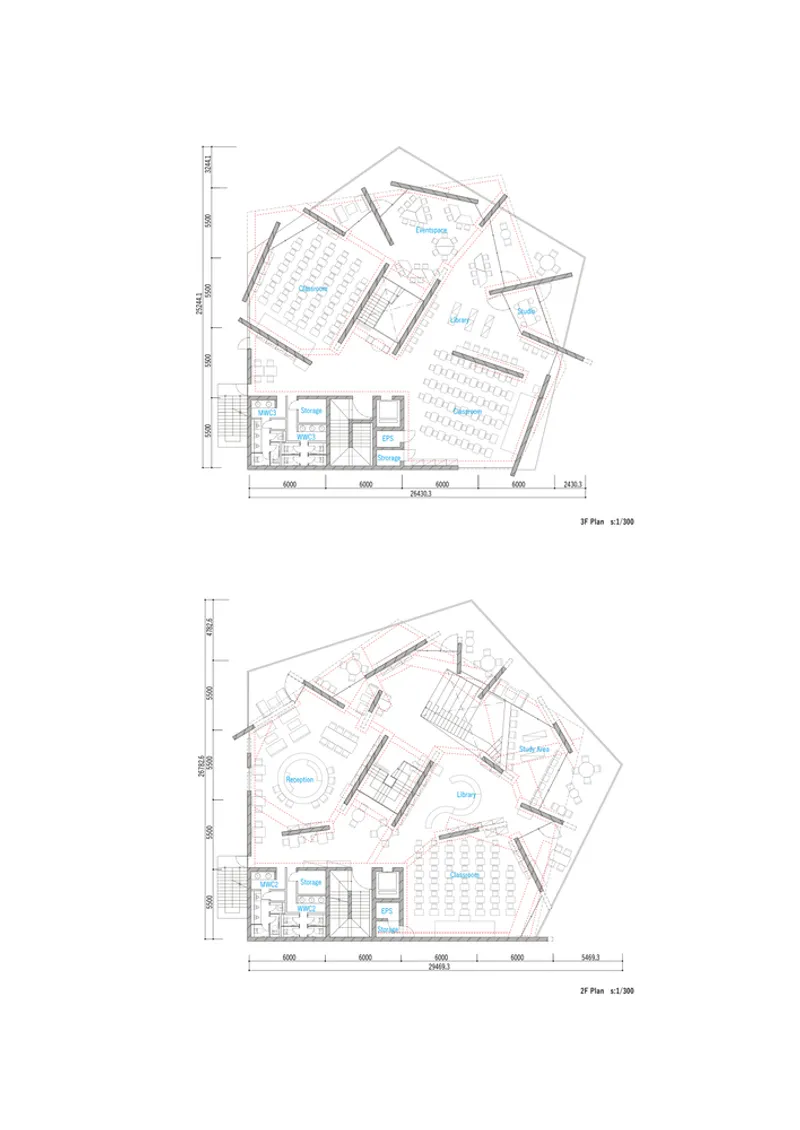
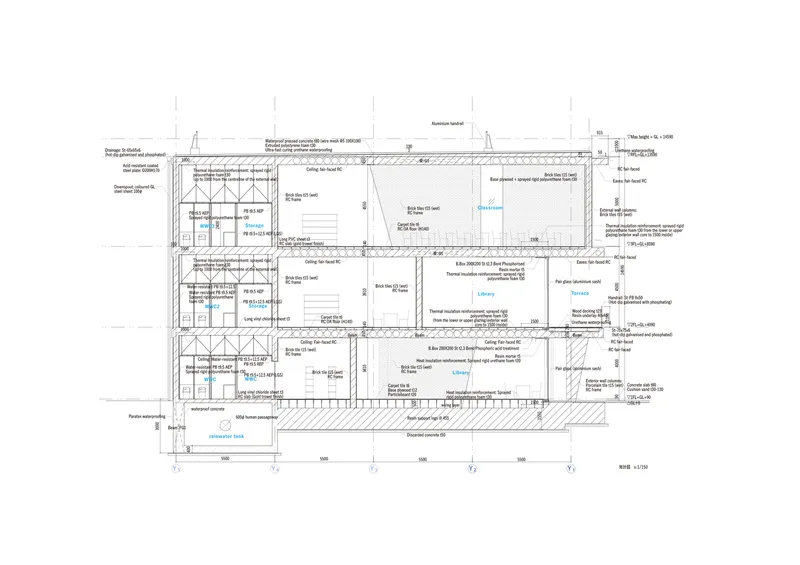
The floor plans confirm the angular geometry visible in the photographs. The building's irregularly shaped footprint organizes halls, seating areas, and service rooms around a central void, with exterior planting wrapping the perimeter. The two-level plan drawings show how the offset floor plates create the half-level connections that define the interior experience. And the detailed section, with its roof trusses and construction annotations across three structural bays, reveals the ambition of the engineering: long-span concrete slabs cantilevering over angled brick supports, held in tension by concealed steel.
What stands out in the drawings is the absence of any standard rectangular module. Nearly every wall meets its neighbor at an angle other than ninety degrees, yet the plans read as disciplined rather than chaotic. The architects have clearly worked through the geometry with care, making sure that every angular move serves a spatial or structural purpose rather than existing for its own sake.
Why This Project Matters
School buildings in Japan, and everywhere else, tend toward efficiency: regular grids, double-loaded corridors, classrooms that could be anywhere. The Shonan Institute High School Library pushes hard against that norm. By investing in angled geometry, sectional complexity, and a rich material palette, kousou and Fukei Co. have made a building that treats students as people who deserve spatial generosity, not just adequate floor area. The terraces, voids, and half-levels offer dozens of micro-environments within a single compact structure, rewarding exploration and making the act of studying feel less like confinement.
The broader lesson is about what institutional architecture can be when the brief is taken seriously and the client is willing to trust the process. A library that functions also as a social hub, a circulation network, and a piece of urban infrastructure on a school campus is not a luxury. It is a demonstration that the boundary between building type and building quality is thinner than most school boards believe. Shonan's students will grow up knowing what good architecture feels like, and that is worth more than any square-meter metric.
Shonan Institute High School Library by kousou and Fukei Co., Kanagawa, Japan. Photography by Shigeo Ogawa.
About the Studio
Share Your Own Work on uni.xyz
If projects like this are the kind of work you want to make, uni.xyz is a place to publish your own, find collaborators, and enter design competitions.


Popular Articles
Popular articles from the community


ALGAL REALM: A Bio-Integrated Lunar Habitat Design for Life Beyond Earth
ALGAL REALM reimagines lunar habitat design with algae-powered life support, 3D-printed regolith, and vertical living for a lunar future.

The Musturak Paradise: Senior Living Architecture for a Connected Future in Temara, Morocco
The Musturak Paradise reimagines senior living architecture in Temara via private homes, social spaces, culture, community, and shared care.

Co-Life: Senior Housing Design That Reconnects Older Adults With the City
Co-Life reimagines senior housing design through healing gardens, shared streets, workshops, and a sustainable community across generations.

Play: Fragments of Their World
Familiar architecture becomes modular playground design, creating safe spaces where displaced children can learn, connect, imagine and play.

Similar Reads
You might also enjoy these articles


Hodi-Mandai Geram
Project Function: Preservation and revitalization of the Intangible heritage and socio-spatial identity of the Hodi by Housing, Cultural Memory Center, Sacred Grove, landscape, local tourism economy


Olio Towers: A Mid-Rise for Performers That Fuses Housing, Rehearsal, and Stage
Located blocks from Houston's Theater District, this modular tower stacks living units around a central performance atrium.

Oasis: Modular Green Housing Carved into Dhaka's Urban Fabric
A shortlisted Plugin Housing entry reclaims unauthorized settlements in Dhaka with stepped concrete volumes, green roofs, and ventilation-driven design.

Black Hole: A Floating Megastructure for the Post-Physical Era
Emiliano Mazzarotto envisions a spherical, self-scaling arena where e-sports, digital hotels, and holographic stadiums replace traditional public space.

Explore Library Architecture Competitions
Discover active competitions in this discipline

Challenge to reimagine the Iron Throne

Photograph architecture without architects

Illustrate the lost glory of Angkor Wat - Render Challenge

Design challenge to reuse E-waste
Comments (0)
Please login or sign up to add comments
No comments yet. Be the first to comment!