
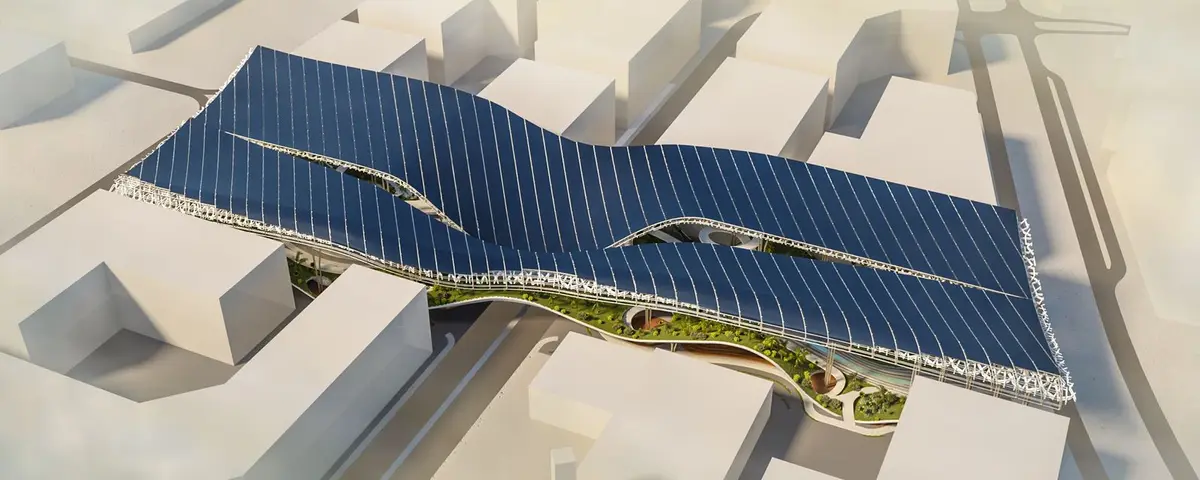
Solar Springs: A Vision of Sustainable Urban Architecture for Masdar City
A climate-responsive public landscape merging solar infrastructure, fluid form, and community life in the heart of Masdar City.


Solar Springs is conceived as an expansive piece of sustainable urban architecture that redefines how public space, renewable energy, and landscape infrastructure can coexist within a future city. Designed as a unifying structure spanning the project site in Masdar City, the proposal operates simultaneously as environmental infrastructure, civic landscape, and architectural landmark.
Rooted in the priorities outlined in Masdar’s planning documentation, the project responds directly to the city’s ambition for carbon-neutral development, pedestrian-first urbanism, and climate-responsive design. Rather than treating sustainability as an add-on, Solar Springs embeds environmental performance into the very geometry and spatial logic of the architecture.

A Continuous Solar Canopy as Urban Infrastructure
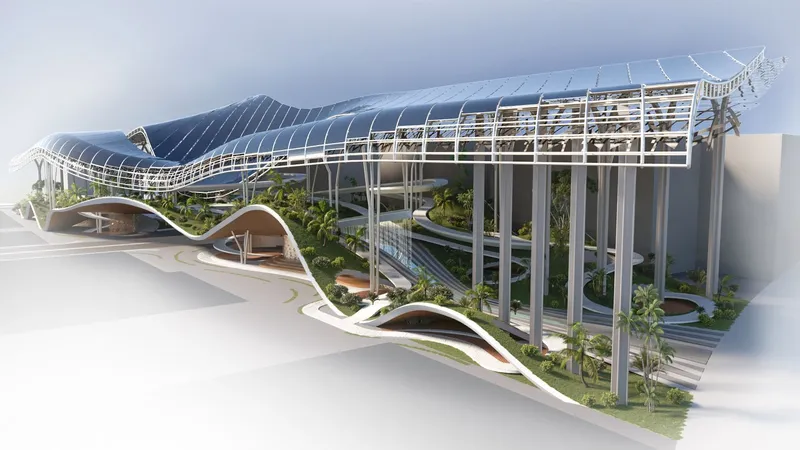
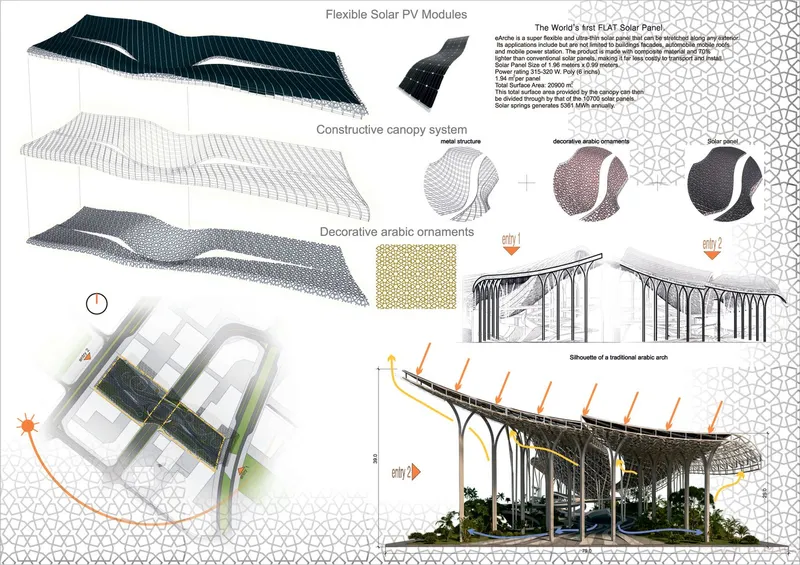
At the core of the project lies a vast, flowing canopy system that stretches across the entire territory. This elevated structure acts as a solar-responsive roof, providing shade, regulating microclimate, and supporting renewable energy generation. Its undulating profile is carefully calibrated to optimize solar exposure while creating varied spatial conditions below.
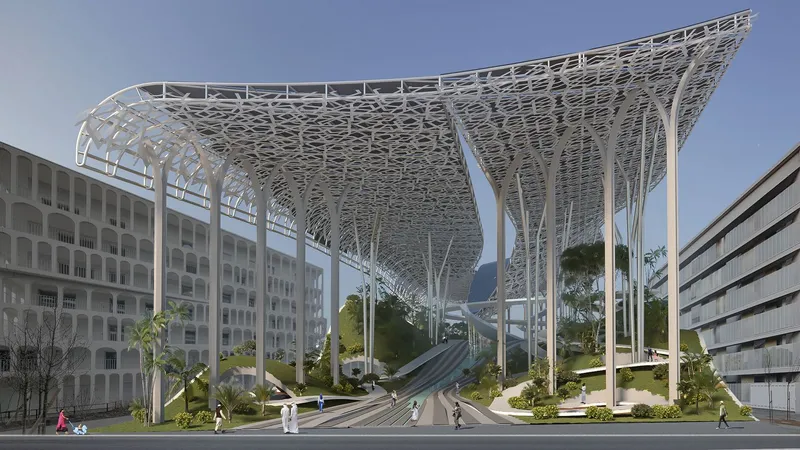
The canopy is supported by a forest of slender, branching columns that lift the structure above the ground plane. This strategy preserves openness at street level, allowing uninterrupted pedestrian movement, visual permeability, and natural ventilation. The architecture behaves less like a building and more like an inhabited landscape system.
Landscape as a Multilevel Public Realm
Beneath the solar canopy, the ground plane unfolds into a layered public landscape composed of interconnected programs. Meandering paths, ramps, and bridges weave through planted gardens, water features, and social spaces, encouraging slow movement and exploration. The design prioritizes pedestrians, creating shaded, walkable routes that remain comfortable even in extreme desert climates.
Key programmatic elements are distributed across the site, including open-air theaters, concert areas, playgrounds, water parks, and green gardens. These functions are not isolated zones but are seamlessly integrated into a continuous topography, blurring the boundaries between architecture, landscape, and urban life.
Water elements play a critical role in microclimate moderation, introducing evaporative cooling while reinforcing the project’s oasis-like character. Curving water circuits and waterfalls become both environmental devices and experiential highlights, enhancing thermal comfort and sensory engagement.
Climate-Responsive Form and Material Logic
The architectural language of Solar Springs is defined by fluid geometry and porous surfaces. The lattice-like canopy structure filters sunlight, casting dynamic shadows that shift throughout the day while reducing heat gain. This patterning is not purely aesthetic; it is a performative system tuned to climatic conditions.
Materials are selected to reflect heat, withstand harsh environmental conditions, and minimize maintenance. The elevated structure allows hot air to rise and dissipate, while shaded zones below remain cooler and more habitable. Together, form and materiality work in harmony to create a resilient and energy-efficient public environment.

Social, Cultural, and Urban Impact
As a piece of sustainable urban architecture, Solar Springs is designed to function as a social condenser for Masdar City. It offers spaces for gathering, performance, recreation, and everyday movement, supporting both planned events and spontaneous use. The architecture encourages interaction across age groups and cultures, reinforcing a sense of shared civic identity.
By spanning infrastructure, landscape, and public program, the project demonstrates how future cities can integrate renewable energy systems without sacrificing spatial quality or human experience. Solar Springs becomes a model for how climate-driven design can produce spaces that are not only efficient, but also inclusive, expressive, and deeply connected to place.
Toward a New Model of Sustainable Urban Architecture
Solar Springs proposes an alternative vision for urban development in extreme climates, one where architecture operates as an adaptive environmental system rather than a sealed object. Through its continuous solar canopy, layered public spaces, and climate-responsive strategies, the project reimagines the role of architecture as an active participant in shaping sustainable urban life.
Designed by Алексей Шестаков, the project stands as a forward-looking exploration of how cities like Masdar can evolve into living laboratories for sustainable urban architecture, where technology, ecology, and human experience are seamlessly intertwined.



Popular Articles
Popular articles from the community


Lunar Spiral: Space Architecture Shaped by the Mathematics of the Universe
Lunar Spiral reimagines space architecture through Fibonacci geometry, lunar regolith, levitating habitats, and self-sustaining Moon living.

The Musturak Paradise: Senior Living Architecture for a Connected Future in Temara, Morocco
The Musturak Paradise reimagines senior living architecture in Temara via private homes, social spaces, culture, community, and shared care.

Conexión: Biophilic Design Reimagines High-Rise Living in Hong Kong
Conexión reimagines high-rise living in Hong Kong through biophilic design, green facades, shared spaces, daylight, water and nature within.

Play: Fragments of Their World
Familiar architecture becomes modular playground design, creating safe spaces where displaced children can learn, connect, imagine and play.

Similar Reads
You might also enjoy these articles

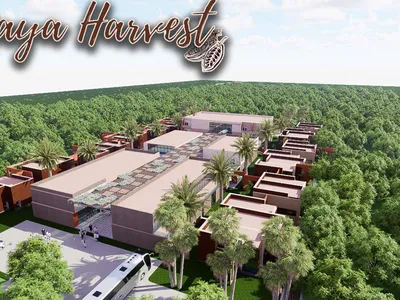
Maya Harvest: A Cacao Resort Village Rooted in Mayan Tradition and Local Craft
Situated within a Tabasco cacao plantation, this shortlisted resort proposal merges vernacular materials with hands-on cultural immersion.
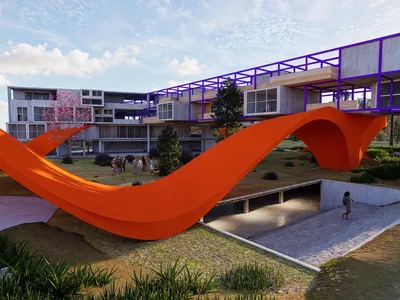
Harmonia: A River-Shaped Community That Grows Over Decades in Boa Vista
Curved pathways and modular grid structures along the Branco River create a phased settlement designed to evolve from 2030 to 2050.

The Architecture of Bathing: A Mughal Hammam Reimagined Across the Yamuna
Charlotte May's honorable mention entry for The Black Taj reinterprets Agra's bathing rituals through red sandstone, water, and framed views of the Taj Mah

Om-1: A Wall-Hung System That Moves Your Workspace Off the Desk
Modular plywood boards, magnetic pegs, and utility elements migrate clutter from the horizontal surface to the vertical plane.

Comments (0)
Please login or sign up to add comments
No comments yet. Be the first to comment!