

The Lifeblood Of Society
An essay on the relevance of protests to society and architecture paired with conceptual solutions for improving spaces for protests.

To paraphrase John Adams, “Protests are the lifeblood of a healthy society.” For centuries, protests have been an avenue for the masses to effectively communicate their displeasure to those in power. This avenue to express opinions has helped maintain a balanced social order which, in turn, helped progress our society forward. It is this check and balance system that has helped us overcome many issues throughout history. This tool allowed us to gain better ideals of equality, drastically reduce prejudice, and collectively deny tyrannical ideas and regimes. We should be so grateful that such an avenue exists, because, without it, our society would very much be Kafkaesque or Orwellian. Instead, most of our society enjoys democracy. We enjoy an unwavering right to express ourselves the way we see fit and to live out our lives as the masters of our destiny.
Of course, not all protests are created equally. Some succeed and some fail. Some protests are done to call out injustices and corruption, while others are done to repress progressive change. While I must admit that protests aren’t always done to affect positive change, their existence is still one of the best examples of the democracy most of us enjoy. It is still a huge bonus to have such an avenue available for us to show mass dissatisfaction to those in power. Besides, the main purpose of protests is to voice an opposing opinion. I think we can all agree, regardless of whether the protest is positive or negative, it forces us to start a dialogue between two opposing schools of thought – a banner ideology espoused predominantly by democracy.
Today, protests are one of the most prominent avenues for political discourse between the public and those in power. While the quality of the conversation is not always apparent, protest is a means of discourse, nonetheless. Of course, in this discourse conducted by the people and those in power, they will need to find the proper locale for such an activity and in steps architecture. It is within our profession’s responsibility to conceptualize, design, and improve public space. It is, after all, within the public realm where these discourses happen. If protests are the lifeblood of a healthy society, then good space is the lifeblood of the public realm. Public space is only as good as its design and the discourse conducted in them is affected by the design as well.
We all know that public spaces change drastically during a protest. Almost all the designed functions and intents of the space get thrown out the window and a new paradigm exists once the activity starts. Because of the new-found function where public spaces act as the negotiation table, we must now respond with the proper design parameters to aid in the success of the political discourse. For example, we must consider what makes protests and demonstrations effective. A unified message and protest are a good place to start in these matters. Reports have indicated that there are protests around the world that have failed due to the lack of a clear message and a proper leadership hierarchy. In addition, these protests failed also due to the lack of proper follow-through, meaning, there was no chance for proper dialogue between the masses and those in power.
With rudimentary parameters provided, how can the architecture profession aid in easing the political dialogue between the two parties?
Much like a design problem, we must address each need point for point. I have stated earlier that some protests fail due to the lack of a clear message, a lack of proper leadership, and a lack of follow-through dialogue. To address the first point, I’d like to cite the 2017 Women’s March in Washington. Although it was named “Women’s March” the protest’s message was clear: equal rights for all. The protest’s message was so well received by the masses that it became the single largest demonstration in US history. Although it was an enormous success, we should consider the fact that the protest was unsustainable (architecturally speaking). In my opinion, protest sites these days should be treated like pop-up locations. There should be a nearby facility to help set up the area as a protest zone with a standardized system. Deploying portable toilets, medical tents, supply tents, and command centers (which may encourage a leadership hierarchy within the protesters) should be available throughout the protest. This system would hypothetically give the protesters a strong political machine throughout the demonstration. Additionally, these protests sometimes last for days and we should have the means to maintain a level of comfort and coordination throughout it.
To be clear, the standardized system I stated would help the organization of the protest allowing them to better get their message across.
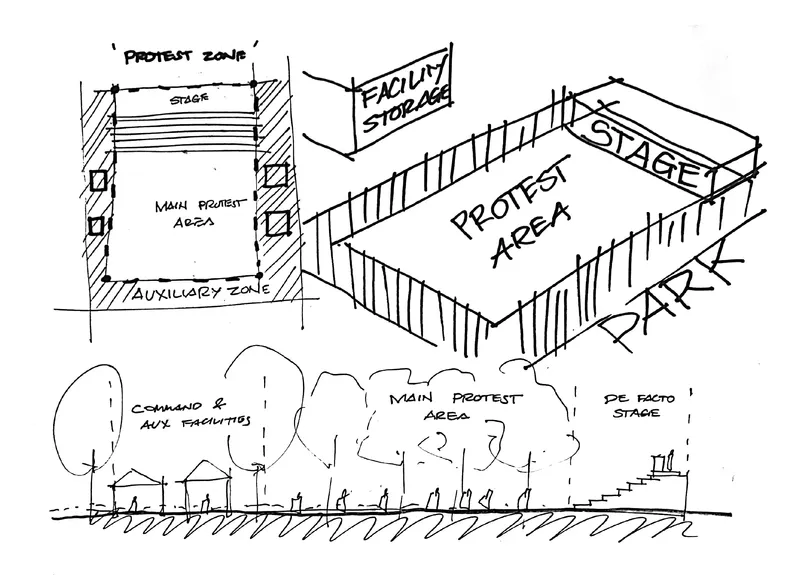 Fig. 1 - Conceptual Sketches
To answer the second point (and to an extent the first point), I would like to cite Martin Luther King Jr.’s “I Have a Dream” speech. This iconic speech by MLK was delivered on the steps of the Lincoln Memorial. He did so because the steps created a de facto stage for him to address those with him. Should a park or an open space be made available for protests, there should be a provision for either a de facto stage (much like the steps of the Lincoln Memorial) or a space where an actual stage can be set up. This idea, in tandem with the standardized system I stated, should allow for the protesters to create a better hierarchy for the protest.
Having a standard-bearer, or an icon, in a public demonstration would only increase the chances of the message coming across.
Finally, there should be more spaces in key government buildings that would allow for discourse between the masses and those in power. While this idea may be a little unorthodox, there should be an avenue for discourse following public demonstrations. After all, the right to protest is one of the key signs of a healthy democracy. The spaces can vary depending on their idea of how the discourse should occur. Maybe adding a small conference room to key offices where officials and protest leaders can discuss issues would help ease the conversations between the parties. If the space allows, perhaps a bigger forum can be created within government buildings to allow a more democratic approach to the discourse. The possibilities in this scenario are endless. They are, however, only valid if elected officials want to uphold their end of the deal, but that’s a conversation for another time.
With that, I would like to end with a thought in conjunction with my opening remark: “A balanced social order is the lifeblood of a strong civilization.” A balanced social order means that the citizens must make their grievances known and force government officials to come to the negotiating table. We, as architects, must admit that some things are out of our control. There are some issues we cannot solve with our architecture. Powerful as we may be our architecture cannot directly solve political issues. I believe that we must accept this reality and focus on what we can solve. We may not be able to solve problems directly, but we do create the spaces they (the masses) protest in. We also create the spaces where they conduct their negotiations and discourse. Therefore, it is within our power and responsibility to create the best possible spaces for discourse and negotiation to help facilitate a better dialogue. This is our eternal role in ensuring the balance of social order. At the end of the day, we must always believe that the interests of the many will outweigh the interests of the few. We must strive to better understand these problems to create enlightened solutions for a unified and stronger civilization.



Popular Articles
Popular articles from the community


Play: Fragments of Their World
Familiar architecture becomes modular playground design, creating safe spaces where displaced children can learn, connect, imagine and play.

Riyadh For All: Intergenerational Urban Design for Active Aging in Rabat
Riyadh For All reimagines urban design in Rabat with intergenerational co-living, adaptive courtyards, and Moroccan cultural exchange today.

Lunar Spiral: Space Architecture Shaped by the Mathematics of the Universe
Lunar Spiral reimagines space architecture through Fibonacci geometry, lunar regolith, levitating habitats, and self-sustaining Moon living.

Co-life: Sustainable Architecture for Age-Friendly Community Living
Co-life reimagines sustainable architecture for seniors through courtyards, rammed earth, shared gardens, and spaces designed for belonging.


Similar Reads
You might also enjoy these articles

Day and Night Park: A Time-Based Urban Newsstand in Beijing
A temporary urban newsstand in Beijing blending travel, light, and reading through poetic colors, compact form, and community-focused design.

Modernist Patio Renovation in El Masnou, Barcelona by Oliver Segura Arquitectura + Cebrià Arquitectura
Modernist patio renovation blending tradition and innovation with a movable pool, leveled floors, and Catalan materials in El Masnou.
Alto Residencial Coop: Cooperative Housing Development in Santiago de Compostela by Carbajo Barrios Arquitectos
A linear cooperative housing complex blending white volumes and perforated metal façades, enhancing community living, natural light, privacy, and urban integration.
Vil Genis School by BPA ARCHITECTURE – Massy, France
Vil Genis School in Massy, France, features sustainable design, south-facing classrooms, community integration, accessible spaces, and modern educational architecture.

Comments (0)
Please login or sign up to add comments
No comments yet. Be the first to comment!