The Tim Story: Redefining Public Transport Comfort through Urban Design Innovation
An award-winning portable seating solution transforming urban commuting into a comfortable, sustainable, and inclusive experience.


Public transportation is the backbone of urban mobility, yet it often comes with discomforts that discourage daily commuters. The Tim Story—an everyday office-goer—illustrates these challenges and highlights a human-centered design response. The Tim Story project, designed by Abhishek Rana, received an Honorable Mention in the @ease competition. It proposes an innovative product that rethinks how we design comfort in public transit.
The Problem: Everyday Urban Discomfort
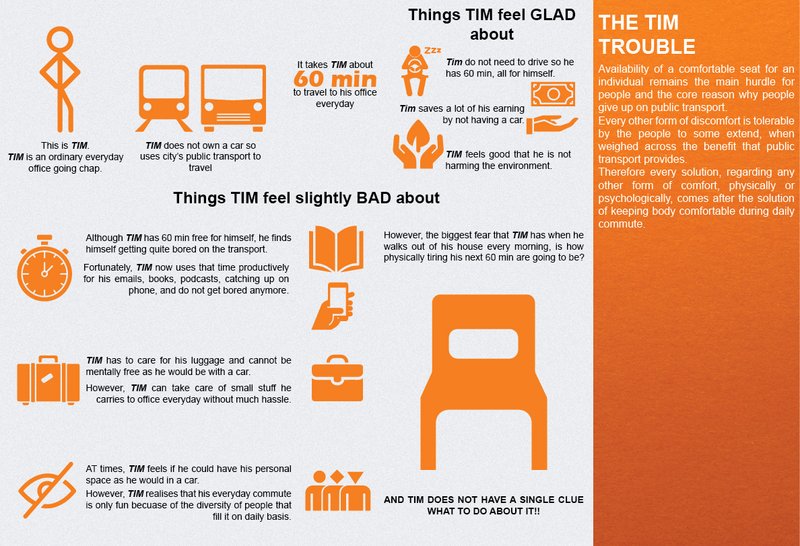
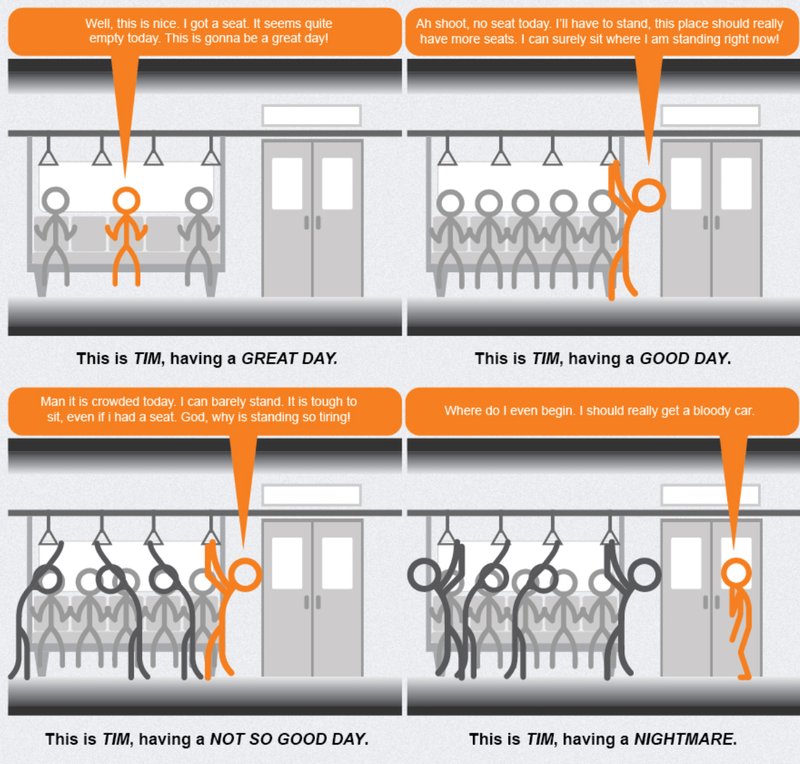
Tim’s journey represents millions of daily commuters who rely on buses and metros. While public transport saves money, reduces environmental impact, and allows time for other activities, it often lacks the most basic element—physical comfort. Long commutes with overcrowding, lack of seating, and the strain of standing can quickly turn a good day into a nightmare. Research shows that the single biggest deterrent to using public transport is the unavailability of a comfortable seat.
Urban Design Meets Human-Centered Architecture
The project reframes public transportation not just as infrastructure but as an architectural experience—where design can intervene to improve well-being. By merging urban design innovation with product-scale thinking, The Tim Story emphasizes that small, adaptable solutions can make large-scale systems more livable. This approach aligns with the principles of sustainable architecture and human-centered design, where the focus extends beyond buildings to everyday interactions with public spaces.
The Solution: Portable Comfort
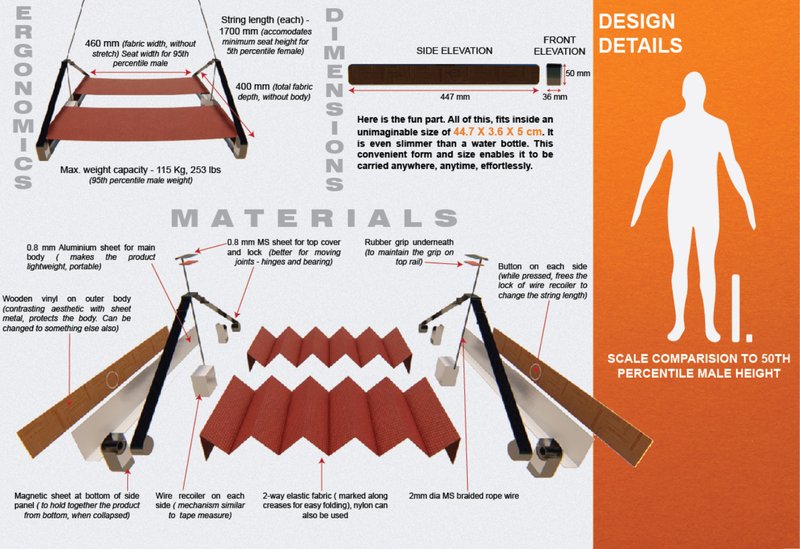
The proposed product is a foldable, elastic fabric seat system designed to be lightweight, portable, and user-friendly. It can be hung from the top rail inside buses or metros and quickly transformed into a supportive seat or leaning aid. Key features include:
- Compact design: Collapses into a slim form smaller than a water bottle.
- Adaptability: Functions as a seat, backrest, or stabilizing support.
- Portability: Easy to carry daily, without reliance on large-scale retrofitting of transport systems.
- Inclusivity: Designed to accommodate a wide demographic range with ergonomic considerations.
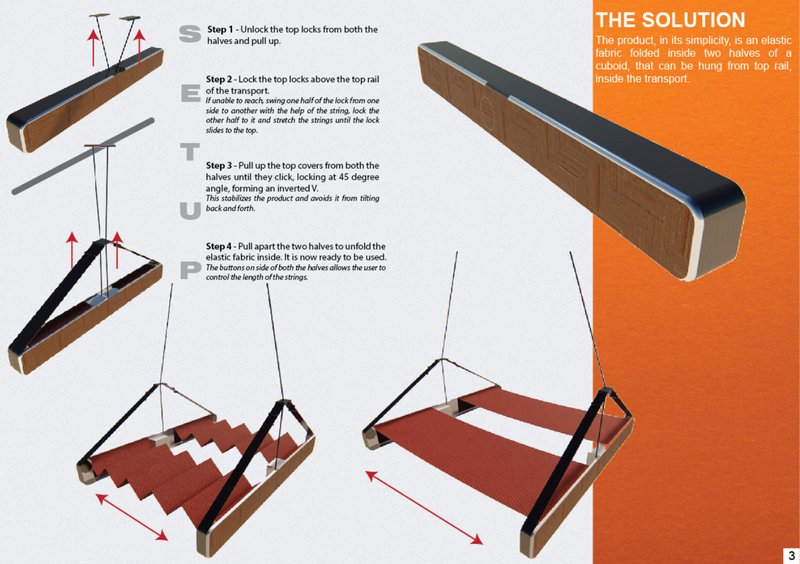
How It Works
- Unlock and hook the product to the transport’s rail.
- Extend the elastic seat fabric.
- Use it as a seat when space allows, or as a leaning backrest in crowded conditions.
- In extremely packed environments, it doubles as a support handle, reducing fatigue.
This versatility ensures that Tim can have a "great day" commuting—whether seated, leaning, or standing.
Materials and Ergonomics
Constructed with lightweight aluminum, elastic fabric, and ergonomic dimensions, the design balances durability with comfort. The product’s minimal size (44.7 × 3.6 × 5 cm when folded) makes it ultra-portable while maintaining a weight capacity of up to 115 kg. This makes it suitable for a diverse commuter population.
Architectural Relevance
Though product-scaled, The Tim Story is deeply architectural—it demonstrates how design innovation can reshape user experience in shared urban spaces. By addressing physical comfort, it supports the broader goals of sustainable architecture: reducing car dependency, promoting mass transit, and enhancing the livability of cities.
The Tim Story is more than just a portable seat—it is a commentary on how urban design innovation can transform overlooked aspects of daily life. By solving a seemingly small problem, it encourages greater public transit adoption, reduces environmental strain, and improves the psychological well-being of commuters.
This Honorable Mention entry of the @ease competition by Abhishek Rana exemplifies the future of human-centered urban architecture—where comfort, sustainability, and inclusivity converge in every design decision.