Transformability
------ Flexible Sustainble Shelter
In an agricultural country like the United States, grain bin is a very common architectural element. People use it for agricultural storage and agricultural activities. However, it has witnessed the agricultural culture with American characteristics and the cultural and historical changes of a region. When such an ordinary steel building gradually declines, what new value can we give it?
With the help of satellite map survey and online literature review, we have mastered a lot of information related to Kansas, such as cultural, geographical, climate and so on. We believe that in the regeneration of the grain bins, we should not only change the old space , but also consider how to really use this form of old building from multiple angles and aspects.
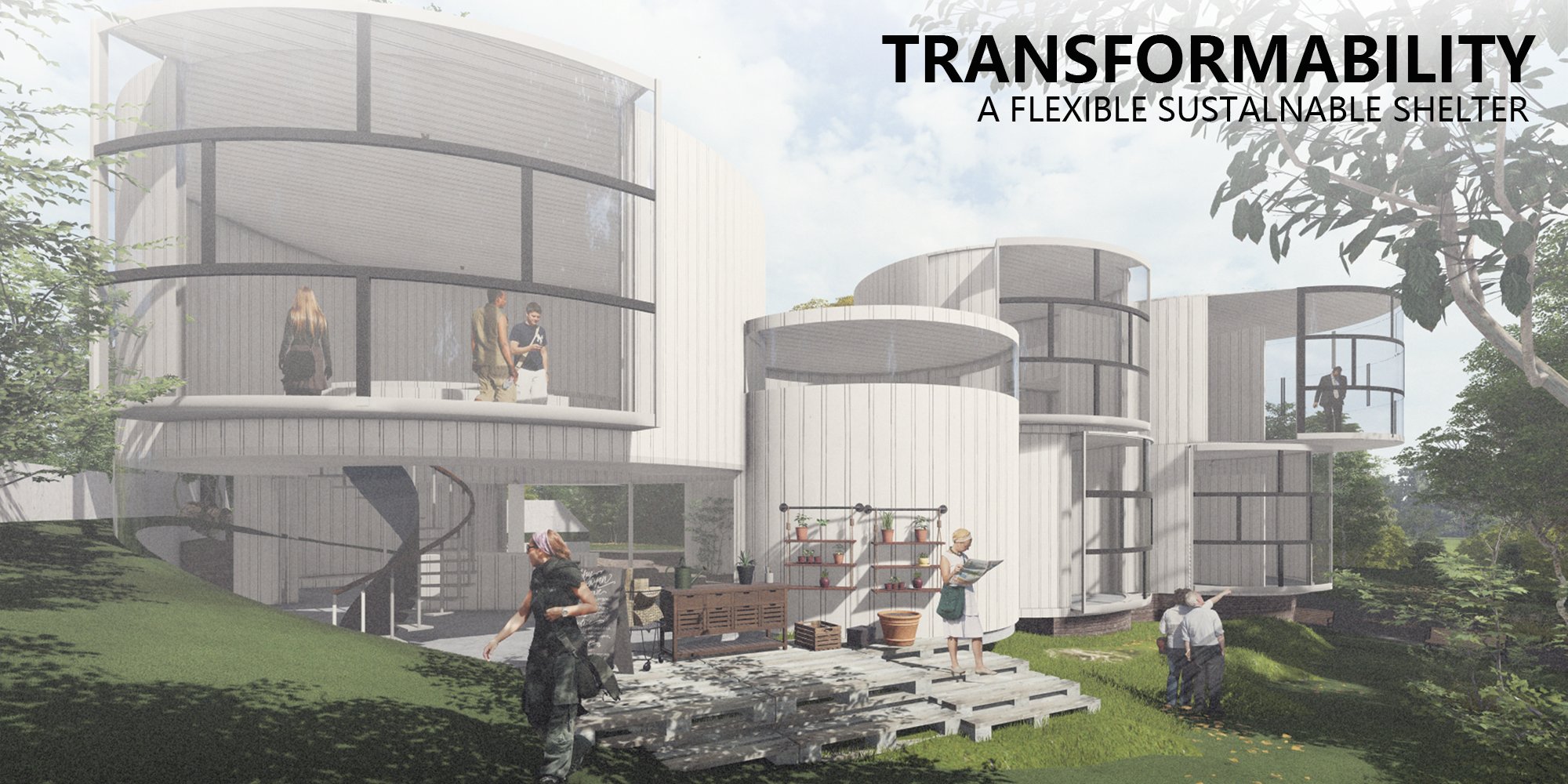
Combining the relevant research on the characteristics of the grain bins and the local context, we decided to transform the original monotonous cylindrical grain bins into an agricultural accommodation center with multiple functions. It is a SUSTAINABLE SHELTER that can be TRANSFOR, moved, pushed and pulled according to climate change, which just looks like a FLEXIBLE drawer.
First, SUSTAINABILITY.
Nowadays, "sustainability" has become an inevitable and important issue of architectural renovation.
The vertical greening and experimental planting areas for crops and double-layer DSF technology related to agricultural schools have improved the microclimate of the building to a certain extent.
The vertical greening, crop planting areas, DSF technology, etc. related to agricultural schools have improved the microclimate of the building to a certain extent. On this basis, the use of new clean energy and the recycling of old materials can also contribute to sustainability.
The sunshine and wind environment in Kansas make it possible for us to install solar panels and wind power generation devices on the roof. The form of self-sufficiency can not only provide sufficient energy for the operation of building equipment, but also reduce the cost of introducing the power grid to the suburbs, and even provide energy for the city in return.
At the same time, the landfill near the site also provides us with a large amount of construction materials that can be used. For example, waste plastics, metals and other wastes. They can be recycled as 3D printing materials. After processing, they can be used to make movable window frame structures required for construction. This makes the structure of window frames and slide rails lighter and reduces energy consumption.
Second, FLEXIBILITY.
When talking about flexibility , we have to mention the sunflower, the state flower of Kansas. This highly flexible local crop provides us with a lot of creative inspiration.
Sunflowers rotate with the movement of the sun, showing strong flexibility. This has also affected our building , forming a new way of façade organization. We broke the traditional closed and fixed shape of the grain bins, so that the monotonous space can be moved and zoomed.(The rollers that control the operation of the building's skin and part of the internal space rely on the clean energy mentioned above.)
With the movement of sunlight, the mobile building skin windows enrich the changes in the interior space of the building to natural light, and also meet the needs of small-scale agricultural planting and scientific research, and even have a strong disaster prevention or shelter function.
Third, SHELTER.
The east side of the lodging center is the main accommodation space, and each accommodation unit adopts the form of a capsule hotel, which improves the utilization rate of space; the west area is mainly responsible for reception, teaching, conference, scientific research and other functions, forming a small comprehensive agricultural learning base. This allows tourists to invest in agricultural research in a special life experience and enhance their interest in agronomy.
However, such a smooth function operation is actually under threat. Kansas has a temperate continental climate, hot and rainy, and sandstorms often appear, which seriously threatens our agronomy lodging center.
At this time, the deformable architectural features provide us with adequate protection. Under normal weather conditions, we can move buildings to expose some crops and plants to the sunlight. This movable skin can also track the slow changes of sunlight in different seasons of the year to help carry out some agricultural experiments.At the same time, when a sandstorm comes, we can push the movable part back to its original position and combine it with the wall of the building itself, which can resist the invasion of sand and dust to a certain extent.
Moreover, over time, our buildings can also be expanded or changed to adapt to different needs. For example, change the orientation to face the sunlight, or locally push and pull to expand the space.
The regeneration of the grain bins based on deformability has spawned discussions on additional topics such as sustainability, adaptability, and shelter. This not only satisfies people's demand for architectural space, but also meets the challenges of the natural environment. But in fact, the value of this deformability lies in the experience level. These agricultural learners who have been here for 2 to 3 weeks, after experiencing such " deformability", can not only feel the unique living experience in the old space, but also realize profound issues.