

Urban Nomads: A Reusable Steel Prototype That Turns Construction Site Jugaad into Dignified Worker Housing
A modular, stackable steel shelter for Mumbai's migrant builders that absorbs workers' own improvisations into a dignified, reusable housing system.


Every tower in a growing city has a shadow settlement at its base: the camp where the people building it actually live. These camps are assembled from leftovers, packed too tightly, and badly ventilated, and they are treated as temporary enough to escape the planning attention that housing normally gets. Urban Nomads starts from that blind spot. It argues that temporary does not have to mean undignified, and it backs the argument with a modular shelter that can follow its occupants from site to site.
The project is by Aniket Risbud and is grounded in surveys carried out across the Mumbai Metropolitan Region. Those surveys found a clear gap. Construction methods in the region have moved forward quickly, while workers' living conditions have barely changed. Risbud's answer is a prototype built on a demountable steel framework. It is meant to be cheap, quick to put up, and made from readily available materials. Just as important, it is shaped by close observation of how workers already adapt the spaces they are given.
Reading the Camp Before Redesigning It
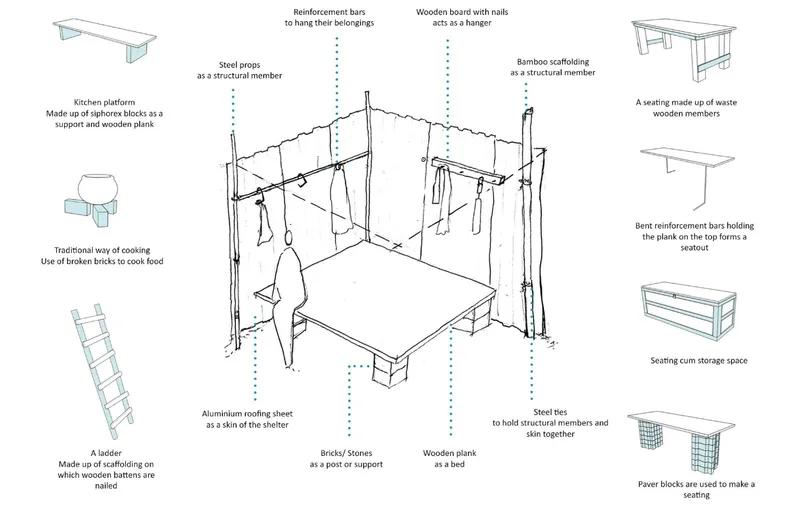
The opening sketch documents a makeshift shelter: a bamboo frame, a plank bed raised on bricks, and reused furniture gathered around it. The research is honest about what it found. Workers practise jugaad, the local word for inventive improvisation. Bamboo scaffolding becomes structure, steel rods serve as hangers, broken bricks make a cooking hearth, and fabric sheets act as walls.
Risbud does not treat these fixes as problems to be cleared away. He treats them as a brief. The prototype takes their logic into its own architectural language, so the new shelter feels familiar to the people using it from the first day. That is a shrewd move. Housing imposed on transient workers is often ignored or reworked by them, while housing that grows out of their existing habits is far more likely to be accepted.
A Railway Compartment Logic for a Single Room
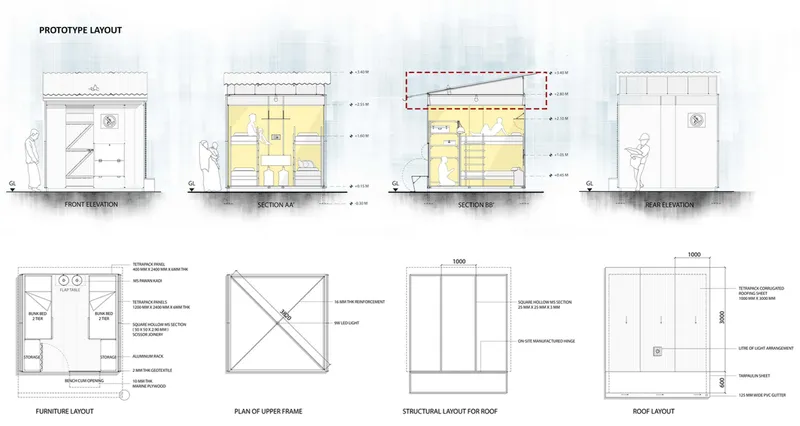
The prototype drawing set includes elevations, two sections, a furniture plan, an upper frame plan and a roof layout. Together they show a small room planned with the tight economy of a train carriage. Risbud names railway compartments and micro-housing as direct references. Bunk beds stack the sleeping space vertically and leave the floor free for daily life, and storage is built into the walls and furniture so belongings do not take over the room.
The design is disciplined by anthropometric studies, which set ceiling heights, seating levels and circulation clearances so the unit works for different ages and genders. The sections matter most here. With so little floor area, comfort depends on how air and light move through a narrow volume, and the project makes cross-ventilation and natural light core objectives rather than optional extras.
One Kit, Five Sites
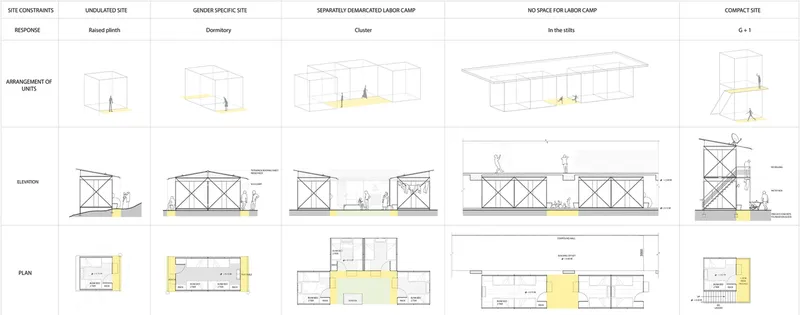
This comparison chart is the strongest argument for the system. It tests the unit against five site constraints, ranging from a raised plinth to stacked two-storey arrangements, with elevations and plans for each. Construction sites are rarely generous or predictable, so a fixed design would fail almost as soon as it arrived. The chart shows that the same kit of parts can lift off wet ground, pack into a narrow strip, or rise a second level when land is short.
This adaptability comes from three properties built into the steel frame. Units can be stacked for land efficiency, folded for transport and storage, and expanded to house either a single worker or a family. Each unit works independently, yet each is also designed to join a larger cluster. That dual role is what turns a shelter into the seed of a settlement.
Joinery Designed to Be Taken Apart
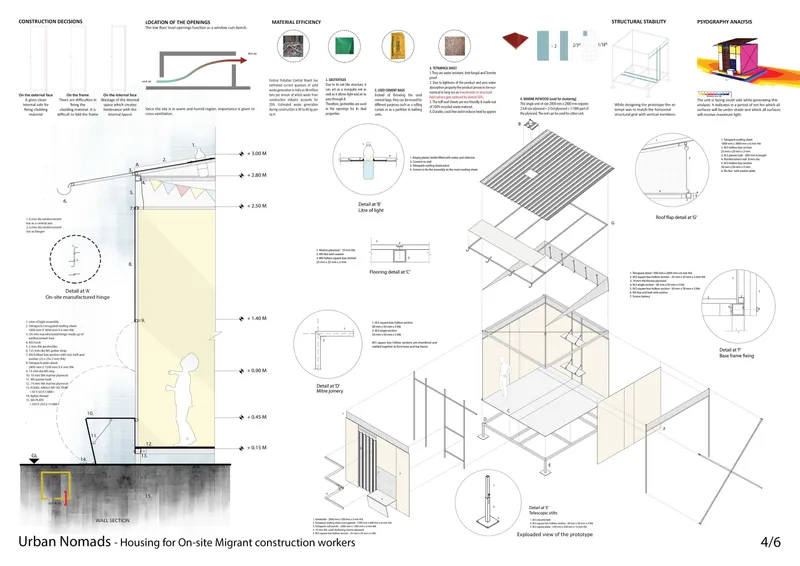
The exploded axonometric, wall section and joinery details explain how a reusable shelter actually holds together. In this kind of project the connections are the architecture. If the joints cannot be assembled quickly by the workers themselves and then taken apart without damage, the promise of reuse falls apart. The sheet's focus on details and material studies shows that Risbud understands this.
The material strategy supports the project's stated goals of shorter construction time and less waste. A frame that moves from one site to the next replaces the usual cycle of building a camp from scrap and then abandoning it. The leftover materials that once defined these camps give way to a system designed to outlast any single project.
From Unit to Neighbourhood: Day Care, Canteen and Clusters
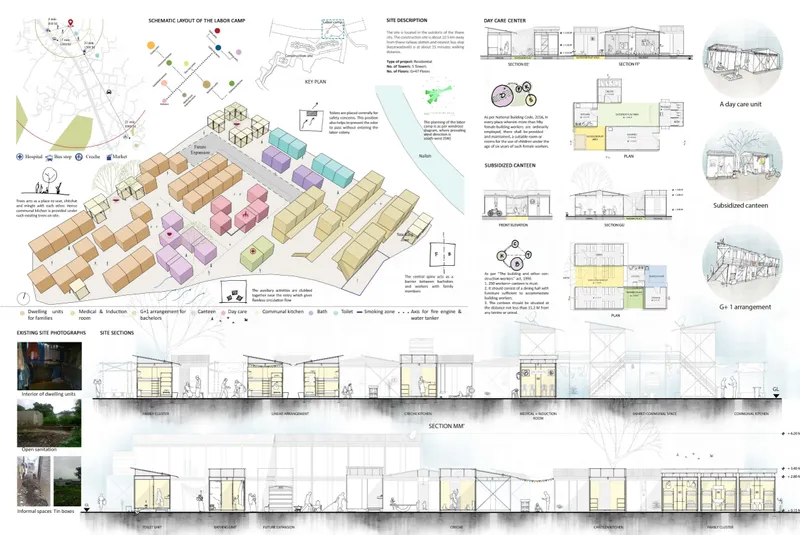
The site plan widens the view from the room to the camp as a whole. Colour-coded clusters of units are grouped around shared facilities, including a day care centre and a canteen, and site photographs anchor the proposal in real conditions. The day care centre is a telling inclusion. Migrant construction work often brings whole families to the site, and a plan that accounts for children recognises the camp as a place people live in, not just a dormitory for labour.
Arranging units in clusters also provides what the bare minimum of shelter cannot: a social structure. Shared spaces become places where residents gather and run their daily routines, and the grouping of units gives a sense of neighbourhood even on land that will be vacated once the building is finished.
Why This Project Matters
Urban Nomads takes on a building type that architecture almost never addresses: housing for the people who build everything else. Its central claim is that impermanence does not excuse poor design, and it makes that claim believable by staying modest. The project uses a steel frame, readily available materials, folding and stacking components, and a room planned around the human body. None of it relies on speculative technology, which makes it look more achievable than many more ambitious housing proposals.
The project's most valuable lesson is methodological. By studying jugaad closely and building it into the design, Risbud treats workers as skilled problem-solvers rather than passive recipients of aid. That respect shapes the outcome: a shelter people are likely to recognise, adapt and accept. For a city that keeps building upward, Urban Nomads makes a clear point. The dignity of a skyline begins with the dignity of the camp at its base.
View the Full Project
About the Designers
Designer: Aniket Risbud
Enter a Design Competition on uni.xyz
uni.xyz runs architecture and design competitions year-round that reward proposals with spatial conviction and real site intelligence.
Project credits: Urban Nomads- Housing for On-site Migrant Construction Workers" by Aniket Risbud.


Popular Articles
Popular articles from the community


Opera on the Sea: Driftwood Logic Shapes a Timber Opera House on Estonia's Coast
Trevor Orgill's opera house translates the entangled drift of floating timber into a civic building where wood, water, and music converge.

Extended Shell: Retrofitting Kolkata's Balconies as Living Urban Thresholds
A modular retrofit system recovers the social and environmental intelligence of Kolkata's historic verandas for contemporary Park Street residents.

Cloaked Colonization: A Mobile Underwater Habitat That Moves Like a Fish
Micah Abaya's shortlisted EHC Pacific entry reimagines ocean settlement as a dispersed network of self-sustaining architectural organisms.

Manzana Morphosis: Stretching Barcelona's Grid into a Living Landscape for 2050
A radical reworking of the Eixample manzana turns density into a tool for generous public space, vertical ecology, and environmental performance.

Similar Reads
You might also enjoy these articles

Maya Harvest: A Cacao Resort Village Rooted in Mayan Tradition and Local Craft
Situated within a Tabasco cacao plantation, this shortlisted resort proposal merges vernacular materials with hands-on cultural immersion.
Harmonia: A River-Shaped Community That Grows Over Decades in Boa Vista
Curved pathways and modular grid structures along the Branco River create a phased settlement designed to evolve from 2030 to 2050.

The Architecture of Bathing: A Mughal Hammam Reimagined Across the Yamuna
Charlotte May's honorable mention entry for The Black Taj reinterprets Agra's bathing rituals through red sandstone, water, and framed views of the Taj Mah
Om-1: A Wall-Hung System That Moves Your Workspace Off the Desk
Modular plywood boards, magnetic pegs, and utility elements migrate clutter from the horizontal surface to the vertical plane.

Explore Digital Nomad Housing Competitions
Discover active competitions in this discipline

Design challenge to equip cities with modern furniture

Packaging challenge - Design meets sustainability
Comments (0)
Please login or sign up to add comments
No comments yet. Be the first to comment!