
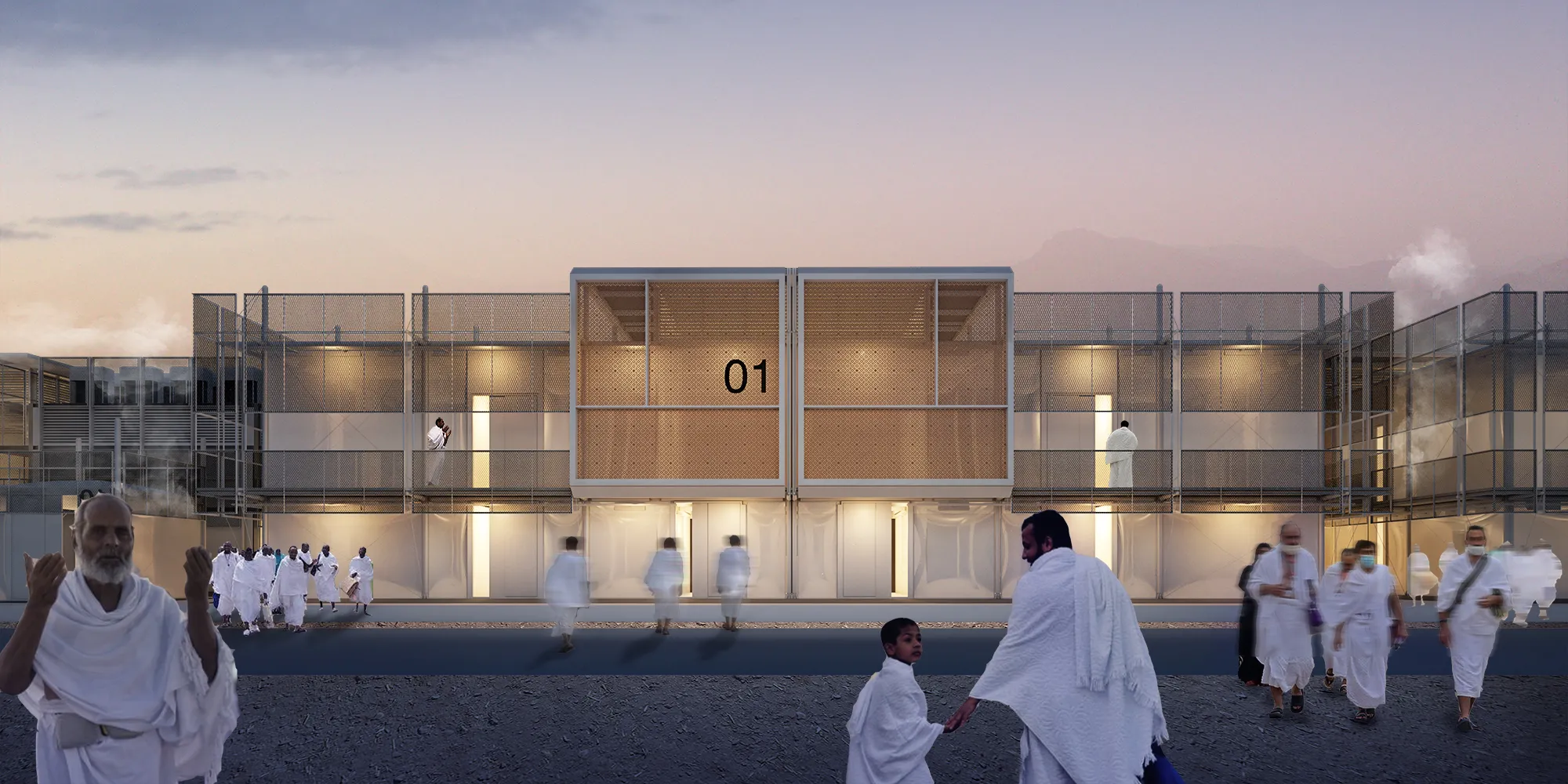
WADI MINA’S HOUSE OF RESPITE
Wadi Mina’s House of Respite offers comfortable lodgings for the pilgrim jamaah around the Day of Arafah and Jumrah stonings

Wadi Mina’s House of Respite suggests a reimagination of the tents in Mina as a temporary refuge for the pilgrims between the hajj rituals. Here each pilgrim is free to carry out their individual needs whether reconnecting with families, meeting with others, individual prayer, and internal reflection.
In relation to the hajj rituals, two crucial needs are recognized to directly influence Mina. On one hand, there is a need to increase the pilgrim capacity. Consequently, smooth incoming and outgoing movement of the pilgrims in and around Mina is becoming even more vital. Accordingly, four critical issues are uncovered. They are the impossible expansion of the tents horizontally, the management of the pilgrims in term of comfort, and hygiene, the iteration of fraternity among the pilgrims, and lastly the occupancy of the tents on and off season.
The idea of a refuge is further expanded from the three premises found: space, programme, and time. Spatially Mina sits within a valley to the east of Mecca, between the Ka’aba and Arafat hill. Popularly known as the Tent City, Mina is defined by its sprawling white tents with hills on its northern and southern sides. It is also bounded by the arterial expressways surrounding the area. Programmatically, Mina is the stopping place after the Day of Arafah and before tawaf. It is during this stop that the pilgrims will perform the stoning of the three jumrahs for 3 days. As the stoning took only some part of their daily time, the pilgrims tend to fill in their free time to meet with others, perform their own ibadah, or just to have a rest. Chronologically, the occupancy of Mina is determined by the hajj season. Its occupancy is marked by the massive movement into the Tent City after the Day of Arafah. Outside hajj season, Mina is relatively empty.
House of Respite proposed for lodging clusters each with two-storey steel framed and tensile membrane lodgings as the temporary accommodations for the pilgrims throughout their stop in Mina. These lightweight lodgings are supported by ancillary spaces - restrooms and retail/office building. This proposal adopted the concept of fractal-like fragments which can be found in one of the most celebrated architectural elements in the Arabian Peninsula: the mashrabiya. Concurrently, the concept is derived from the hajj ritual itself. Here, the fractals can be picked up from the nature of niyyah where the intention to submit to God through hajj is supplemented with a more personal aim like repentance. Fragments on the other hand can be picked up in the form of the various processions that make the hajj ritual.
The proposed programme for the site centres around the lodging clusters described previously. This clusters provides the necessary background activities to support the ancillary spaces. The aim is to provide comfort for the pilgrims as the current tents are densely occupied. Each cluster is made up of two 32m x 16m lodging quarters with one bathroom building, and two retail/office buildings. Each quarter is made of two 16m x 16m lodgings that house 132 beds. Including irregular clusters, the site therefore can accommodate around 4,500 persons. Adaptability in reflection of season is also applied in the scheme. The scheme works both on and off hajj season. Off season, the structures will be occupied by retail and upkeeping programme in preparation for the next season.
Strategically, the site is fragmented into 7 cluster of lodgings. This clusters are tied with a principal common space: the main thoroughfare. This thoroughfare is the main circulations cum socialising space. This separation via clusters allows for distribution of the pilgrims into different areas throughout the site therefore avoiding overcrowding. The composition of the clusters considered the existing orientation of the site. This is to avoid extensive groundworks while also conforming to the visual composition, and ancillary services provision of the existing Tent City. The pilgrim management is extended within the lodging where firstly, the structure is expanded vertically to further separate the pilgrims between ground and first floor. The increase of floor space allows for a lower density which increase the comfort inside the lodging. In addition, a musolla is provided within the lodging as a dedicated multipurpose space. The common space is also extended to the outside in the form of the connecting terraces, the secondary lanes, and the main thoroughfares. This is the reiteration of the fraternity which is already present in the Tent City. Structurally, lightweight and tensile system is utilised as the construction system. The advantages of this system include the ease of installation and dismantle in accordance with the programmatic needs. For instance, the occupancy difference during on and off hajj season. Rapid dry construction also allows for faster redevelopment of the Tent City. This is in parallel with the need of regular maintenance of the structures where easy access to the services space is crucial. These services system themselves are integrated within the structure. Among the crucial services are the water and waste system, air-conditioning system, and electrical system. Their ducting and conduits are run within the floor space for ease of access.


Popular Articles
Popular articles from the community


Co-Life: Senior Housing Design That Reconnects Older Adults With the City
Co-Life reimagines senior housing design through healing gardens, shared streets, workshops, and a sustainable community across generations.

Riyadh For All: Intergenerational Urban Design for Active Aging in Rabat
Riyadh For All reimagines urban design in Rabat with intergenerational co-living, adaptive courtyards, and Moroccan cultural exchange today.

Lunar Spiral: Space Architecture Shaped by the Mathematics of the Universe
Lunar Spiral reimagines space architecture through Fibonacci geometry, lunar regolith, levitating habitats, and self-sustaining Moon living.

Co-life: Sustainable Architecture for Age-Friendly Community Living
Co-life reimagines sustainable architecture for seniors through courtyards, rammed earth, shared gardens, and spaces designed for belonging.


Similar Reads
You might also enjoy these articles

The Rhythm of Seasons
A Farmers' Market Connecting Nature and the City

More Than a Building-Designing a Living System
More Than a Building-Designing a Living System
Base Beyond
DESERT COMPOUND ARID: TOURISM OF ABSENCE AND ABUNDANCE






Comments (0)
Please login or sign up to add comments
No comments yet. Be the first to comment!