
Russ Harding
Journals 1
MARS ROTOR
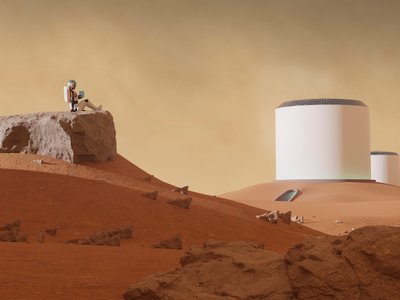
Humans evolved with Earth’s gravity and atmospheric conditions, adapting to anything else will take many generations. As we spread out from our home planet our basic biological needs and functions will remain the same - so replicating the conditions in which we evolved will be critical to sustaining civilisation away from home. Mars has 40% of Earth’s gravity and 1% of Earth’s atmosphere - however it’s proximity as well as the scientific and economic potential of the planet makes it one of mankind’s most promising first outposts, despite it’s inhospitable nature. As colonisation begins, many missions will spread out to different areas - some large outposts alongside many small scientific sites - and with the multi-year (likely permanent) nature of these missions, there will be a need for centralised rest, recuperation and coordination facilities, which provide more earth-like conditions and better amenities than possible with smaller mission-focussed scientific camps. Utilising the low gravity, near vacuum conditions, magnetically levitated spinning centrifuge habitats are able to recreate earth-like conditions, making them perfect for medical and time-off centres. Beginning as a generalised facility, as the population grows different habitats would begin to specialise their roles, for example pregnancy would very likely be problematic in micro-gravity; therefore a specialised midwife and early childhood habitat would give young Martians the best chance at growing up healthy in the conditions their biology is adapted to, from millions of years evolving on Earth. 3D printed out of carbon-fibre composites, contruction of the habitats could (through energy intensive processes like electrocatalysis) utilise the 95% Carbon Dioxide native Martian atmosphere to create Carbon and Oxygen - for building and life - meaning growth isn’t reliant on building supplies from Earth. The Rotors are located strategically between the bases of Valles Marineris and the Tharsis Uplands.