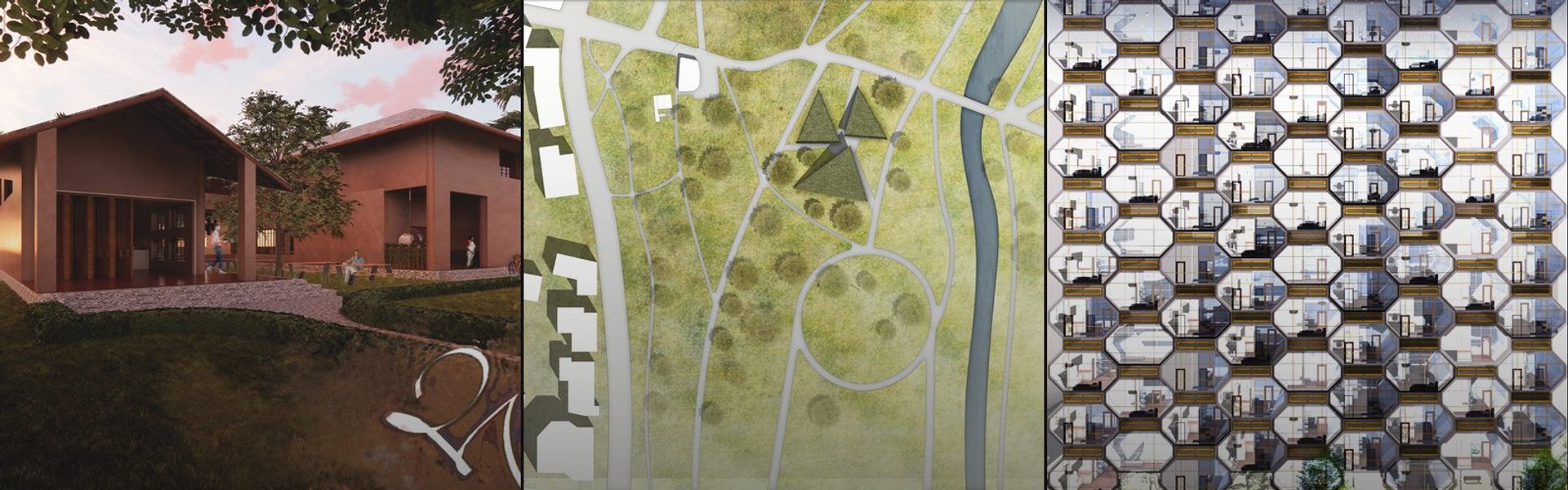

Residential Building
Residential building design exploring housing typologies, construction methods, and community-focused living spaces.

Living in today’s world has evolved beyond the basics of survival. Physical spaces are not merely the embodiment of technology anymore; they have become much more sophisticated and desirable. The upgrade to technology and smart homes is actually giving rise to a new class of design that is keeping the future of residential architecture competitive in the sense of adapting to current wants and needs. In rapidly changing conditions, residences have remained as one of the most malleable typologies in remote corners of our world. While housing caters towards well being and living of the overall community, residential architecture seeks to address issues of micro-living, space crisis in cities with the help of innovation in design thinking and cutting edge technology. A residential building explores the needs of individuals or a set of people. The building tries to provide spaces that are comfortable for those individuals and also manage the impact of a single dwelling in relation to its site, surroundings, and users. Img 1: The falling waters by Frank Lloyd Wright is one of the best examples of 21st-century residential building What is a residential building? "A residence" means having the character of a detached one-family or two-family dwelling or a multiple single-family dwelling that is not more than three stories high with separate means of egress, including the accessory structures of the dwelling, and that does not have the character of a facility used for the accommodation of transient guests or a structure in which medical, rehabilitative, or assisted living services are provided in connection with the occupancy of the structure. A residential building provides more than half of its floor area for dwelling purposes. It generally has sleeping accommodations, but not always either cooking or dining facilities. Some residences are occupied by individuals or families, while others are by institutions such as schools, prisons, naval bases, and other personal care homes. It is a common sight in urban areas all around the world, although may vary, however, vastly depending on whether it's a single-family home or some sort of multi-tiered apartment building. For example, some buildings are zoned for residential use only while others may be zoned to allow up to a certain number of commercial businesses; with the latter commonly consisting of grocery stores, pharmacies, and convenience marts offering various mixed-use services. Why are residences so important? A residence is referred to as a "place where you can be". However, housing plays an important role in economic opportunity for individuals and families. The benefits of owning your own house are very tangible, ranging from being able to keep your family together when you run into hard times etc., to having the resources for any future needs you might have. Img 2: A home is a place where you feel you belong, how can we as architects preserve this feeling with changing times? Research shows that housing unaffordability has been linked with poorer physical health, yet also with psychological health issues in the short term. The overall quality of the built environment has a direct impact on mental health and well-being in later stages of life, which is why neglecting or undermining the home lifestyle can have lasting effects over time on individuals and in a bigger picture on the collective society. What is residential architecture? Residential architecture is the process of designing and building residential, non-commercial properties and living spaces. The residential architecture includes everything from townhomes to mansions and everything in between. It can be modern or nostalgic. Urban or rural. Eccentric or simple. Anything! In a nutshell, residential architecture is all about capturing the needs and desires of the homeowner and translating these often obscure concepts into a real-life home of their dreams. On that note, it refers exclusively to the design and building of dwellings used specifically as residences/places for living as individuals or close families. How did the residential building evolve? The term "architecture" refers to the practices of designing and constructing buildings. With a very specific designation for residential architecture, in particular, this practice has evolved significantly over time - with increasing population, changing demand, and technological developments/advances residences have seen a significant change in nature. From owning a detached house/independent residence as a status symbol to opting for cheaper semi-detached homes people moved towards cities and industrial areas due to work and affordability. Img 3: Semi-detached homes provided cheaper rates and a feeling of owing an independent house As the population exploded, housing required was on the rise. The development that started during the industrial revolution brought in new opportunities and new challenges for people. This resulted in the growth of urban centres. New facilities such as health care facilities, recreational parks, and gardens attracted a lot of attention due to the growing population density. Transportation systems improved with railways and buses becoming the common mode of transportation. From the surrounding towns and villages, people began migrating to the city in search of jobs and a better life. As a result, there was a housing boom and an increase in apartment construction. Apartments could house a minimum of two families on a single floor, whether it was a walk-up apartment or a mid-rise apartment. Later on, skyscrapers were constructed along with high rise apartments. Skyscrapers were built using much more advanced technology than high rise structures. As a result, residential buildings have evolved and transitioned into housing and skyscrapers as a distinct typology. The common types of structures that can be defined as residential buildings today are: Img 4: Building categories for residential building As part of firms or government organizations, residential architects concentrate on designing and building individual living spaces. They may work alone, for a contractor, or in collaboration with other residential architects. Clients and client needs differ from one another, and those looking to make a living as a residential architect should be accommodating of this fact. Finally, a residential architect or residential architecture firm will deliver a product that is stylish, safe, and functional; one that follows local residential building codes while catering specifically to specifications and aesthetic preferences. Based on data provided by the US Census Bureau, new construction of homes has been consistently decreasing every year since 2011 to a low of 483,000. After hitting rock bottom in 2011, new construction increased every year through 2021 where it reached a high of 765,066. Demands are increasing but so is the need for housing creating a boom for housing complexes as well as private residences, but it's also raising an issue about how this may be impacting our environment due to the large number of resources needed to create these buildings. How can we as creators, students and designers overcome this issue? How can we put our ideas through a channel that keeps volumes but also doesn't disappear in emerging real issues? Architecture Competitions Architecture contests have a long history, dating back over 2,500 years. Several cathedrals throughout the Middle Ages, as well as the Acropolis in Athens, were built as a result of design competitions around 448 B.C. Many of the Church's efforts during the Renaissance were decided through design competitions in which all kinds of artists brought their varied talents to build up something grand in every sense of that word. In recent times an architectural competition form has taken on many forms. One form is a design challenge in which a company or the government planning to build a new structure invites architects to submit designs and plans. Architectural competitions are a great way to find creative design enthusiasts who not only have the relevant skills for designing and developing your project but who also share your vision regarding the problems affecting our society today. Types of architecture competitions: -Competitions that are open to all (international, national, or regional) -Competitions for projects or for ideas: based on whether the intention is to build the project or to generate new ideas. -Anonymous or cooperative procedures: anonymity supports greater objectivity during the evaluation and award-granting deliberations. -Student or institute design competitions (held on university/state/country level for individual or group of students only) Which were/are the popular competitions for residential buildings? Residential architecture is the basic framework of the built environment today. There is a constant upgrade and change in lifestyles and issues related to it. With the ongoing global crisis in climate and increasing population, architects have been striving to develop living technologies and designs that would make living comfortable as well as mitigate existing urban issues gradually. • Building a Martian House • ArcAce's Tiny House Community • Mobitecture • House on Ile d'Oleron • Prefab 2030 Img 5: Mobitecture winner, 2121: A Sky Nomad (Credits- Wai Hing Wong, Chen Huang & Sam Iwas) • The Tiny House 2021 • White House Challenge • Home 2021 • Nano nest Img 6: Nano Nest- Honorable mention (Credits- James Ingram) • Ryterna module Architectural challenge 2021: Tiny House • Treehouse 2021 • Home Futura • Quarantine Pod 2021 • Vancouver affordable housing challenge • New York affordable housing challenge Img 7: Home Futura Editor's Choice-The Exodus • Virtual Home • Hollywood: The last house on Mulholland • Encamp • NomadHouse • Dwell One • Residence Rush • Squared Up Explore more projects in residential architecture: UNI Design Competitions UNI is a global network of architects and designers who are solving some of the most challenging problems around the globe. UNI brings together the world's largest pool of design challenges that are curated by the finest architecture academicians and professionals globally. Since 2017, UNI has hosted more than 200+ architecture competitions for various idea level to realization level briefs. In the past, UNI has helped 50+ organizations, universities, and government bodies to use our platform to generate architecture and design solutions through competitions. Explore current challenges that explore residential architecture: Discover other competitions: https://uni.xyz/competitions