
Architecture on the Clock
Architecture with time
Overview
Survival of man-made artefacts
Only a few man-made artefacts/ forms/ organisations survive several decades or even millennia. Most of these are not built with the intent of longevity but are mostly accidents of time and history.
Often defined by constant change, buildings thrive for expansive spans of time, contents within them evolving and adapting to the needs of the time, playing a key role in the community until it can no longer turn over to serve a purpose. Eventually leading to its dysfunction.
Decay of built architectural forms
But why do we rely on accidents to evade the long drawn out decay of built forms?
What crucial factors are we missing in order to be able to make this architecture decision ourselves? What elements are we ignoring that would act as a catalyst to extend the lifeline of a building? Are all elements that contribute to successful design entirely tangible?
Consider ‘time’. Society always functions in flux. Consider constantly evolving ‘user needs’. Think about how all three of these interact to define built forms. Look into how programmes are designed and outlined. Why is it that we focus so much on the now, that we do not stop to maybe think that even the tiniest user function or need might change? Why do we skimp on even the least bit of space to change?
Examples of rebuilding heritage
Serving as one of the oldest examples, the Parthenon was originally built to be a temple, but over the course of its 2500 year history, has assumed the role of a treasury, a church, a cathedral and a mosque, in addition to serving as an army barrack and a storehouse for ammunition before it became the tourist attraction it is today. In context is another great icon of the 20th Century.
Designed as an ‘evolving spatial diagram’, the Centre Pompidou, is heralded for its ability to free up indoor space, with each of its seven 500 m2 floors being entirely uninterrupted by load-bearing structures, and its ability to be divided up and reorganised at will, ensuring maximum flexibility.
Another example of such architecture is the Ise Grand Shrine of Japan, estimated to be around 2,000 years old, it is rebuilt every 20 years, upholding the Shinto belief of the death and renewal of nature and the impermanence of all things. The shrine itself has evolved over the years, all the while managing to keep its essence including traditional construction techniques.
Design Challenge: Architecture awards
Understanding how multiple factors contribute to the longevity of a built form, and how not all of them might be tangible, change and time come into focus. Hiding in plain sight, time and change don't come one without the other. Slow to begin and then all at once, change shifts and transforms, clear only in ways that only a time-lapse spanning a decade could unfold. Simultaneously navigating the grasp of time and architecture changes are constantly evolving with societies, user needs and functions. Like change and time, the act of learning is something that remains constant.
Design Challenge: The awards are to develop an architectural concept that encapsulates the existence of a building as a process - in a case example of a skills development centre.
Area Programme
Learning 70%
- Classrooms
- Outdoor learning spaces
- Learning studios
- Collaborative learning spaces
- Workshops and libraries
Community 20%
- Performance spaces
- Informal learning spaces
- Recreational and social spaces
Services 10%
- Washrooms
- Kitchen
- Dining spaces
- Parking
- Landscaping
- Miscellaneous
The programme of the Skill Development Centre must include the above mandatorily. However, the participants are free to add other architecture programmatic facilities depending on their design.
Objectives
- Life cycle: Conceiving a holistic approach of how building, would exist 30 years into the future.
- Adaptive: How sections of or an entire building would change from the inside, out.
- Materiality and Aging: Comprehending how buildings, surfaces and materials age.
- Open-ended: Comprehending constantly evolving user needs and behaviour patterns.
The following objectives can be a point of beginning to conceive this architecture awards. Participants can assume their own contexts and users before initiating their design process.
Site
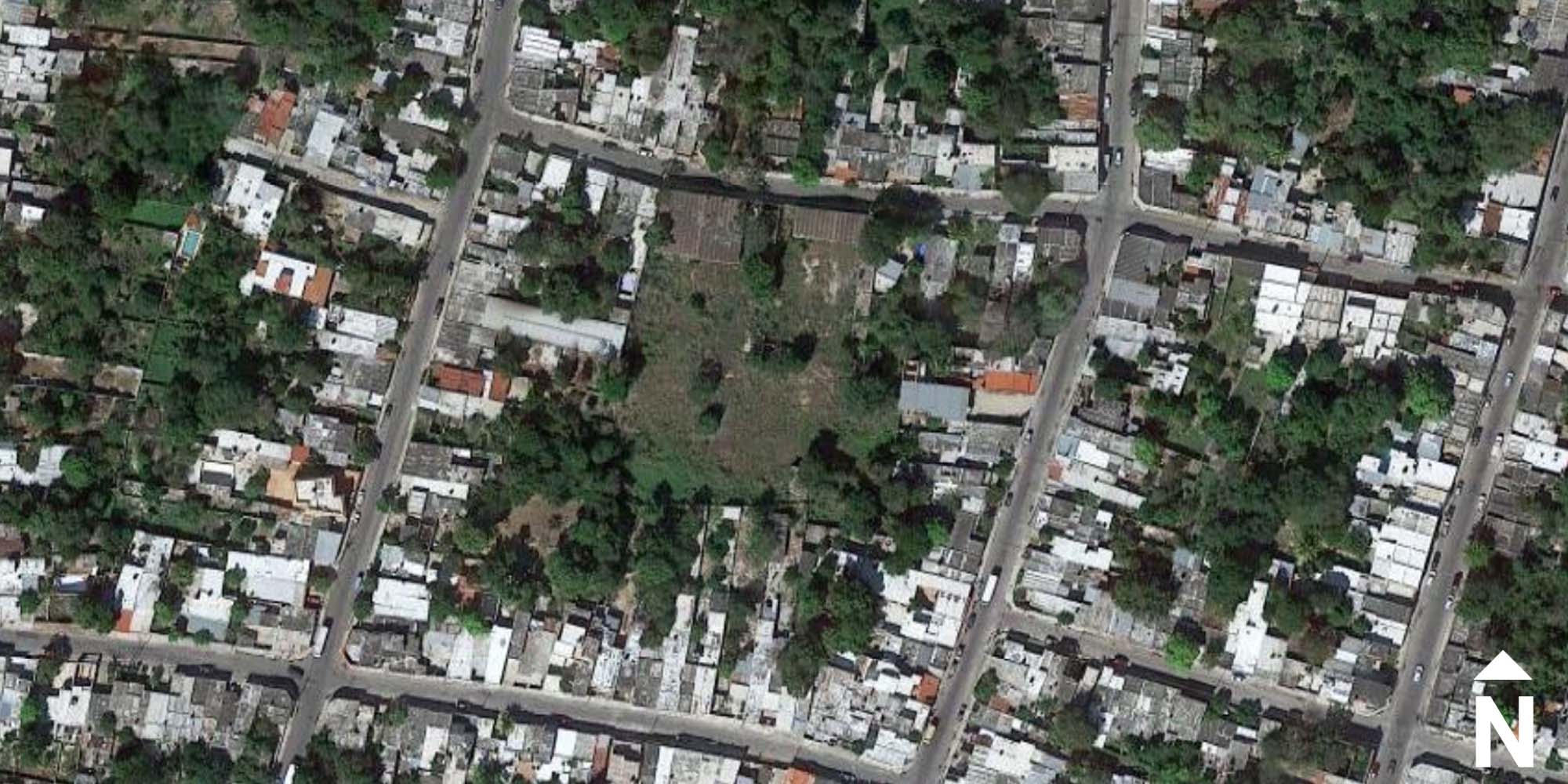
- Mérida, Yucatan, Mexico
- Site area: 8892 sqm
- Height restriction: 3m
- Site coordinates: 20°57'07.4"N 89°37'42.4"W
The State Capital of the Yucatan Peninsula, Merida is a prime location for economic growth and investment (seen by the Yucatan state economy growing at three times the national average). However, the rapid influx of population into the city due to the increase in economic activity has led to unplanned and unchecked development.
Urban poverty and an uneven distribution of resources and services can be seen in certain pockets of the city. Traditionally having been isolated from the rest of the country by geography, creating a culture unique to the region, today Merida is also the Cultural Capital, an active hub of cultural centres, museums, art galleries, restaurants, movie theatres, shopping malls, and leisure facilities.
5. 4 Km from the International Airport (Aeropuerto Internacional de Mérida Manuel Crescencio Rejón), the site is in the heart of Merida - the Centenario, one of the most expansive historical centres in the Americas. The neighbourhoods of Mérida, much like the rest of the region has managed to retain their Mayan, Spanish, French, British, Lebanese roots and is home to the highest percentage of indigenous population within any large city in Mexico.
Judging Criteria
The architecture entries will be judged by an international jury of the competition on the following criteria:
- Presentation: The fundamental to a good entry is a visual delivery of ideas.
- Concept/Idea: Quality of thought and intent in the pre-design phase.
- Programme/Spaces: How the spaces are conceived along with the programme.
- Design Outcome: The final architectural outcome of the solution.
The judging panel can also add other criteria based on their internal discussions - which will be in line with the problem statement. Participants are advised to fulfil above given criteria first in their design. Names of the jury panel will be announced soon.
The decision of the Judges Panel is final, no appeals will be entertained and no further correspondence shall be entered into.
Please note that the jury scores are NOT affected by the number of likes on a project. Every submission is evaluated based on the judging criteria. However, ‘Likes’ play a role in determining the People’s Choice Awards.
Curator
Architect: Ludwig Godefroy Architecture, Mexico
Graduated from the school of architecture de la ville et des territoires - marne la vallée , Paris 2004 : Leeser Architecture - New York 2005 : EMBT, Enric Miralles Benedetta Tagliabue - Barcelona 2007 : Rem Koolhaas OMA - Rotterdam 2008 : Tatiana Bilbao - Mexico 2011 : Ludwig Godefroy Architecture Ludwig Godefroy has worked on many architecture projects across the world.
It seems to me that it introduces an important and essential subjectivity subject, appropriate to everyone, where concordance is an extraordinary meeting point between things, a source of surprise, and for me very often a starting point to start a project. A concordance is something personal, but without being too intimate to prevent sharing. It is according to me, what makes a work of architecture unique, according to its sensitivity, its curiosity, its emotions and also its history.
It is difficult to define concordance, it can be a similarity, a correspondence, a resonance, an identification, a relationship, even synchronicity. I think that the most important thing for me, is that it works from the level of intuition, that way I don't know why I arrived in Mexico, the only thing I know is because I have not left Mexico; simply because I achieved an agreement with this country with which I have developed a tender and loving bond.
Similar Competitions
Discover competitions you might be interested in




Design challenge to reuse E-waste

Illustrate the lost glory of Angkor Wat - Render Challenge

Photograph architecture without architects


Challenge to reimagine the Iron Throne

