

BeeGraphy Computational Design Awards '26
From Logic to Configurators
MATHEMATICAL FORMS & VISUAL COMPUTATION
This challenge invites designers to explore mathematics as a visual and spatial language through parametric systems. Set within a small gallery in Zurich - where clarity, rigor, and intellectual precision are central. The brief focuses on designing a physical installation that makes mathematical relationships perceptible through form.
Rather than illustrating mathematics literally, participants are encouraged to develop a math-driven parametric visual system in which equations, functions, or rule-based logic directly generate geometry and variation. The system may be rooted in fundamental mathematical operations such as arrays, attractors, repetition, or transformation, or use techniques like image sampling to translate data or images into spatial form. The emphasis is on revealing structure, logic, and dependency through visible transformation.
 Parametric paper installation visualising mathematical flow and transformation - Flight Gallery Installation by INCLUME
Your Task
Design one fabrication-ready, math-driven parametric system for a physical gallery installation, where clear mathematical logic directly generates geometry and visible variation. The system should translate equations or rules into buildable form while remaining adaptable through parameters.
The system can be spatial, planar, or volumetric, designed within a virtual canvas equivalent to 1.5 m × 1.5 m x 1.5 m, with parameters that produce clearly visible changes in form.
What we’re looking for?
We are looking for math-driven parametric systems where a clearly defined mathematical or computational rule directly generates form and variation. The relationship between logic and geometry should remain legible and consistent, revealing structure rather than obscuring it.
Submissions should demonstrate:
-
Strong exploration of a single mathematical idea, investigated deeply rather than broadly
-
Thoughtful use of variation to explore outcomes, not decorative complexity
-
Visual restraint and compositional balance appropriate for a gallery setting
-
The ability to generate multiple distinct outcomes while preserving a clear identity
-
Conceptual clarity in how the system communicates mathematical relationships
Design Criteria
Your design outputs must demonstrate:
-
Precise translation of mathematical or computational logic into geometry
-
Consistent system behavior across parameter changes
-
Clear and well-structured parameter organization using BeeGraphy
Examples to Inspire
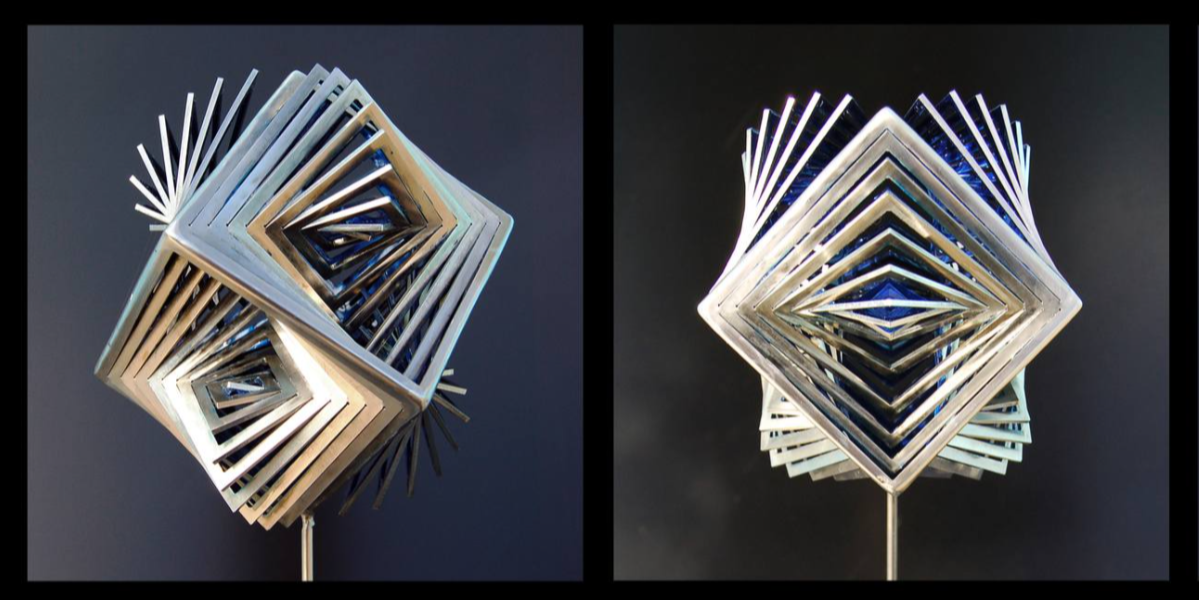 Kinetic square sculpture exploring rotational symmetry - Velvet Meanders by MARK ASPINALL
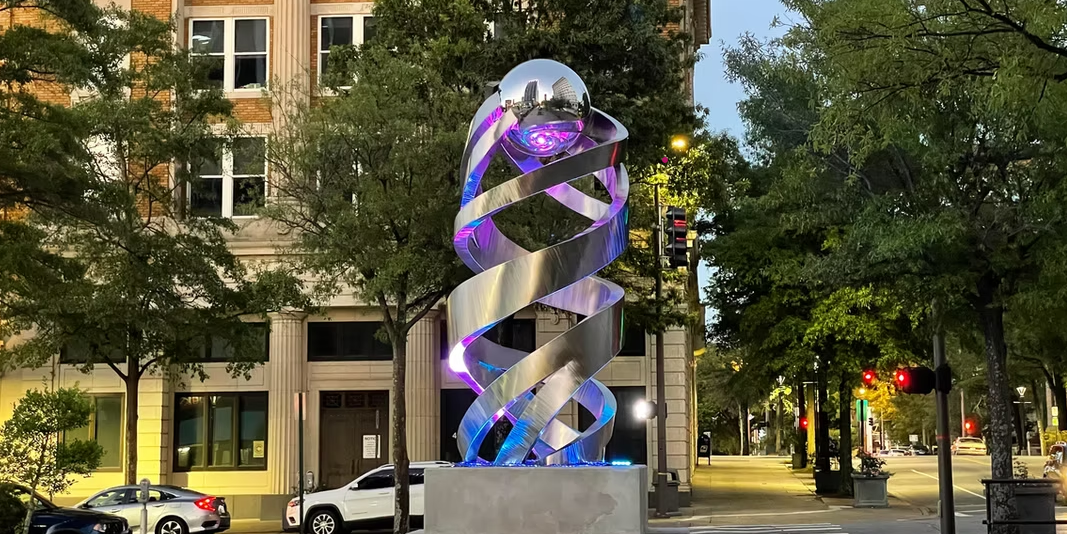 Stainless-steel helix rising around a mirrored sphere - Helios by HUNTER BROWN
Fractal geometry deployed as a market-ready system - ENDLESS COLUMN
These are references, not limits.
What to avoid?
- Decorative elements with weak mathematical grounding
- Systems where math is hidden rather than expressed in form or shape

