
Retro - Fit
Retro-fit balcony module design challenge for future intervention
OVERVIEW
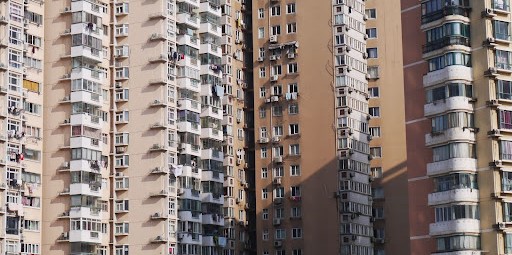 Fig: 1 - Urban density housing in metropolitan city
REPLICATION
A rapidly densifying urban sprawl and the need to house an ever-increasing population have led to an explosion of mass housing schemata. The housing tower sought vertical growth due to a severe shortage of land resources to accommodate said housing. As a result, the modern housing tower has become a collection of several replicated dwelling units, stacked vertically over one another.
Such replication: the one plan principle in housing has often resulted in the element of individuality being taken away from the resident of the house. The process of owning a house has thus transformed into a series of compromises for many dwelling in urban settlements rather than aspirations being met. Primary among those is the compromise of space.
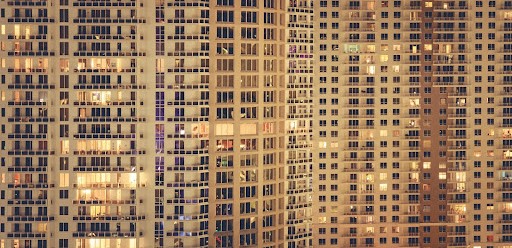 Fig: 2 - An image represent the example of layers on a building in urban cities
URBAN RETRO-FIT
The city that we see around us no longer comprises a single stock of the built and unbuilt. It exists in layers and strata. These layers added by the users to the bare built form owing to improperly planned (or unplanned) provisions and lack of space inside the dwelling unit are called Urban Retrofits. These broadly include AC units and webs of pipes and ducts we often see outside buildings. Along with the built form, they are reflective of the city’s character just as much, if not more.
Precast construction technology has now slowly become more commonplace, helping to achieve the economy of construction, time and cost. As a response to the growing problems of modern-day housing specified before, several building elements can now thus be “retro”-fit over existing homes. Apart from enabling the resident to acquire such provisions economically, this also enables the user to exercise a degree of additional control over his home, apart from the basic unit sold to him. The balcony is now one such element.
 Img 3: An illustrative graphic of a balcony on a highrise in a megacity.
BALCONY
As a space, a balcony is used for leisure, for services, as an elaborate vegetal container, a thermal break between the interior and exterior, and as a potent element impacting the elevation design of the building. Depending upon their size, they can be used to host several people for small gatherings or to serve as a perfectly intimate space for residents to engage with their immediate surroundings, or work. More so, vegetated balconies are even capable of forming their own microclimates. Yet still, the notions with respect to what a balcony represents in a home, how it is constructed and how it is installed have remained more or less the same since the industrial age.
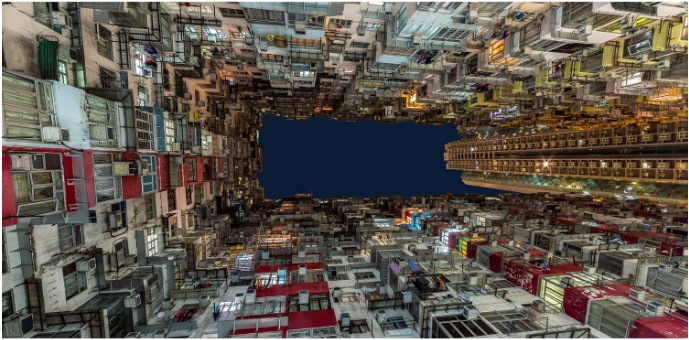 Fig: 4 - A dense housing cluster in Hong Kong with closely packed units.
ISSUES
- A good number of housing buildings curl unto themselves and have uneasy corners, rendering them unfit for the provision of conventionally planned balconies. Furthermore, a balcony is a rather necessary space attached to a room, an essential link between a room and its immediate exterior. For most residents, that can’t be foregone, can’t be substituted by mere view windows. However, it has now been commoditized as a luxury that homeowners have to pay extra for.
- Another issue is that with the modest housing unit shrinking, people often encroach balconies to enlarge the space available to them within the home.
- A contiguous RCC balcony is also one of the major sources of gain of warmth and coolth into the primary slab of the building, thus altering interior regulated temperatures if unshaded.
- As a building element, it is also consequential in enabling the resident to personalise his own extended space and exercise a degree of control. In many ways, the balcony inspires intervention. Housing constraints today, however, seem to have taken that away from the user.
- The primary issue however remains a lack of space in the balcony to carry out all the functions that it’s essentially designed for. It thereby becomes essential to re-imagine fundamentals when it comes to the design of the conventional balcony.
The question seemed to be asked here is: Can a Balcony in a house be more, mean more, and be less work for the homeowner himself?
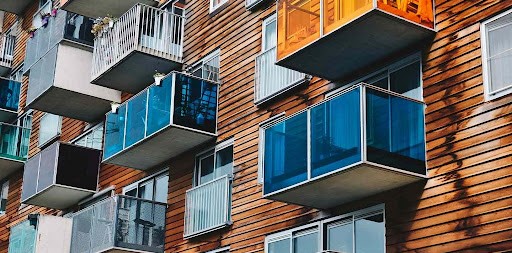 Fig: 5 - An image illustrative of the volumes of intervention in a building with stacked balconies.
BRIEF OF THE COMPETITION
The challenge is to design and detail a retrofit balcony module that can be readily attached to both new and old structures.
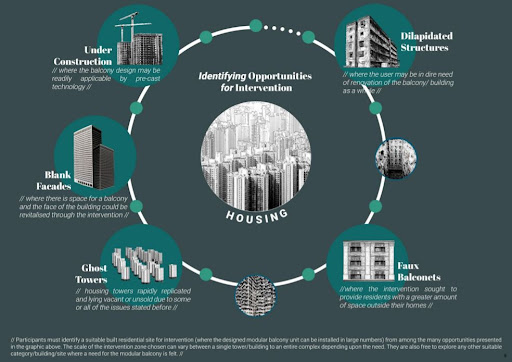
Participants must also choose an existing built residential site where they wish to apply this retrofit intervention.
The design of the prototype balcony must reflect how it attempts to solve some or all of the issues stated previously and more. It should push the boundaries of the utilities that we can derive from such a small ancillary space in a home, while at the same time tending to the elevational aspects of the site of intervention chosen.
While rethinking the essential purpose of balconies and deriving more out of them to be made increasingly accessible and affordable, the design must be proposed as a kit of parts rather than a monolithic intervention. The design must incorporate a DIY aspect in terms of upgrades/add-ons allowing residents to partly engage in its application.
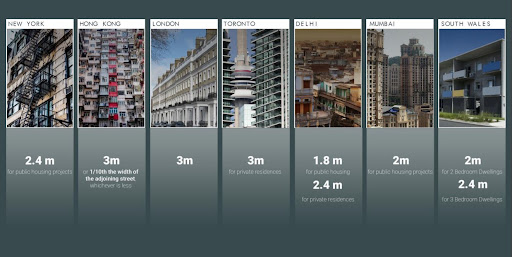 Img 6: Infographic for statutory restrictions on balcony depths in major cities across the world
ARRIVING AT THE MODULE FOR INTERVENTION
The balcony as a building element has a number of regulations that it must adhere to with respect to its design in order to ensure structural and occupant safety. While all of these cities have close to no restrictions on the length of the balcony allowed outside homes, for both public and private projects, the depth of the cantilever is limited to the above numbers to avoid encroachment and tension in the structure. This data regarding legal regulations in some major cities across the world forms the basis for the selection of the size of the module fit for intervention.
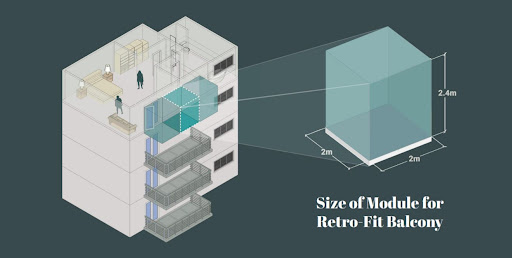 Img 7: The size of the module for designing the retro-fit balcony. The housing building shown on the left is purely significatory in nature, showing the modular application of the retro-fit unit
MODULE
Participants are required to design the retrofit balcony intervention in an adaptive volume/module of 2m x 2m x 2.4m.
A further temporary horizontal extension of 300 mm is allowed for other purposes including shader, planters, drying rods etc. The design must also incorporate an aspect of safety, in the form of railings, parapets etc to ensure occupant safety. The design of the railing is left entirely to the participants, and as a response to the context of the site of intervention chosen.
OBJECTIVES
- Efficiency: The effort should be concentrated towards deriving the maximum utility out of a limited volume of space.
- Feasibility: The design should be constructionally and structurally sound and feasible.
- Material Suitability: The prototype must be composed of appropriate materials, derived from context and based on structural needs.
- The multiplicity of Uses: The design must look to redefine pre-ordained notions of what a balcony is used for.
- Modularity: The design must be scalable to multiple dimensions and constraints.
- Durability: In addition to being feasible, the intervention must be durable in the face of external conditions.
The following objectives can be a point of beginning to conceive this design. Participants can assume their own users before initiating their design process. However, the context must be derived from the site chosen for intervention.
Similar Competitions
Discover competitions you might be interested in




Challenge to design an open learning module for the elderly


Challenge to design a portable music platform


Challenge to design a portable theatre


The Global Benchmark for Architecture Dissertation Awards
