
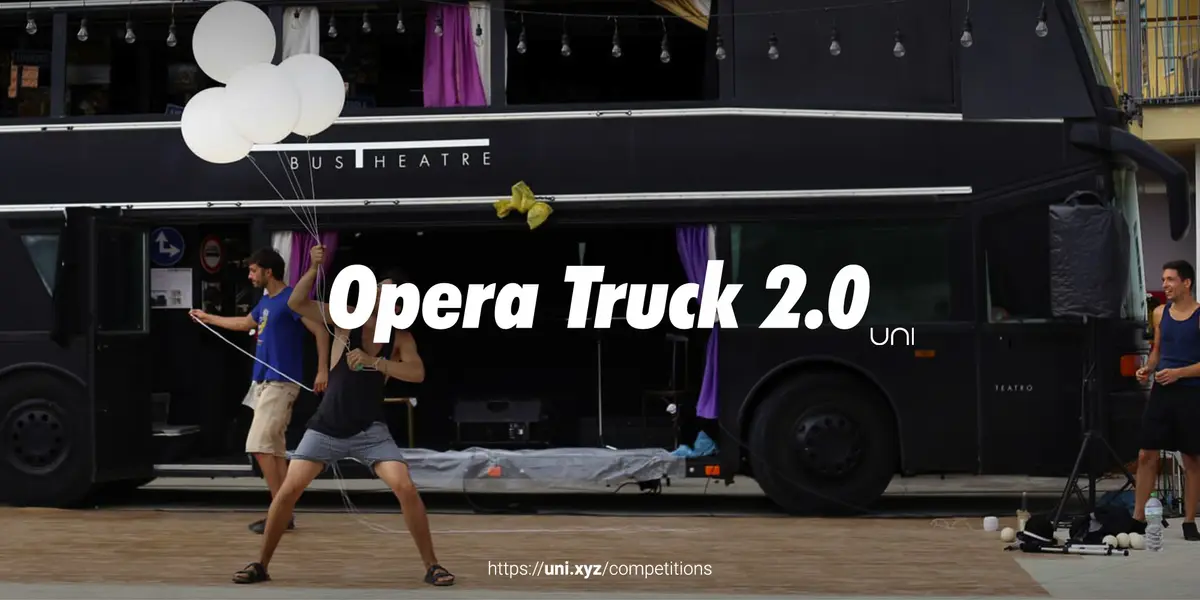
Opera Truck 2.0
Challenge to design a portable theatre
Announcement
- Check the previous edition of Opera Truck 2020
Overview
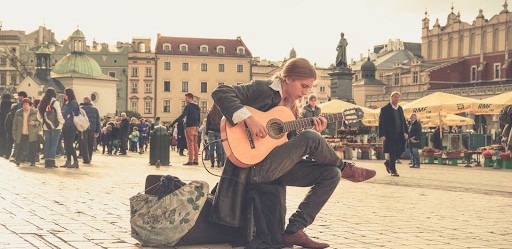 Fig: 1 - An artist performing on the street
DIFFERENT IDENTITIES OF ART
Art is a repository of a society’s collective memory; it tends to preserve what historical facts cannot. It is a form of representation of culture and tradition in the most lucid form and acts as a visual language that speaks to all. It has become a chronicle that has created different identities for itself, namely, visual, performing, and written.
Art creates ocular stories that cannot be divorced from its cultural implications and must be embraced. It has the power to awaken all your senses and convert them into ideas. It has been shaping society and culture subconsciously from times unknown. Art’s transition from utilitarian purposes and aesthetics into works of expression happened hundreds of years after its birth. Where is it now?
Art is the fundamental form of representation yet it is unnoticed, at the comfort of our screens there is a visual barrier that deprives us of its actual flavour.
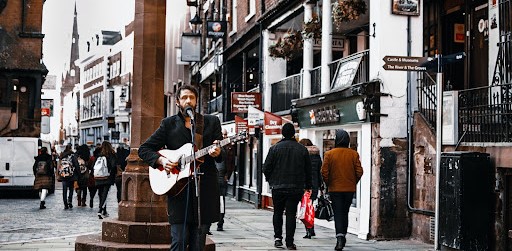 Fig: 2 - A singer performing while no one noticed
ART IN LIFE?
Art as a symbol of expression has been voicing society’s opinions and grievances and has been present through wars and victories. Today, tables have turned and art is restricted to reach only a handful who have developed an interest by virtue.
Although art has made its presence through digital media and has taken various roles (in the form of visual, performing, and written arts) and built a virtual relationship, there is a disconnect that exists.
This gap has been aggravated by limited accessibility and the unavailability of art everywhere. Lack of direct interaction opportunity with performing arts and the cost restrictions that accompany when one wishes to experience a live performance in a theatre has diminished the association we shared with art.
Will this ever change?
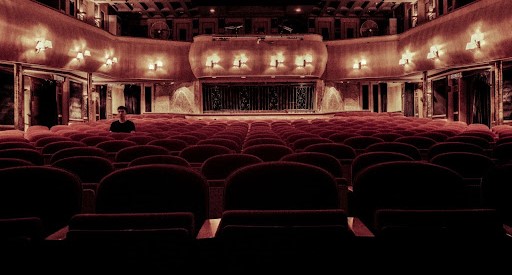 Fig: 3 - Nowadays theatre loses its public - Losing interest
RE-ESTABLISHING CONNECTION WITH ART
Enjoying any form of art sounds implausible to a large number of people who have never experienced art physically or found an opportunity to build a relationship. From an artist’s perspective, pursuing any form of art as their means of livelihood for sustenance is a far-fetched dream.
Entertainers, dancers, painters, and street artists use open public spaces for their performances. They have enabled the option of an exclusive form of interaction for the audience by offering art as an experience and expression. They have challenged the antiquated form of displaying art only in theatres by their performance. Their reach is bound by a lack of infrastructural support on performance locations or the disengagement of spectators with art.
Can we as designers suggest an alternative to house such artists by giving them an open platform to explore their potential? Can this intervention help re-establish the disconnect of people with art?
If art is the pinnacle of expression, then why is it understood by only a few?
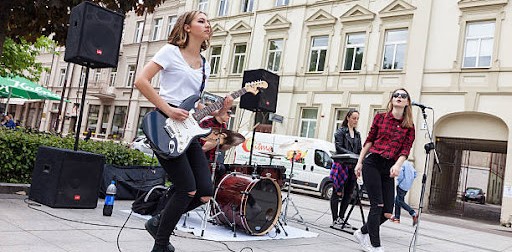 Fig: 4 - A performer needs not a bigger stage
THEATRE EXPERIENCE AT A LESS PRICE
Art is timeless. However, the mediums to show art in the physical realm are quite outdated. Theatres helped in the past in a generation when television and the internet were yet to gain traction. In today’s world if people are not coming to view art (because of many factors), can’t art forms reach out to people? Can architecture and technology help us to reach our audiences in a way that appeals to today’s age?
The idea behind this design is to bring a theatre-like experience to the streets at a very tiny price as well as at the convenience of the artist/performer.
This problem takes inspiration from street artists and equips them with an instantly available theatre to showcase their art and talent on the streets of Madrid.
The challenge here is to design a shared portable theatre box for a group of street artists.
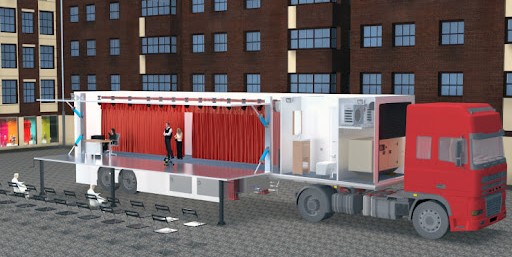 Fig: 5 - A portable stage-A concept
OBJECTIVES
- Mobile: Design should follow principles of portability, ergonomics, and mobility
- Flexible and Expandable: The device must be Expandable enough to be placed in any public plaza across the city.
- Technology: Integrate new mediums of technology and visualization in the opera truck.
- Adaptive: The opera truck should be flexible enough to accommodate the needs of diverse kinds of artists (painters, musicians, entertainers, etc.)
The Operatruck is conceived to be an all-inclusive setup of what an artist should need for performance, be it lights, speakers, props, backdrops, seats, modern visualization equipment, etc.
The portable theatre box has to be compact in nature, keeping in mind ease of movement through streets/urbanscapes or while being towed by a car. The artist’s setup designed is not conceived as a place for living for the artists, but as portable theatre only.
SCALE
The design site is conceived as a volume of which finds its maximum shape by fitting in the dimension of portability and vehicular movement around the city. This makes the opera truck a universally possible concept for artists all around the world. The height is restricted at 5m, but participants may consider a variety of uses when put in different locations, and multiple configurations.
- In Mobile State: Maximum permissible covered area should be a maximum of 20 sq. mt with a minimum corresponding volume, excluding the operational area required for driving/navigation and other technical/service needs.
- In Static State: Total covered area used for stretchability/expandability should not exceed 25 sq. mt
Participants can begin from a single plaza of a generic urban space to kickstart the design process and take inspiration in design through the context of this city. The design outcome can communicate to the urban scenarios of the world as well.
