
Salut Paris
Reclaiming the urban voids into public space of Paris
OVERVIEW
Paris

Img 1: Map of Paris, 17th Century.
Paris, the capital of France has been inhabited since the beginning of the 3rd Century BC along the banks of river Seine. It started as the hub of a trading center which eventually led to its growth as a metropolis.
Romans settled in Paris around the 5th Century BC and placed their origins in the town of Parisius. During the 13th and 14th Centuries in the reign of Philip II, it was improvised extensively. Streets were paved, the city wall was enlarged, and a number of new towns were enfranchised. Throughout the middle ages, Paris was ruled by a number of French rulers who added to its landmark (Notre Dame, Louvre Fortress, Palais de la Cité etc) and built new mansions for the nobility.
By mid 18th Century, it became densely populated with a cityscape that had not changed since the middle ages. Napoleon III hired Hausmann for one of the largest urban transformations. Consequently, he built the first transport network encircling Paris, transforming it from a medieval town to an industrial centre of the 19th Century.
Network

Img 2: Aerial view of Paris
This railway network, known as Petite Ceinture, initially made for transporting goods, functioned for over 70 years (1862 to 1934), making a tremendous impact on the development of industry during this course. The urban renovation that was done by Haussmann was not only to cater to the huge influx of population but also to make Paris a flourishing industrial town.
As technology and demand grew, the Paris government laid the foundation for “Paris Metro” in 1898 and the first metro began by the year 1900. It gave the residents a better civic life and built a new layer of transportation lattice, enhancing mobility within the city’s inner districts. It resolved the deadlock of traffic congestion and overcrowding.
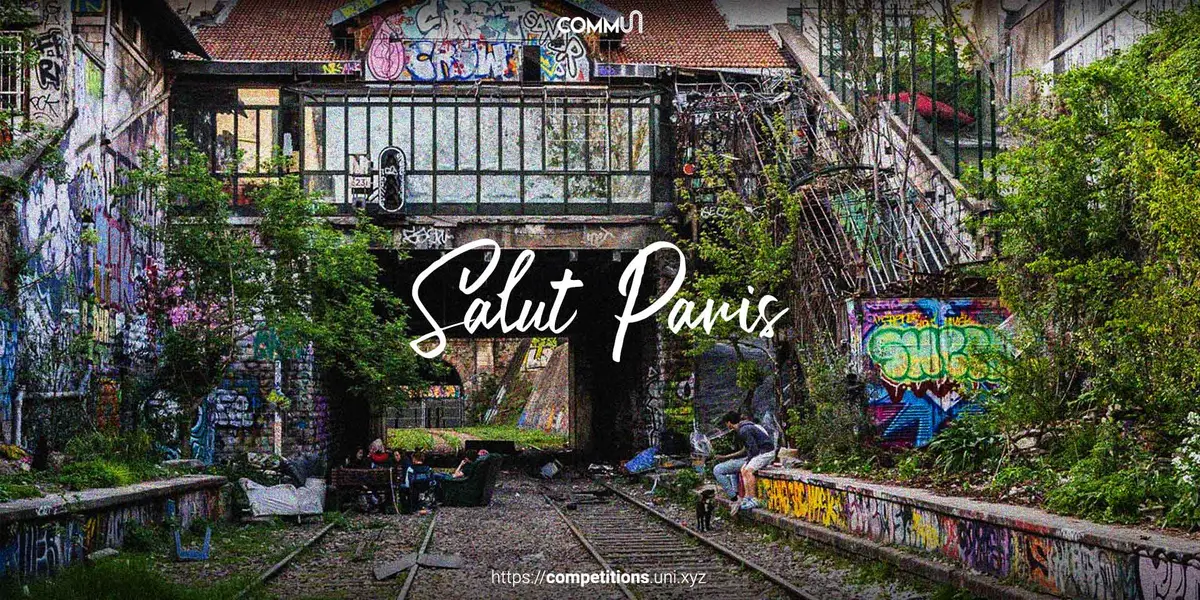
During the overlap of a better urban transportation network, the existing railway line Petite Ceinture encircling the city became defunct as people opted for a faster option. and by the year 1934, it was officially shut. It turned the railway line space and stations into urban voids. Hence, they became an eyesore, until the people and the government started intervening to repurpose them.
Issue
The tracks and stations of Petite Ceinture which once formed a part of the city fabric are now left with its mere traces and long-abandoned spaces. With time, these were hidden by plantation and is now an overgrown vestige. Soon the people acknowledged its existence and started rejuvenating it in parts, by transforming old stations into restaurants, or gardens, renting out spaces to private businesses, urban hiking trails etc.
Yet, most of the 32 km of this stretch still remain neglected, running through prime locations of the Paris metropolis. Even though the width of space is limited, its linear expanse makes the overall volume of the unused space very large. The future of this extensive deserted network is still uncertain and looking for a timeless solution.
Designing a public space
Petite Century is just one of the obsolete areas of Paris. Defunct Industrial towns, warehouses, malls etc have a similar fate in many urban areas once their use is completed. Yet, due to its prime location, it still drives the interests of the residents and localities living around. The linearity of space makes it a challenge for urban planners and designers at large to utilize the area without uprooting the essence of railway tracks, i.e. the purpose of its existence.
It expects the designers to explore a new breed of public spaces. The place and its reminiscence itself weave a story and nostalgia for people, giving them a glimpse of history 150 years old.
Architecture intervention aims to create a public space for transient activities (marketplace) and a cohesive community platform. It would enhance the existing infrastructure filling the urban void that has been existing for decades. Conclusively, the project would establish a common physical space between the old metropolis and the expanding city.
Designing public spaces
The objectives can be a point of beginning to conceive this design. Participants can assume their own contexts and users before initiating their design process.
- Adaptability: Alternate uses of the marketplace (urban playground, space for community activities etc)
- Modular: Modular layouts for transient/permanent shops
- Cost-Effective: Inexpensive/ sustainable materials and design ideas
- Scalable: Flexible design to accommodate the changing demands of weekend market and community participation activities
Brief: The challenge here is to design and augment the public spaces by converting them into a community platform near the historical Ornano St. which has a pre-existing garden and Restaurant (Le Recyclerie and Jardins du Ruisseau) that attracts visitors and local commuters looking for a local collaborative area.
The expected number of visitors per day can be assumed to be around 300 with more footfall during weekends. The number of permanent to temporary shops can be in the ratio 1:3. In addition to the “flea market,” participants may add more programmes to their project subject to their design idea of the public space.
La Recyclerie, Paris
Established along with one of the neglected platforms of the Petite Ceinture former Ornano station, the project La Recyclerie Bar is a one of a kind project that not only re-used the abandoned space of Petite Century but also converted the patch into a community space used as a restaurant and a hub for society and climate development activities.
It includes activities like urban farming, health workshops, pop-up stores etc. The site chosen for this project is a part of this small public space and extends up to 100 m starting from La Recyclerie.
Site
-
Area : ~2250 m2
-
Height limit: 15 m (49.21ft)
-
Site coordinates: 48°53'51.5"N 2° 20'38.8"E
Established along with one of the neglected platforms of the Petite Ceinture former Ornano station, the project La Recyclerie Bar is a one of a kind project that not only reused the abandoned space of Petite Century but also converted the patch into a community space used as a restaurant and a hub for society development-driven activities.
It includes activities like urban farming, health workshops, pop-up stores etc. The site chosen for this project is a part of this small public spaces and extends up to 100 m starting from La Recyclerie.

Similar Competitions
Discover competitions you might be interested in


Design challenge to equip cities with modern furniture


A Global Graduation Competition for Architecture, Urban Design & Interior Design


Aesthetic Design Ideas for a Better World · Student Category
