
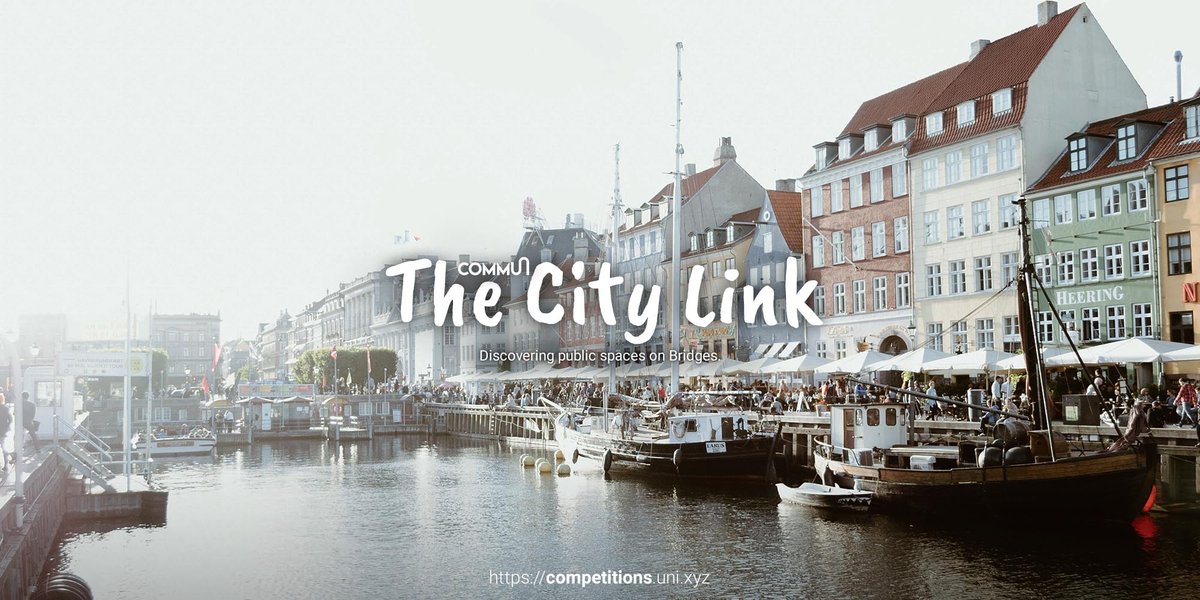
The City Link
Discovering a public space on a cycling bridge
OVERVIEW
Premise

Img 1: Streets for humans?
Civilizations were made when humans were able to mobilize large distances. Fast-forwarding this to the current era, where science and technology have spread immensely, mobility and transportation are now easier than ever. The places we live in are becoming larger in scale every day and to mobilize people, transportation had to evolve with it.
Cities began to be reshaped more harshly to serve the growing need of vehicles, urban planning of cities was dominated by transport centric designs. Consequently leaving no space for the pedestrians and cyclists, where human activities took place majorly, at a much slower pace. On the contrary, some places did not want cars to define their city streets and brought a permanent change.
Cycling

Img 2: A view of Amsterdam
Cities like Copenhagen (Denmark), Amsterdam, Utrecht (Netherlands), have changed this norm altogether, by adapting the model of bicycling as primary means of transport and establishing a culture that has survived for more than 50 years. They have ingrained cycling as a habit among its residents, where people of all age and class ride a bicycle to work, school, college.
Cycling is now a symbol of many things and its benefits are not limited to health and the environment. It has helped in building a society that promotes social equality, freedom and had revolutionized women empowerment in the 18th Century.
The number of cyclists in these cities is growing, and to support this, urban planners have been building cyclist bridges and routes, to develop physical cycling infrastructure all over the country. While there are cities like these making a change, where do we stand?
Issue

Img 3: Cyclist moving at a pace faster than.
When tourists, migrants, International students get an opportunity to visit or stay in cities like Copenhagen and others, they witness the cycling culture. This experience is unmatched and entirely different from what they have seen all their lives. As we strive towards modes of transportation that increase the ease and speed of travel, we continuously look for better options.
In such a scenario, where change is perpetual, we have to switch to greener choices i.e. bicycles, which are a symbol of moving towards a sustainable city. To trickle the culture of cycling all around the world, more than just urban infrastructure is needed.
A facility that enhances the experience of tourists/ visitors and students altogether can intrigue them to take something back with them. How do we attain this?
Design a cycling bridge

Img 4: LightPathAKL, Auckland, New Zealand.
To be able to live in cities with an atmosphere that is dense and getting polluted, the shift to sustainable options on all fronts is a necessity. Adapting from cities with prevailing a bike culture, can give a unique experience for the visitors that promotes cycling worldwide. It can be a starting point for tourism and exploration within the city and inculcate the habit of cycling that they can continue back home.
Brief: The challenge here is to design a cycling bridge for pedestrians and cycling that is not limited in its absolute function.
It must utilize the bridge as a powerful public space as well as a pioneer for tourists or first-time cyclists to explore the city. A bridge that usually serves a single purpose of cutting the travel time between two destinations can be explored for more. In urban areas that are already condensed with built structures, a functional bridge can be a turning point in shaping architectural experiments.
Programmatic Outline
Community 25%
- Gathering Space
- Cafe/Eatery
- Information Center
- Retail Stores
Bicycling 55%
- Bicycle Parking/Renting
- Workshop
- Retail Store
Service 20%
- Reception/Waiting
- Area Storage Staff
- Facility Public
- Washrooms
- Kitchen
- Staff Facilities -Office -Lounge
The programme of the City Link Bridge must include the above. However, the participants are free to add other programmatic facilities depending on their design.
Objectives
-
Functional: Project must be functional as a bridge to be used for pedestrians and cyclists.
-
Blend: Programmatic requirements and the purpose of mobility must be fulfilled.
-
Iconic: Structure must be iconic and monumental for the residents of Copenhagen.
-
Public space: Structure must act as a vibrant public space for commuters and visitors.
This design challenge does not require technical/structural detailing or calculations of the bridge.
Copenhagen

Copenhagen, Denmark’s capital, sits on the coastal islands of Zealand and Amager. It was originally a Viking fishing village established in the 10th Century. The city is known to be one of the most sustainable cities in the world, efficiently working towards climate change through its transportation & town planning.
Site
- Area: 1500 m2
- Height Limit : 15 m
- Site Coordinates: 55°40'31.9"N 12° 35'22.8"E
- Openable Passageway Width : 25 m
The location for the Bridge is chosen across the Port of Copenhagen in Denmark, approximately 100 m in length and in close proximity to the Knipples Bridge. Rich public spaces and community centres across both sides of the site make the location appropriate for enhancing public life with a unique architectural intervention.
Site Location





